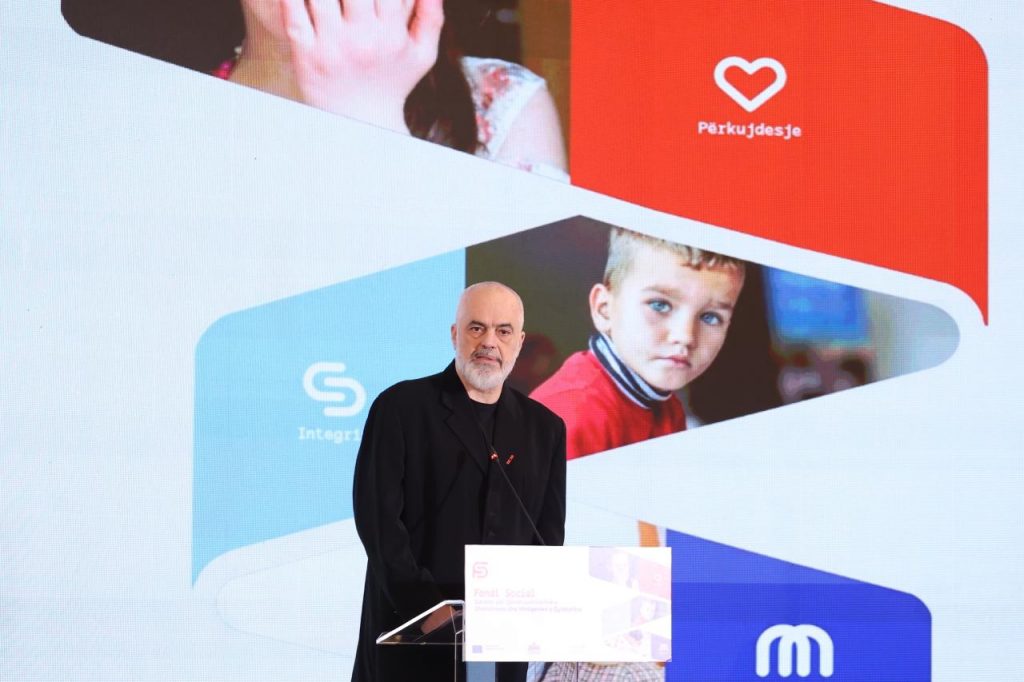
TIRANA, Feb 11 /ATA/ – Prime Minister Edi Rama said on Wednesday that 65,000 individuals are currently benefiting from Albania’s social care system, as the government unveiled 14 new services for vulnerable groups under the Social Fund 2026 programme.
Speaking at an event titled “Social Fund 2026 – Guaranteeing the Sustainability of Welfare Services,” the government head said the rollout of services for children and mothers in need, people with disabilities, the elderly, women and girls who are victims of violence, and children without parental care marked a significant step forward.
He described the active involvement of local government as a key innovation in the reform.
“The key new aspect of this process has been the extension of services to the local level and the active inclusion of local government,” Rama said. “It is still in its early stages, but it has already given us every reason to believe this is the right path.”
Rama said 65,000 individuals now receive support through what he called a structured system of institutions, service points and caregivers.
“It is something very meaningful that Albania is now providing dedicated care for 65,000 individuals,” he said. “These are not simply beneficiaries of a financing scheme, but people supported by an organised system of institutions and services.”
The prime minister also stressed the need to involve more families in the social care system, particularly in providing foster care for children without parental support.
“Given the way Albanian society works, it is important that together with municipalities we encourage more families to become part of this social care system,” Rama said. “We need more families willing to take part in this social effort and to care for children who need not just shelter, but the warmth of a family.”
He said local authorities and mayors play a crucial role in promoting this approach and persuading families to participate, adding that a dedicated fund should be allocated for this purpose.
Rama said the budget for social services has increased six fold since the reform began and is 17% higher this year than in 2025.
“But the budget is not everything,” he added. “We need to deepen and consolidate this decentralisation process and further improve living standards in social care facilities.”
He also referred to the transformation of the “Zyber Hallulli” Child Care Home in Tirana into what he described as a care village within the city, and said similar community-based models could be explored with other municipalities to improve standards and quality of care.
/m.q/j.p/u.sh/