TIRANA, June 3 /ATA/ – Interest in Albania’s history and culture is growing, as evidenced by the increasing numbers of visitors to cultural heritage institutions and sites across the country.
Recent official data show that museums complex and the traditional Bazaar in the historic town of Kruja attracted more than 30,000 foreign and local visitors in May alone, with 25,000 of them visiting the landmark Skanderbeg History Museum, and over 5,000 visiting the Ethnographic Museum.
The Skanderbeg History Museum, the Ethnographic Museum and the old Bazaar are some of the most visited cultural heritage sites in Albania.
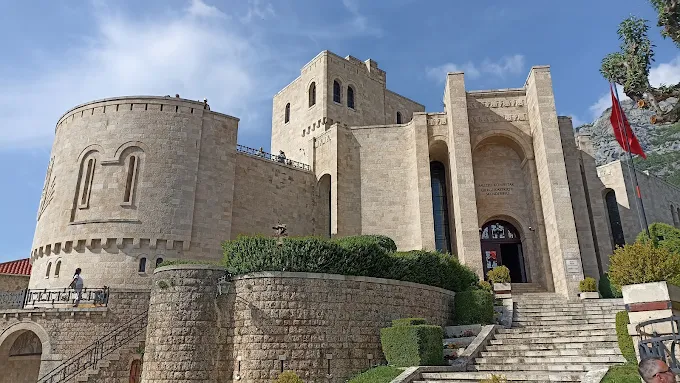
Kruja Castle has proudly stood on top of a rocky cliff, high above its city, for the last fifteen centuries, witnessing the long turbulent history of this place, which was once the centre of Arbëria (Albania’s ancient name). The Castle is situated at an altitude of 557m above sea level and it houses the Gjergj Kastrioti Skanderbeg National Museum, one of the most visited attractions in Albania today. Built in the early 1980s, crowning the castle walls, this recognizable museum structure has become an icon of this city’s skyline. The museum was constructed as tower type dwelling, mostly built in the north of Albania, as a venue and memorial for the most important and popular figure in Albanian history.
Inside, the exhibits reveal insights into Skanderbeg’s life, his historical victories and achievements, as well as copies of Skanderbeg’s weapons: his recognizable helmet crowned with a goat’s head, and his sword.
Kruja is a charming medieval town, beautifully situated among mountainous peaks and the green valley stretching all the way down to the Adriatic coast.
/j.p/u.sh/