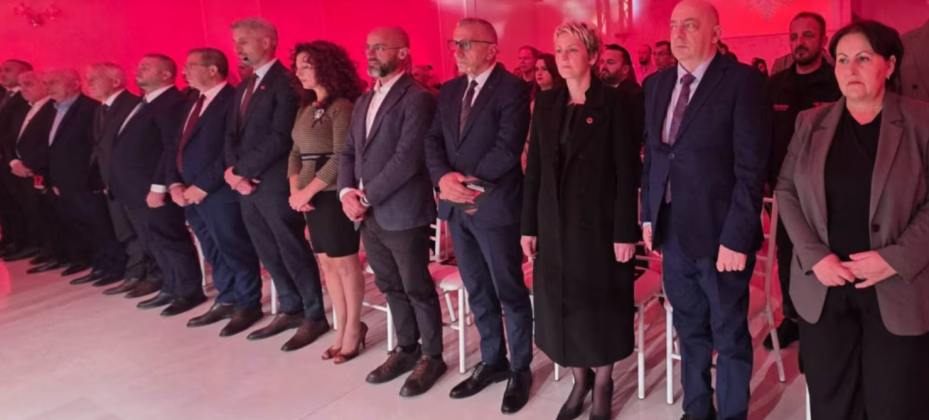
PRISTINA, Oct 25 /ATA/ Eight Albanian parties from Preševo, Bujanovac and Medveđa are contesting Serbia’s snap parliamentary elections, to be held this Sunday, 25 October, under a joint list called the “Albanian Coalition”, aiming to increase their representation in parliament.
After years of divisions and rivalries, the parties united with the mediation of Kosovo Prime Minister Albin Kurti. They aim to win three seats in the Serbian parliament, where the Albanian community had only one MP in the previous legislature.
Ahead of the elections, Kosovo Prime Minister Albin Kurti and Kosovo President Justina Shiroka Pula urged Albanians from these municipalities who live in Kosovo and are eligible to vote to return to their hometowns to cast their ballots.
In a message published on 24 October, Kurti explicitly called for support for the “Albanian Coalition”, which appears as number 17 on the ballot.
“Discrimination, exclusion and oppression require a firm democratic response. Through solidarity. Through perseverance. Through participation,” he said.
Kurti added that Albanians in Preševo, Bujanovac and Medveđa have the right to build their lives in their homeland, with equal opportunities.
In her appeal on 24 October, Shiroka Pula stressed the importance of participation in strengthening the political representation of Albanians.
“Unity is the key to stronger political representation. That is why we must be united on the list and united at the ballot box, to secure more Albanian MPs in the Serbian parliament,” she said.
According to the 2022 census, more than 60,000 Albanians live in Serbia.
From division to a joint electoral list
In a statement to Radio Free Europe/Radio Liberty (RFE/RL), published on 1 October, Visar Memeti, leader of the Alternative for Change party, said that the agreement to unite the parties had been reached at the second meeting, thanks to Kurti’s mediation.
“In 2020, we had three MPs, but then we split and the result was one MP. Our aim now is to win three MPs again; this would significantly strengthen our representation in the Serbian Parliament,” Memeti said.
Shaip Kamberi, leader of the Party for Democratic Action and the sole representative of the Albanian community in the previous composition of the Serbian Parliament, told RFE/RL that the parties had held opposing positions on participation in the elections, their demands and joint actions.
According to him, these differences were overcome through the mediation and advice of Kosovo’s prime minister.
“The parties that took part in the 2022/2023 elections independently, outside our list, which held the majority, saw that it was difficult to win a seat without uniting. Now, apparently, they have understood this, and we have reached this outcome,” Kamberi said.
Kamberi and Memeti said they had also agreed to act jointly after the elections. Memeti stated that the decision on whether to support the next government or remain in opposition would be taken after the vote.
An attempt to unite the Albanian parties had also been made in 2020, at the initiative of the Albanian government, but one of the parties did not join the list at the time.
Who is in the coalition and what are its aims?
The Albanian Coalition comprises the Party for Democratic Action, Alternative for Change, the Democratic Party, the Albanian Democratic Party, the Movement for Democratic Progress, the Movement for Reforms, the Alternative for the Valley and the Democratic Union of Albanians.
The parties aim to implement a seven-point plan previously agreed with the Serbian government. It includes Albanian representation in state institutions, the economic recovery of the municipalities in the Preševo Valley, and the official use of the Albanian language, script and national symbols.
Albanian representatives have for years complained of discrimination, including in employment, education and institutional representation. The Serbian authorities deny the allegations of discrimination.
Burhan Behluli, editor-in-chief of TV Spektri in Bujanoc, told RFE/RL that citizens had for years been calling on Albanian parties to unite in order to represent their interests at central government level.
“I believe that the mood on the ground and citizens’ growing distrust of the current politicians have prompted them to take a more realistic view of their position and accept the agreement,” he said in a statement published on 1 October.
Pristina’s role and expectations after the elections
The agreement between the Albanian parties gives Pristina a role that extends beyond their unification on a single electoral list.
According to Shaip Kamberi, Article 5 of the agreement provides for Kosovo’s prime minister to be involved in consultations on key strategic issues.
On 30 September, Kurti described the joint electoral list as a potentially important and historic step in the fight against what he called “discrimination and exclusion” and “ethnic administrative cleansing” in Serbia.
He also reiterated the demand that Albanians in Serbia should enjoy the same rights as Serbs in Kosovo, including reserved seats in parliament.
However, Belgzim Kamberi, from the Musine Kokalari Institute for Social Policy in Pristina, told RFE/RL that greater parliamentary representation was not enough in itself.
“The true value of this representation will be measured, above all, by its impact on economic development and the well-being of citizens in Preševo, Bujanoc and Medveđa, representation in institutions, the advancement of individual and collective rights, and the return of the problems facing this area to the political agenda,” he said.
According to him, Albanian MPs should prioritise tangible results in employment, education, the use of the Albanian language, the implementation of existing agreements and addressing the issue of the deactivation of residential addresses.
/rel/sm/