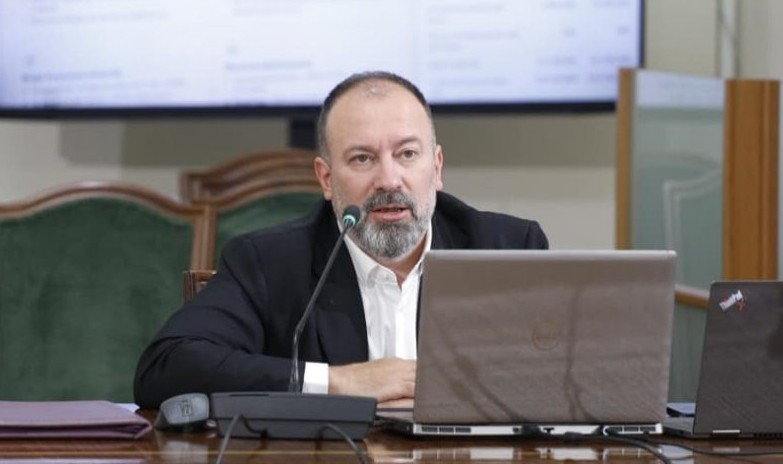
TIRANA, Sept 23 /ATA/ The administrative–territorial reform and its impact on service delivery for citizens was the highlight of the presentation by Arbjan Mazniku, co‑chair of the Special Commission on Administrative–Territorial Reform, before the Legal Affairs Committee. Mazniku described the reform as an issue that directly impacts citizens’ daily lives, ranging from street cleaning, lighting and road maintenance to school services and water supply.
Mazniku underlined that over nine months the Special Commission, despite opposition attempts to obstruct its work, held 23 meetings and hearings, engaged more than 3,500 citizens in consultations across 11 regions, and handled 88 requests, petitions and proposals.
Mazniku reported that between 22 April and 25 June, the Commission held 11 public hearings, covering 56 municipalities, alongside five parliamentary hearings with mayors. In total, 88 requests, petitions and proposals were handled. He noted that Parliament established the Commission on 27 October 2005, and within three days the majority appointed its eight members.
He noted that the opposition delayed naming its members, boycotted the Commission’s early sessions, and repeatedly caused meetings to fail for lack of quorum. He recalled that only in February, after Socialist members proposed changes to the Commission’s structure in plenary, did the opposition decide to participate.
He added that the Commission lost 112 days before approving its calendar due to the opposition’s systematic absence, but noted that public hearings were nonetheless held in 11 municipalities with the participation of 3,500 citizens, involving both majority and opposition members.
Mazniku emphasised that the Commission reached a critical juncture: either to close without producing any results—its only outcome being deadlock under the parity and co‑chairmanship arrangement—or to preserve the work undertaken. He explained that Socialist members chose the latter, advancing a specific proposal on territorial reform and the division of the map, closely connected to the electoral cycle.
Mazniku underlined that the three other elements of the reform—municipal functions and services, local finances and regions—would require an additional year of parliamentary and government work to be detailed. A significant part of his presentation was devoted to the findings of the experts’ report and the outcomes of the 2014 reform.
Mazniku highlighted that Albania reduced its local government units from 373 to 61 municipalities, describing this as an 84 per cent consolidation. He reported that local revenues per capita rose from 2,684 to 13,292 lek, while arrears fell by 76 per cent. Local spending increased from 34 billion to 92 billion lek, and revenues from local taxes and fees grew from 11 to 40 billion lek.
According to him, most aspects of citizens’ daily lives are shaped by local government, and any reorganisation must be directed towards improving services. He outlined the reform path, noting that the territorial map requires immediate treatment, while municipal functions, local finances and regions should be further developed over the next year to provide detailed frameworks.
Mazniku argued that the reform must also be viewed in the context of European integration, highlighting Albania’s opportunity to benefit more from related instruments and funds. He stressed that the initiative should not be politically driven but focused on improving services for citizens and maximising gains from the EU accession process.
/sm/