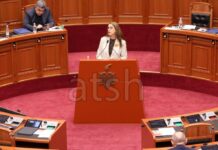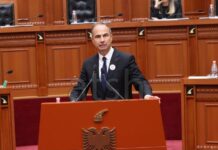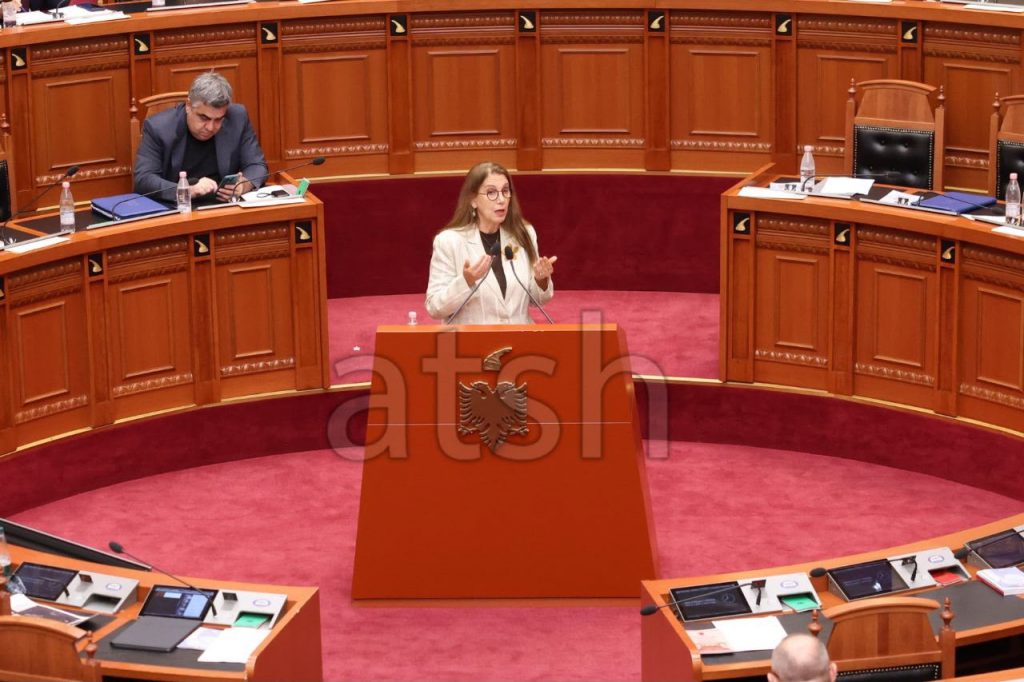
TIRANA, Sept 17 /ATA/ Education Minister Mirela Kumbaro stressed in her Q&A session on the PISA 2025 results that the international assessment is conducted under OECD rules and by an international consortium. She emphasised that PISA is neither an exam organised at the discretion of the Ministry of Education nor a list of schools subject to arbitrary changes by officials.
Education Minister Mirela Kumbaro emphasised that PISA participant selection is carried out through standardised sampling procedures designed to ensure statistical representation of the pre-university education system. She underlined that PISA is not an exam organised at the discretion of the Ministry of Education, nor a list of schools subject to political manipulation, but an international assessment governed by OECD sampling rules and the consortium overseeing the process in more than 90 countries, applied uniformly regardless of which government is in power at the time of testing.
The minister went on saying that when she hears claims that “someone has decided to exclude schools” from this process, unless it is deliberate disinformation—which she said she does not wish to believe—she immediately understands that two fundamentally different things are being confused: an international statistical procedure, established long before the testing begins, and a political assumption of intentional interference.
“I deeply regret the trivialisation of this debate, where respect for an OECD assessment—now discussed worldwide, as all education systems draw lessons from its results—is undermined by the short-sightedness of your political dealings, as though it were about election results at SHQUP headquarters, where figures are rounded up according to top-down directives,” Kumbaro stressed.
Minister Kumbaro clarified that in the PISA testing, student participation in the selected schools reached 97.37%, above the OECD’s required standard of 80%. The data also show that school selection did not follow an urban–rural division but was conducted according to international statistical methodology.
Minister Mirela Kumbaro explained that while Albania’s school participation in the PISA sample was slightly below the OECD’s 85% standard at around 80%, student participation within the selected schools reached 97.37%, well above the required 80%. She argued this figure disproves accusations of manipulation, noting that if anyone had wanted to select students to influence results, it would have been done within the chosen schools—but this did not occur.
She noted that almost every student called to participate in PISA testing attended, was assessed, and had their results recorded. Regarding schools not included in the sample, she stressed that the figures are clear and not speculative, rejecting the deliberately misleading impression that the process excluded rural schools while favouring urban ones.
Minister Kumbaro added that about 6,000 students participated in the 2022 PISA cycle, compared with 5,959 in 2025, showing that both the number and demographic distribution of tested students remained practically unchanged between the two cycles.
Albanian students scored 433 points in mathematics in the international PISA test, ahead of peers in Greece, Romania, Serbia, Montenegro, Bulgaria, North Macedonia and Kosovo. In science, they achieved 435 points, on par with Montenegro, surpassing students from Greece, Romania, Serbia, Bulgaria, North Macedonia and Kosovo.
/sm/