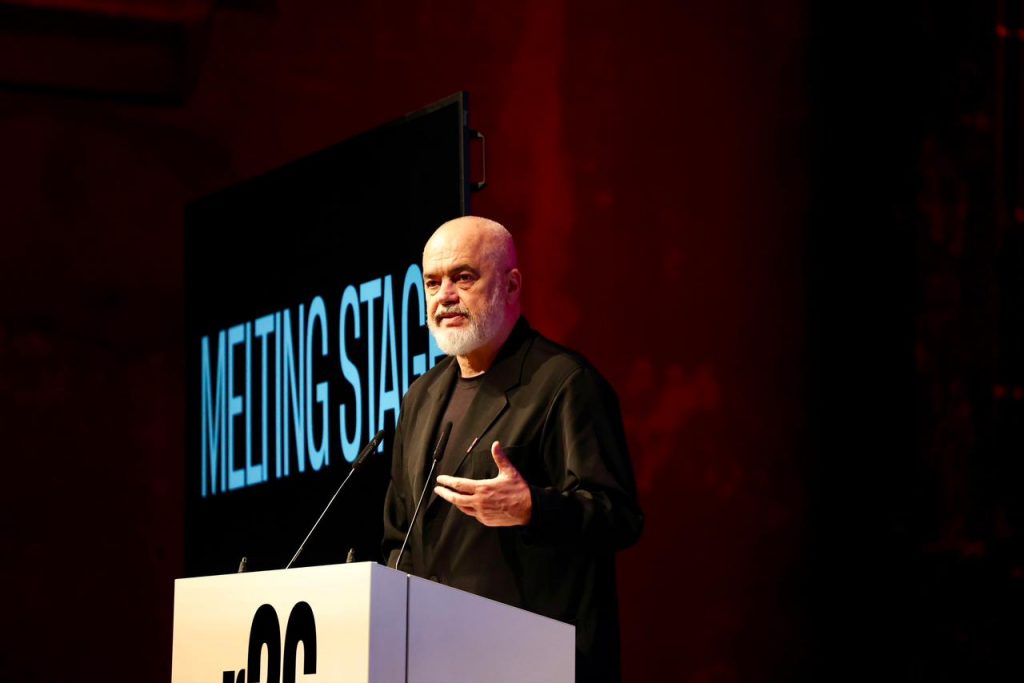
TIRANA, July 1 /ATA/ – Prime Minister Edi Rama said on Wednesday that Albania is positioning itself as a “laboratory” for digital transformation in public administration, speaking at the European innovation and entrepreneurship forum “Ruhr Summit” in Germany.
In his address, Rama described the ongoing global shift as a “silent revolution” that is reshaping the relationship between power and citizens.
He argued that in the era of traditional resource-based economies, smaller countries were constrained, while in the age of artificial intelligence and digital systems, even small states can become centres of innovation.
“I think this is why I have been invited here, as a representative of one of Europe’s smallest laboratories,” Rama said.
The Prime Minister referred to Albania’s history of isolation, noting nearly half a century under what he described as one of Europe’s most closed dictatorships.
“For almost half a century we lived under perhaps the most isolating dictatorship on this continent, a kind of North Korea of Europe, building bunkers instead of bridges, walls instead of windows, and suspicion instead of trust,” he said.
Rama said the country emerged from transition with not only democracy, but also an overburdened bureaucratic system inherited from the past.
He described public administration at the time as weighed down by procedures, stamps, signatures and long queues, where every service required a complex and time-consuming process.
“Every administrative procedure became a pilgrimage. Every office had another office, every signature another signature, and behind every counter there was someone who had decision-making power over a document that ultimately belonged to the citizen,” he said.
Rama said the key challenge was not simply digitising forms, but redesigning the relationship between citizens and the state.
He added that corruption should be seen not only as a moral issue, but also as a structural problem embedded in administrative systems.
“We made a choice, not to modernise governance, but to reinvent the relationship between citizens and the state,” he said.
Rama said Albania now offers more than 1,000 fully digital public services, with around 95% of them accessible online without the need for citizens to physically visit institutions.
He noted that some services still require in-person presence, such as marriage registration or fingerprinting, but said the goal is to further expand digital access.
“It is the government that goes to the citizen, not the other way around,” he said.
/gj.m/u.sh/