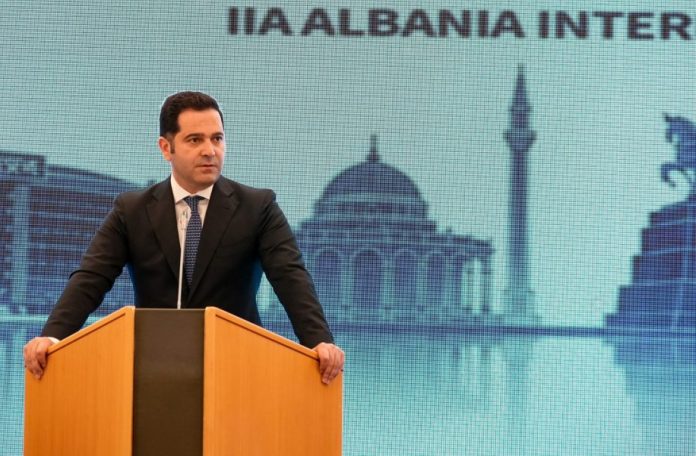
TIRANA, May 11 /ATA/ Minister of Finance Petrit Malaj participated in the conference “Strengthening Internal Audit”, organized by the Institute of Internal Auditors (IIA Albania), a member of the Global Institute of Internal Auditors (IIA Global).
Also in attendance were the Governor of the Bank of Albania, Gent Sejko, and Anthony Pugliese, President and Chief Executive of IIA Global.
In his remarks, Malaj stated that internal auditing constitutes one of the main pillars of good governance, transparency, and financial integrity. He emphasized that, for the Ministry of Finance, it is a key priority of public financial management reform, also within the framework of the European integration process.
In this context, Malaj emphasized that concrete steps have been taken to transform the role of the internal auditor and to align it with the most advanced international standards.
Among the key initiatives, the minister highlighted the development of a new internal audit guideline, establishing a modern model for accountable and professional oversight in public administration; the launch of a professional certification program for internal auditors, with modules supported by OECD/SIGMA, aimed at long-term investment in human capital and capacity building; the creation of a sustainable national certification system based on international best practices; and the translation and institutional adoption of the Global Standards for Internal Auditing, implemented through collaboration between the Ministry of Finance and IIA Albania.
These measures,” the minister stated, “clearly demonstrate that Albania is establishing an auditing system grounded in quality, integrity, and trustworthiness.
On the other hand, Malaj emphasized that the Ministry of Finance has done excellent work in aligning Albania’s legal framework with that of the European Union.
“We are leading several chapters, and among them, Chapter 32, ‘Financial Control,’ remains one of the most important in terms of consolidating the rule of law and strengthening public institutions. Meeting the standards of this chapter requires more effective internal control systems and independent, professional auditing. This is not merely a technical requirement of the integration process, but a necessity to build citizens’ trust in institutions and to ensure better management of public finances,” Malaj stated.
“A modern administration,” the minister continued, “is measured not only by the policies it crafts, but also by its ability to continuously monitor, control, and improve the way these policies are implemented.”
/sm/