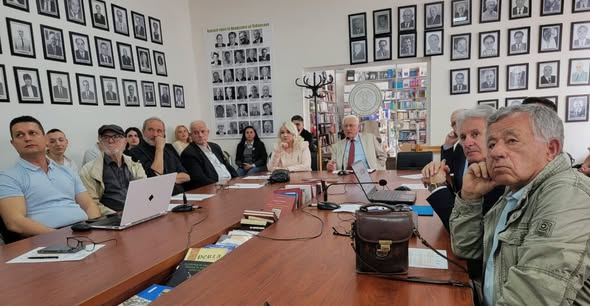
TIRANA, May 8/ATA/ The Academy of Sciences unveiled the mapping and documentation of archaeological potential areas in Lezha (Lissus) project.
This project leverages advanced technologies—including drones, LiDAR, geophysics, and WebGIS—to map, model, and analyze the ancient city of Lissus. By creating detailed 3D documentation, we aim to uncover new data and refine the understanding of Illyrian proto-urban development.
Prof.dr. Neritan Ceka, chairman of the Archaeology Commission and project leader, presented a new perspective on the urbanization process of the Illyrian city of Lissus, together with dr. Elio Hobdari and dr. Ervin Kujtila.
Further on, prof. assoc. dr. Edmond Hoxha, dr. Elva Leka and msc. Erland Alla presented the results of mapping and documentation of the archaeological site of Lissus through GIS and WebGIS technologies.
Key presentations included 3D reconstructions of Lissus (Dr. Pekmezi & MSc. Kuqali) via LIDAR and VR, alongside subsoil analysis using non-invasive geophysical techniques (Dr. Karriqi & Prof. Alikaj).
Dr. Paulin Zefi highlighted the project’s innovative approach to cultural tourism development, i.e. integrating archaeological heritage into local cultural tourism by connecting ancient Lissus with the contemporary community.
At the conclusion of the presentations and discussions, Marsela Robo, Director of National Programs at the National Agency for Scientific Research and Innovation positively assessed the results of the project rather interesting in stimulating scientific debate. She emphasized that the innovations of this project are related to the use of new technologies, their impact on the development of archaeological tourism and the broad involvement of research institutions, businesses and associations in the process. Robo promised support and cooperation from the National Agency of Scientific Research and Innovation for the provision of scientific research infrastructure of public higher education, in service of the Academy of Sciences, its institutes and other research centers. /j.p/p.s./