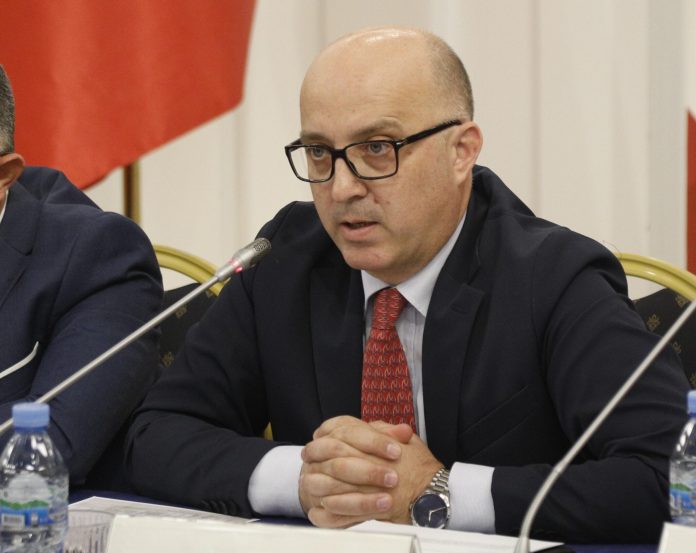
TIRANA, April 28 /ATA/ The High Inspector of Justice, Artur Metani, attended today the joint session of the High Judicial Council and the High Prosecutorial Council, which addressed the ethical and professional evaluations of magistrates as well as measures to reduce the case backlog.
During the inter-institutional meeting, Metani underscored the necessity of a thorough and functional reform of the ethical and professional assessment process for magistrates.
In his address, Metani asserted that the current system should not remain at a merely formal level, but must yield tangible and measurable outcomes. He further noted that the principal challenge is no longer the identification of issues, which are already well documented, but their resolution with accountability and efficiency.
He underscored that the evaluation process should be comprehensive, assessing magistrates’ professional experience, integrity, competence, and efficiency, while fully safeguarding their independence. Furthermore, Metani emphasized that objectives for professional development ought to be grounded in practical experience rather than in generic frameworks.
Metani stressed that the evaluation process for magistrates must be practical and results-oriented, covering their professional experience, merits, qualifications, integrity, competence, and efficiency, while safeguarding judicial independence. He emphasized that professional development objectives should be based on real needs, ensuring that improvement recommendations are realistic and achievable.
Another concern raised was the lack of coherence between the evaluation and promotion of magistrates, as well as the accumulation of pending cases, which, according to him, results in delays and uncertainty within the system. He called for immediate measures to reduce this backlog and to prevent its recurrence in the future.
Regarding the quality of the evaluation process, the Head of the High Inspectorate of Justice called for less formalism and greater focus on substantive content, including the improvement of statistical data and an increased role for qualitative indicators. He emphasized that a reliable system requires accurate, standardized, and accessible data.
Metani also highlighted the importance of functional infrastructure and systems within courts and prosecutor’s offices, considering these a key factor in enhancing the efficiency and objectivity of evaluations.
“Without an accurate, comprehensive, and regularly updated database, any evaluation effort risks relying on incomplete or inaccurate indicators, thereby undermining the integrity of the ethical and professional assessment process for magistrates,” stated Metani.
He further noted, “Enhancing the infrastructure and systems within courts and prosecutor’s offices represents a critical component that directly impacts operational efficiency, the quality of data, and, consequently, the objectivity of the ethical and professional evaluation process for magistrates.”
In conclusion, he called for cross-institutional cooperation, emphasizing that ensuring integrity and accountability in the judiciary is not the responsibility of a single institution. According to him, harmonizing standards among bodies such as the High Prosecutorial Council, the High Judicial Council, and the Office of the Prosecutor General is essential for building a fair and reliable judicial system.
“The role of the High Inspector of Justice is closely linked to ensuring integrity and strengthening accountability within the judiciary. However, it must be clear that this is not the responsibility of a single institution. It depends on our ability to operate as a coordinated system, where each institution contributes in a timely and measurable manner, and where every body fulfils its constitutional and legal role. In this context, it is important to emphasize that harmonizing standards among the High Prosecutorial Council, the High Judicial Council, the High Inspectorate of Justice, and the Office of the Prosecutor General is essential. A system with divergent standards cannot produce a fair process or public trust,” he stated.
/m.q/r.e/a.f/sm/