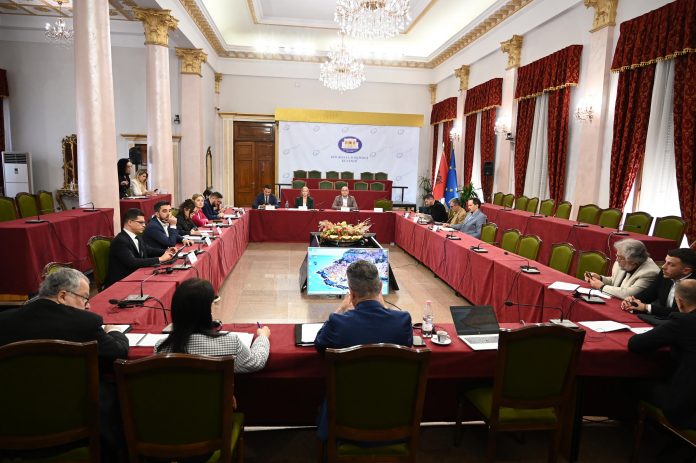
TIRANA, April 20 /ATA/ The Parliamentary Committee on Natural Resources, Infrastructure and Sustainable Development convened on Monday, in its capacity as an advisory body, to examine the draft law “On the mechanism for responding to supply and fuel price crises,” introduced by Member of Parliament Eno Bozdo.
The session was also attended by representatives from the Ministry of Infrastructure and Energy.
In presenting the draft law, MP Bozdo emphasized that its objective is the establishment of a dedicated legal framework for the effective management of crises in the hydrocarbons sector arising from international geopolitical developments, particularly conflicts in the Middle East.
The proposed legislation seeks to provide the country with legal and institutional instruments to safeguard supply security, ensure price stability, and protect both consumers and the national economy.
A key component of the draft law is the alignment with European Union standards and those of international energy organizations, ensuring institutional coordination and compliance with the relevant EU directives.
Rapporteur Besa Spaho underscored that numerous issues have been identified across nearly all of its provisions, noting that under constitutional jurisprudence, legislation must be drafted with clarity and foreseeability.
The session proceeded with further deliberations, following which the members of the committee rejected the draft law in principle.
Subsequently, the committee convened a second meeting during which the Annual Report for 2025 of the Permanent Secretariat of the Transport Community was presented, with Director Matej Zakonjšek in attendance.
Zakonjšek highlighted Albania’s active role in the Regional Steering Committee, noting that this year the country holds the presidency. He described this responsibility as essential for further strengthening regional cooperation and advancing strategic priorities.
In his remarks, Zakonjšek explained that the report encompasses an analysis of key developments, an assessment of progress achieved during 2025, and recommendations aimed at improving the transport sector.
In assessing Albania’s overall transport modes, notable progress was recorded in 2025, with efforts concentrated on strengthening the sector’s legal and regulatory framework. Key initiatives included improvements in road asset management, facilitation of road transport, the introduction of the Green Line, advancement of road infrastructure projects, and alignment with European Union directives.
/sm/