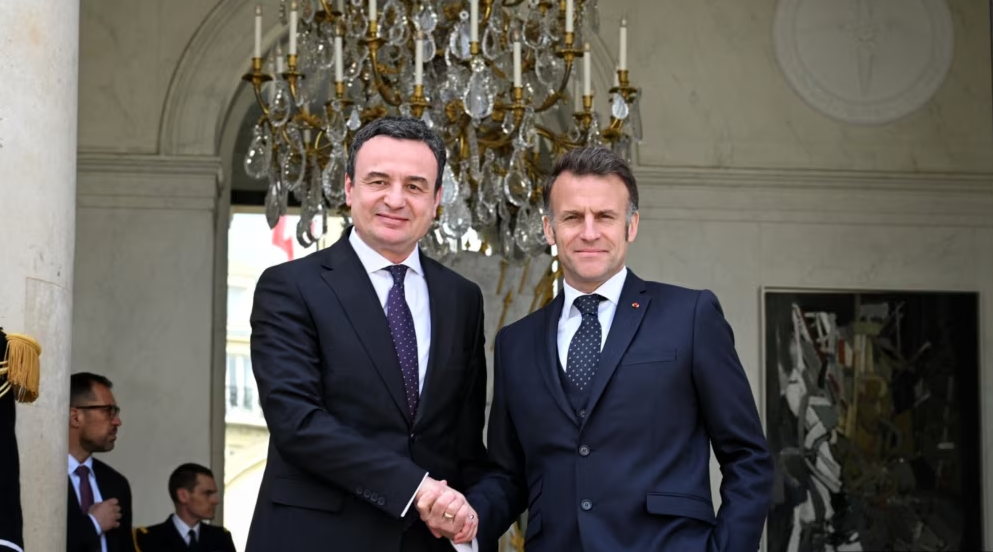
PRISHTINA, March 27 /ATA/ – Kosovo Prime Minister Albin Kurti met French President Emmanuel Macron in Paris on Friday to discuss Kosovo’s security and relations with Serbia, the Prime Minister’s Office said.
The talks, held over a working lunch at the Élysée Palace, highlighted the “continued positive role” of NATO in Kosovo, particularly the KFOR mission, and European Union operations in the country.
“Prime Minister Kurti spoke on Kosovo’s security, including the protection of its borders, the strengthening of local defence capacities, relations with northern neighbour Serbia in the context of the Brussels dialogue and implementation of the full normalization agreement, as well as cooperation with North Atlantic allies and regional security in the Balkans,” the Prime Minister’s Office said.
The discussions also addressed European integration and broader continental security, with Kurti seeking France’s support for Kosovo’s EU accession and membership in international organizations. Kosovo remains the only country in the Western Balkans without official EU candidate status, despite submitting its application in 2022. Normalizing relations with Serbia remains a key EU condition for both countries’ accession paths.
The meeting came a day after Serbian President Aleksandar Vučić said in Belgrade that Kurti might ask Macron to impose conditions “against the Serbian people.” He claims Kurti will ask NATO to withdraw from the ground safety zone in northern Kosovo, and seek French support to deploy Kosovo’s Security Force there.
Vučić also says Kurti may ask France to place conditions on how Serbia uses French-supplied weapons.
Kosovo’s government dismissed Vučić’s remarks as an attempt to generate media attention through “a hybrid information campaign,” noting that Macron hosted Kurti for a two-hour working lunch.
The visit coincides with heightened Kosovar concerns over Serbia’s military capabilities. Earlier this month, Serbia purchased supersonic CM-400 ballistic missiles from China, prompting Defense Minister Ejup Maqedonci to warn of “hegemonic tendencies” toward neighbouring countries.
Kosovo has also protested Serbian military exercises near predominantly Albanian villages close to the border. NATO’s KFOR mission monitors border security, while the Kosovo Police oversee other areas along the roughly 400-kilometre boundary. Under a 2013 agreement with NATO, the Kosovo Security Force (FSK) cannot operate in Serb-majority northern areas without KFOR approval. FSK transformation into a full army is expected to conclude in 2028.
/rel/ u.sh/