TIRANA, Feb 18 /ATA/ – The Minister for Europe and Foreign Affairs Elisa Spiropali has described Corridor VIII as a strategic necessity for Europe’s connectivity and security, urging greater political and financial backing to accelerate the project.
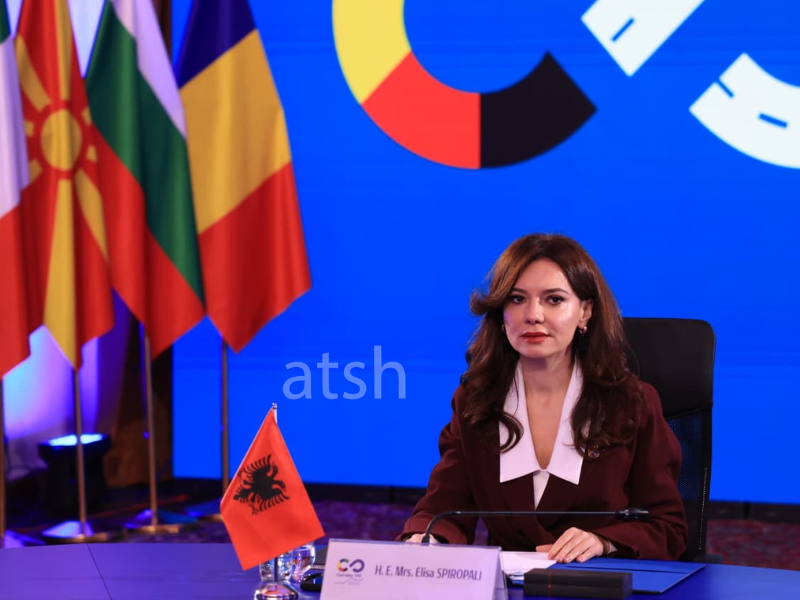
“Corridor VIII is not merely an investment. It is a strategic necessity,” Spiropali said at the opening of a ministerial meeting in Tirana on Wednesday. The gathering brought together foreign ministers and senior officials for talks on Corridor VIII, a regional transport and energy route linking the Adriatic and the Black Sea.
The session was attended by Antonio Tajani, Italy’s Deputy Prime Minister and Foreign Minister; Timčo Mucunski, North Macedonia’s Foreign Minister; Nikolay Pavlov, Bulgaria’s Deputy Foreign Minister; and Romania’s Ambassador to Albania, Octavian Şerban.
Spiropali said the corridor represents the missing east-west link in the southern Balkans, connecting ports, markets and economies with the heart of Europe. Drawing a parallel with the ancient Via Egnatia, she said the project completes a historic task of linking the region more closely to the continent.
Connectivity, she added, “means opportunity, resilience and, in today’s Europe, security”.
Spiropali said Corridor VIII lies at the centre of Albania’s national transport strategy, with priority projects worth more than 2 billion euros, most of them ready for implementation.
She cited progress on the Durrës-Rrogozhinë railway line, financed by European funds, and engineering works under way on the subsequent segment towards Pogradec. A new railway linking Tirana with Durrës and the country’s main airport is in its final phase of construction, she said.
In the energy sector, a 400-kilovolt interconnection line with North Macedonia, following the corridor’s route, is nearing completion, she added.
Spiropali underlined the corridor’s role as a strategic asset for interoperability and European security, noting it is the only true east–west axis in Southeast Europe connecting NATO member states from the Adriatic to the Black Sea.
Beyond economic integration, the corridor would facilitate faster and more predictable movement of allied forces, equipment and supplies, strengthening security architecture on NATO’s southern flank, she said, referring to recent discussions at a NATO defence ministers’ meeting on military mobility in the region.
Spiropali also called for all segments of Corridor VIII to be incorporated into the European Union’s core Trans-European Transport Network (TEN-T), arguing that without such status the project risks remaining strategically important but financially secondary.
“Inclusion in the core or extended core TEN-T network would unlock funding, synchronise investments and turn this corridor into a genuine European priority,” she said.
The next phase of the project should focus on practical coordination, including harmonised timelines among participating countries, interoperable technical standards, streamlined border procedures and coordinated financing from European instruments and international financial institutions, she added.
“For our region, this is not only a transport project. It is a political statement,” Spiropali said. “The Adriatic and the Black Sea are not Europe’s periphery – they are its gateways.”
/gj.m/u.sh/