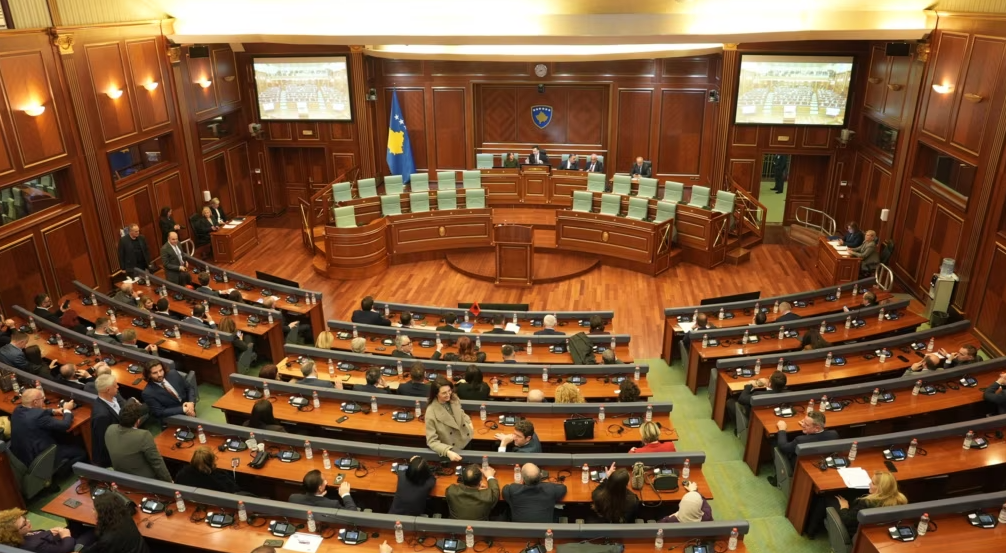
PRISHTINA, Feb 10 /ATA/ – Kosovo has taken the first formal step toward forming a new government, as President Vjosa Osmani has called the opening session of new parliament.
The President’s office said on Tuesday, Osmani has scheduled the constitutive session of the country’s new parliament for Wednesday, February 11, at 12:00 p.m.
“Following consultations with the majority of parliamentary parties and in view of the urgency of establishing institutions, approving the budget, and signing international agreements, in accordance with the Constitution and existing legislation, the President has decided to convene the constitutive session tomorrow,” the statement said.
The announcement comes a day after the Central Election Commission (CEC) certified the results of Kosovo’s early parliamentary elections held on December 28. According to the CEC, the Vetëvendosje (LVV) movement won 51.10% of the vote, securing 57 seats in the 120-member Assembly.
The Democratic Party of Kosovo (PDK) received 20.19% of the vote (22 seats), the Democratic League of Kosovo (LDK) 13.24% (15 seats), and the Alliance for the Future of Kosovo (AAK) 5.50% (six seats). Of the seats reserved for the Serbian minority, the largest, the Serb List, won nine, while the Party for Justice, Freedom and Survival (PShMS) secured one.
The certification process was delayed due to a full recount amid allegations of vote manipulation for some candidates. Dozens have been detained and hundreds questioned, although the party vote totals were unaffected.
Kosovo’s parliamentary rules require preparatory meetings for the constitutive session, a responsibility of the outgoing Assembly Speaker, in this case, Glauk Konjufca’s successor, Dimal Basha. He must meet with leaders of parliamentary parties at least five days before the session to finalize the agenda and assign seating.
The session’s agenda includes forming a temporary commission to verify quorum and mandates, swearing in deputies, and electing the Assembly Speaker and deputy speakers. Last year, the Constitutional Court clarified that the session must be completed within 30 days and is considered concluded only once the Speaker and five deputy speakers are elected – three from the main Albanian parties and two from non-majority communities, including one Serb. A 61-vote majority is required for each position, with up to three nomination attempts allowed per candidate.
The court recently ruled that the election of Serb deputy Speaker Nenad Rashiqi in the previous legislature violated these rules, stating the Serb List deputies, who hold nine seats, have the right to nominate the Serb deputy speaker. The decision was criticized by Vetëvendosje, and it remains unclear how the issue will be handled in the new legislature.
Once the parliament is constituted, the path is cleared for forming a new government. President Osmani must mandate a prime minister from the winning party, in this case, LVV. The designated prime minister then has 15 days to present the new cabinet to parliament and secure the support of at least 61 lawmakers.
Unlike the previous legislature, LVV is expected to have no difficulty securing a parliamentary majority, as it holds 57 seats on its own.
/rel/u.sh/