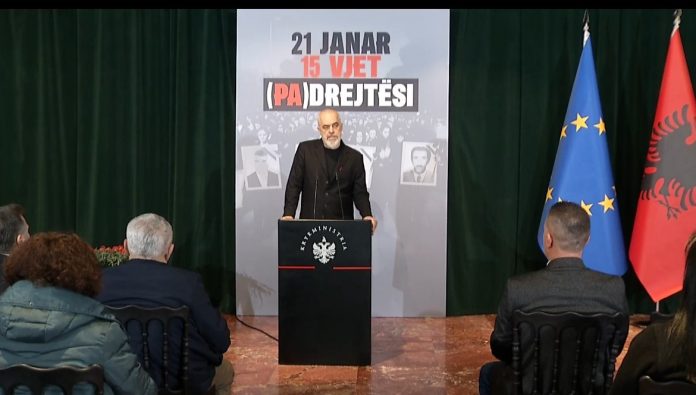
TIRANA, Jan 21 /ATA/ Prime Minister Edi Rama commemorated the January 21 tragedy, which claimed the lives of four protesters on “Dëshmorët e Kombit” Boulevard, in front of the Prime Minister’s office.
In his remarks at the ceremony, attended by the families of the four victims—Aleks Nika, Ziver Veizi, Faik Myrtaj, and Hekuran Deda—the Prime Minister called for justice. According to Rama, despite the judicial reforms, justice for the events of January 21 has still not been served after 15 years.
The Prime Minister stated that SPAK prosecutors have still not referred the “January 21” case to the Special Court, despite a ruling from the European Court on Human Rights in Strasbourg more than two years ago.
Prime Minister Rama criticized the special prosecutors for failing to refer the ‘January 21′ case to the Special Court, despite a ruling from the European Court on Human Rights over two years ago. He highlighted the paradox of funding and supporting these prosecutors with high salaries, while tolerating their troubling mistakes, all in the name of justice and the rule of law.
Rama acknowledged the widespread frustration and sense of betrayal felt by many Albanians, who, despite their faith in the new justice system, have seen no accountability for the January 21 events. He expressed feeling personally hollow and powerless as another year passes without justice being delivered for the victims.
The Prime Minister stated that Albania’s prisons are filled with more pre-trial detainees than those who have been sentenced, highlighting that many are victims of violations of human rights and freedoms by prosecutors and judges who often blindly follow the prosecutor’s lead.
He stated that this is “a grim reflection of a justice system that has been violated, with January 21 representing the flip side of delayed justice—where the key perpetrators of the tragedy were only called for questioning for the first time in recent months, nearly 15 years after what happened.”
Rama pointed out, “From the very beginning, I said that January 21, as a state crime, belongs to the category of crimes that history teaches us about—where justice may be delayed, but it never forgets. The history of state crimes is revealing because no state crime remains unpunished.”
The Prime Minister emphasized that even SPAK, as a completely independent institution, has unfortunately not yet filed charges for the events of January 21.
Rama criticized the delay in justice for the January 21 tragedy, pointing out that, despite the Justice Reform being a key priority, the independent special structures created within it have failed to bring charges even 15 years after the brutal killings. He expressed disbelief that SPAK, despite its focus on political abuse of power, has treated the case as nonexistent, while swiftly handling less significant cases. Rama lamented that SPAK has wasted years on politically motivated or trivial cases instead of addressing the core issue of accountability for the January 21 state crime.
Rama highlighted that it was Mark Nika, the uncle of Aleks Nika, who took the main issue of January 21 to Strasbourg, reopening the case that justice had buried, following a criminal farce disguised as a trial concerning the killings.
“Only through the persistence of the victims’ families, led by Mark, was the case of the most brutal crime in the history of Albanian democracy brought back to the table of SPAK, where Mark submitted authentic recorded material from the scene, captured through the security forces’ communication channels. For years, he had kept this material hidden due to his complete distrust of the justice institutions and fear that it would ‘disappear,’ as so many traces have before. While many traces have been lost, the wolf remains entirely visible to everyone.”
Rama stated that the European Court on Human Rights deemed the use of deadly force, without justification, and the lack of a legitimate basis for using such force to protect the Prime Minister’s office as violations of the European Convention. The court urged the authorities to investigate the event. In the wake of Strasbourg’s ruling, the High Court issued one of the most thorough and uncontested documents, both professionally and morally, which effectively reignited the investigations. He concluded by saying, “Hope dies last, but the need for justice never fades, even when hope does.”
Rama acknowledged the ongoing injustice for the four victims of January 21 and stated that while he doesn’t know how long it will take to see justice served, the demand for justice will never cease and will eventually triumph through persistence.
/a.f/sm/