TIRANA, Nov 7 /ATA/ Environmental Policies in Albania until 2030 and EU alignment took center stage at Tirana International Fair.
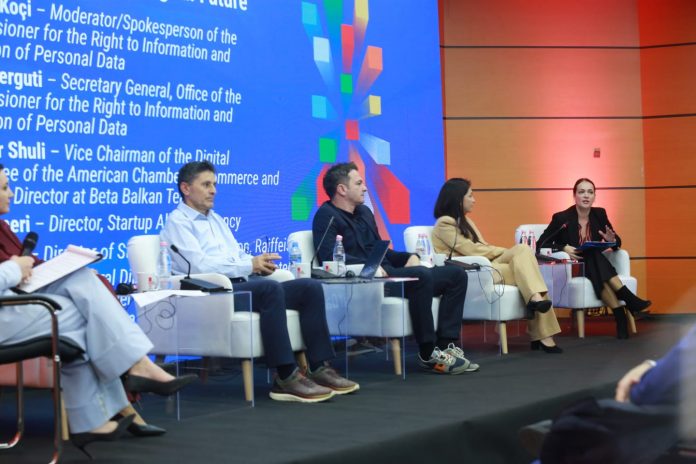
In a special panel on “Circular Economy and Sustainable Environmental Policies,” experts and representatives of public institutions emphasized today the importance of collaboration between institutions, businesses, and communities to achieve national environmental goals.
Deputy Minister of Environment, Elda Xhumari, spoke about the new law on integrated waste management, which, according to her, represents one of the most concrete steps Albania has taken towards alignment with EU directives.
“This law is based on the ‘polluter pays’ principle and provides clear instruments for raising awareness among citizens, businesses, and institutions. Our approach is to turn strategies into measurable and achievable objectives,” Xhumari stated.
She further noted that, at present, three additional draft laws grounded in the same principle are under deliberation, encompassing fiscal incentives as well as sanctions for non-compliance with environmental standards.
“We are drawing upon the best European models and tailoring them to the Albanian context. Our objective is to incentivize businesses to utilize recyclable materials and to mitigate environmental pollution,” the Deputy Minister underlined.
The Executive Director of the AlbNatyra Association, Gëzim Shuli, also addressed the panel, emphasizing the crucial role that local communities play in environmental initiatives.
Gëzim Shuli highlighted that genuine environmental initiatives often originate from citizens and communities, noting that public engagement in concrete actions raises awareness more effectively than theoretical discussions.
Erni Kocani, an expert with the Institute for Urban Research, described the formulation of environmental policies as an evolutionary social process, with public awareness and policymaking going hand in hand.
“In recent decades, societies have shifted from demanding economic well-being to advocating for environmental rights. Laws emerge as a response to growing civic awareness, while citizen activism also serves as a driving force for public policy,” Kocani stated. He emphasized that businesses are increasingly viewing environmental protection as an opportunity for economic growth, turning toward sustainable practices and green investments.
Panelists highlighted that Albania’s circular economy is shifting toward practical, financially and environmentally sustainable approaches, with sustainability now seen as essential for economic and social development rather than just a trend or marketing tool.
At the 31st Tirana International Fair, experts stressed the importance of technology and digital controls for food safety, while the Deputy Minister of Agriculture highlighted the need for electronic product tracking and more skilled professionals in agronomy, veterinary science, and biotechnology.
Deputy Minister Arjan Jaupllari emphasized that food safety requires technology and expertise. He added that farmers need to be provided with the necessary tools to ensure it. Meanwhile, Jona Boci from the Food and Veterinary Safety Institute stated that Albanian products are safer than imported ones.
/e.xh/r.e/a.f/sm/