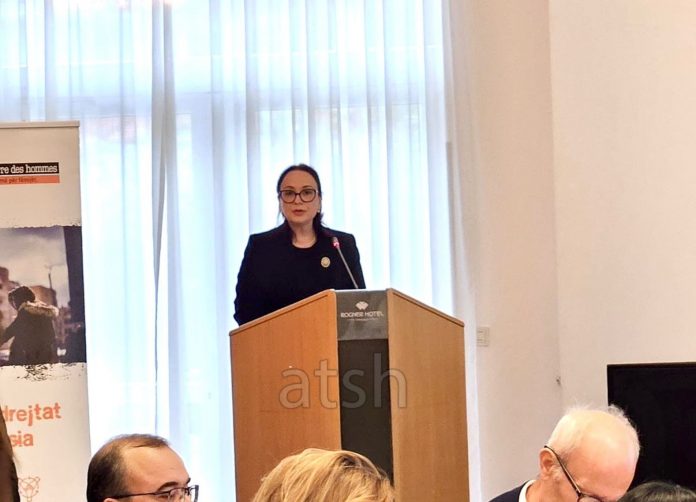
TIRANA, Nov 4 /ATA/ Strengthening a child-friendly justice system was the highlight of of today’s National Conference, “From Procedure to Real Protection: Justice in service of the children,” held in Tirana.
The conference was held as part of the “Youth Voice for Justice and Rights” project, implemented by Terre des Hommes Albania and funded by the Austrian Development Agency.
The event was organized in collaboration with the General Prosecutor’s Office and the School of Magistrates, bringing together representatives from key justice institutions, the police, the enforcement service, probation services, as well as the State Agency for the Rights and Protection of Children.
The opening remarks were delivered by Deputy Minister of Justice Elona Hoxha; David Muckenhuber, Head of the Regional Coordination Office of the Austrian Embassy for Albania, Montenegro, and North Macedonia; and Enkelejda Kallçiu, Director of Terre des Hommes in Albania.
In her remarks, Deputy Minister Hoxha stated that over recent years, Albania has made significant strides in strengthening juvenile justice.
She highlighted the adoption of the Juvenile Justice Code, the law recognizing children’s rights, and the operation for several years of the center for the prevention of juvenile crime.
Hoxha stated that this legal framework marks a clear shift from a repressive approach to a rehabilitative, preventive, and inclusive justice system.
“The Ministry of Justice, in cooperation with other institutions within the system, has now established a clear strategic framework for juvenile justice,” Hoxha said.
David Muckenhuber, Head of the Regional Coordination Office of the Austrian Embassy for Albania, Montenegro, and North Macedonia, emphasized in his speech that human rights, social inclusion, and access to justice lie at the heart of development cooperation.
“We firmly believe that the strength of any society is measured by how it treats its most vulnerable members, namely children. We are convinced that supporting Albania in this area is not only a contribution to national reforms but also part of our shared European commitment to dignity, equality, and the rule of law,” he said.
Highlighting the results of this partnership, Muckenhuber described them as truly inspiring.
“More than 1,700 young people have been empowered to express their views; 60 teachers, social workers, and local officials have been trained to support youth participation; and 59 prosecutors, judicial police officers, and victim coordinators have strengthened their skills in implementing child-friendly practices,” he added.
Enkelejda Kallçiu, Director of Terre des Hommes in Albania, stated that the focus of today’s conference is on inter-institutional dialogue.
During the proceedings, a national study on the implementation of procedural safeguards for children in conflict with the law, prepared by Prof. Arben Rakipi and Dr. Amarildo Laçi of the School of Magistrates, was presented. The study provides a clear analysis of the current situation, pinpoints challenges, and offers recommendations for improving judicial and institutional practices in the country.
Regarding capacity building for professionals, 164 practitioners have been trained on the inclusion of children and youth in decision-making processes, as well as on the importance of inter-institutional cooperation for the prevention of violence and crime.
A total of 59 justice professionals have strengthened their skills in child-friendly interview techniques for minors who are victims of sexual abuse and other serious forms of violence.
Additionally, 55 justice professionals have been trained on Operating Procedure for victim coordinators.
Forty-eight candidates for judges and prosecutors at the School of Magistrates have enhanced their capacities regarding interview techniques for minors in family/civil and criminal proceedings, as well as the implementation of the principle of child participation.
Additionally, thanks to the project, a child-friendly setting has been established at the General Directorate of Judicial Enforcement in Tirana to provide interview and psychological counseling services for minors and their families during the implementation of “Child Contact” decisions.
The discussion panels focused on topics including the importance of both initial and continuous training for justice professionals, the application of child-friendly procedures during investigations and trials, use of non-custodial measures for minors, and the necessity of institutional collaboration to safeguard children’s rights.
The conference concluded with a networking and experience-sharing session among participants, highlighting the importance of a justice system that not only respects but effectively protects children’s rights at every stage of the legal process.
/sm/