TIRANA, July 18 /ATA/ The Bank of Albania forecasts a further growth of the economy during the coming years, underpinned by the increase of consumption, investments, exports, employment and wages, as well as stabilization of inflation close to the 3% target rate.
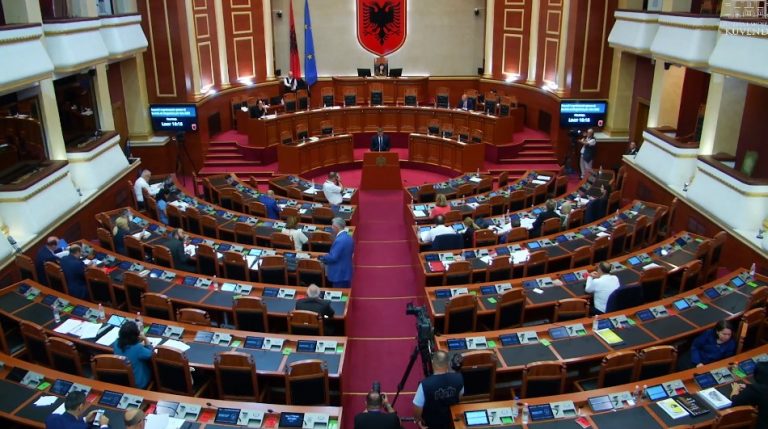
The BoA Governor, Gent Sejko, presented on Thursday in Parliament the 2023 report of the institution he runs, emphasizing that “the Albanian economy has demonstrated an admirable level of resilience in the face of the subsequent shocks and had one of the highest rates of economic growth and the lowest rate of inflation among the countries of the region”.
Sejko said that, “economic growth was supported by the expansion of family consumption, private investments, the export of tourism services, fiscal policy, the expansion of bank credit, falling inflation and the rapid growth of income from tourism” .
Referring to official statistics, Sejko announced that, “the economy grew by 3.4% during the past year, employment increased by 2.2%, while the unemployment rate dropped to a new historical minimum of 10.7% at the end of the year”.
According to him, “the average level of salaries in the private sector increased by 13% while inflation marked a gradual decline, from the level of 7.4% at the beginning of 2023 to the level of 4% at the end of the year, and to the level of 2.7% in the first quarter of 2024”.
Sejko said that the year 2023 marked improvements in the internal and external balances of the economy.
“The current account deficit decreased to the level of 0.9% of GDP during 2023, marking a historical minimum of the post-transition period. Foreign debt dropped below 50% of GDP, while foreign direct investment registered a historic record of 1.5 billion euros. Exports increased by 1.7 billion euros and the level of foreign exchange reserves of the Bank of Albania registered a historical record of 5.8 billion euros, – said the Governor, who emphasized that, – the banking system has continued to improve the indicators of capitalization and the quality of the loan portfolio, with the indicator of nonperforming loans at the level of 4.8%.”
According to him, these positive trends enable the banking sector to supply the economy efficiently and continuously with financial funds and payment and savings instruments.
Among other things, Governor Sejko underlined that the Albanian financial sector marked two important achievements during the past year: Albania was taken off the FATF gray list and the BoA submitted the official request to the European Banking Authority ( EBA) for obtaining equivalence status, which has an impact on increase in lending by European banks operating in Albania.
Sejko said that, parallel to these developments, inflation marked a gradual but continuous decline during 2023.
“It went down from the level of 7.4% at the beginning of 2023 to the level of 4% at the end of it, and to the level of 2.7% in the first quarter of 2024. This performance was influenced by the drop in inflation in foreign markets, by the overpricing of exchange rate and the normalization of our monetary policy stance. The decline in inflation was initially focused on food and oil prices, but it further expanded to other components of the basket, “he added.
/m.m/r.e/sm/