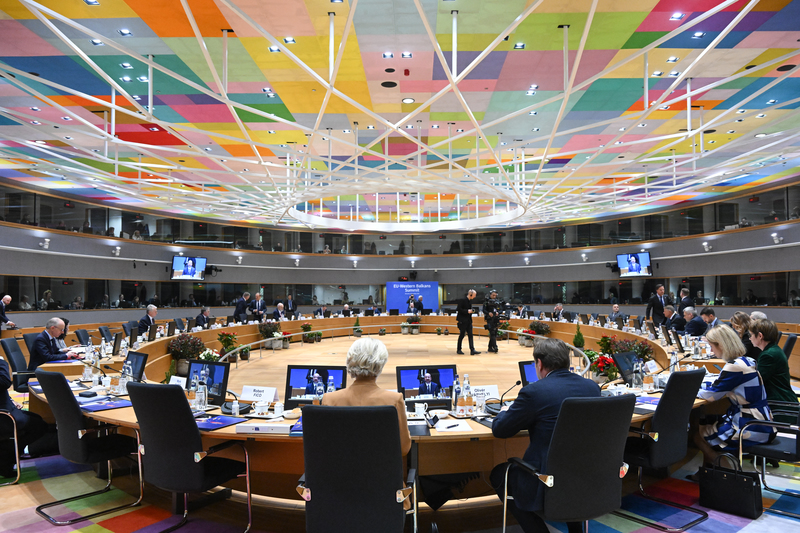
TIRANA, Dec 13 /ATA/ At the end of the Summit EU-Western Balkans held Wednesday in Brussels, the parties came up with a joint statement.
The statement reads that the EU reaffirms its full and clear commitment to the perspective of the membership of the Western Balkans in the European Union and requests the acceleration of the accession process.
Following is the full statement of the EU-Western Balkans Summit
We, the leaders of the European Union (EU) and its Member States, in consultation with Western
Balkans leaders, and in the presence of regional and international stakeholders, today concluded the
following:
1. The increasingly complex geo-strategic environment, dominated by Russia’s war of
aggression against Ukraine and heavily marked by the crisis in the Middle East, continues to
put European and global security at risk. It demonstrates the importance of unity and purpose
within the European family and of the strategic partnership between the EU and the Western
Balkans region bringing about ever closer ties and deeper cooperation with the EU, based on
shared principles and values.
2. Recalling the Thessaloniki Agenda and the Sofia, Zagreb, Brdo and Tirana Declarations, the
EU reconfirms its full and unequivocal commitment to the European Union membership
perspective of the Western Balkans and calls for the acceleration of the accession
process, based upon credible reforms by partners, fair and rigorous conditionality and the
principle of own merits, which is in our mutual interest. The EU welcomes the progress made
by the Western Balkans partners on their respective EU paths since the EU-Western Balkans
Summit in Tirana. The future of the Western Balkans is in our Union.
3. The EU welcomes the resolve of the Western Balkans partners to respect and commit to
core European values and principles, in line with international law. The EU also
welcomes the restated commitment of the Western Balkans partners to the primacy of
democracy, fundamental rights and values and the rule of law. In line with the Tirana
Declaration of December 2022, the EU underlines the need for sustained and irreversible
reform achievements on the rule of law, the functioning of democratic institutions, the
economy and public administration reform. The EU underscores the need for sustained efforts
in the fight against corruption and organised crime, strengthened support for good
governance, human rights, gender equality and the rights of persons belonging to minorities.
The credibility of these commitments depends on the meaningful implementation of the
necessary reforms, and on building a solid track record underpinned by clear and consistent
public communication in the interest of their people. An empowered civil society and
independent and pluralistic media, with full respect for the freedom of expression, are crucial
components of any democratic system.
4. Standing together with the EU is a clear sign of the partners’ strategic orientation, now more
than ever, in light of Russia’s war of aggression against Ukraine and other security
challenges. The EU will continue to invest in multilateralism and will cooperate with partners
to defend and uphold the rules-based international order. A common vision of the future
involves shared values and mutual responsibilities. As we deepen our cooperation with
partners, we urge them to make swift and sustained progress towards full alignment with the
EU’s Common Foreign and Security Policy (CFSP), including on EU restrictive
measures and to act accordingly. We commend those Western Balkan partners that are
already demonstrating their strategic commitment by fully aligning with the EU’s CFSP and
encourage those that have not yet done so to follow suit. We stress the importance of
improved enforcement of restrictive measures and the prevention of their circumvention.
5. The EU remains the region’s closest partner, main investor and trading partner and
principal donor. The exceptional scale and range of this support should be made more visible
and reflected proactively by the partners in their public debate and communication, so that
citizens can appreciate the concrete benefits of the partnership with the EU. Partners should
also communicate clearly about their own commitment to EU values and the necessary
reforms.
6. The EU underscores the need for the commitment by the Western Balkans partners to
inclusive regional cooperation and strengthening good neighbourly relations, including
with EU Member States. Implementing bilateral agreements in good faith and with tangible
results, including the Prespa Agreement with Greece and the Treaty of Friendship, Good
Neighbourliness and Cooperation with Bulgaria, continues to be important. Decisive further
efforts are still required to foster reconciliation and regional stability, as well as to find and to
implement definitive, inclusive and binding solutions to partners’ regional and bilateral
disputes and issues rooted in the legacy of the past, in line with international law and
established principles, including the Agreement on Succession Issues, and the remaining cases
of missing persons and war crimes issues. The EU also calls on partners to guarantee the
rights and equal treatment of persons belonging to minorities.
7. We continue to fully support the efforts of the EU High Representative and the EU Special
Representative for the Belgrade-Pristina Dialogue and other Western Balkan regional
issues. We expect constructive engagement from the two Parties in good faith and in the spirit
of compromise to make rapid progress in normalising their relations, which is critical for the
security and stability of the whole region and for ensuring that the Parties can advance on
their respective European paths. We urge the Parties to fully implement the Agreement on
the Path to Normalisation and its Implementation Annex as well as all past Agreements,
without any further delays or preconditions. We also expect the Parties to pursue sustained deescalation efforts in line with the EU’s requests and refrain from unilateral and uncoordinated
actions that could lead to further tensions and violence, and rhetoric that is not conducive to
normalisation of relations.
8. We welcome the successful meetings of the European Political Community, which took
place on 6 October 2022 in Prague, on 1 June 2023 in Chişinău and on 5 October 2023 in
Granada. The meetings provided a platform for political coordination and opportunities for indepth exchanges on pressing issues concerning the entire continent.
Bringing partners closer to the EU and advancing gradual integration
9. The EU aims to bring the Western Balkans closer to the EU, preparing the ground for
accession, and bringing concrete benefits to their citizens already during the enlargement
process. To this end, the EU intends to explore additional measures aimed at further
advancing gradual integration. The EU underlines the importance of fully using the potential
of existing legal instruments. Building on the revised methodology, the EU recalls the
European Council’s invitation to further advance the gradual integration of the region already
during the enlargement process itself in a reversible and merit-based manner.
10. In this context, the recent Commission’s Communication on the new Growth Plan for the
Western Balkans aims to accelerate socio-economic convergence between the Western
Balkans and the EU and encourages the region to step up the pace of EU-related reforms, and
to advance regional economic integration through the Common Regional Market (CRM),
based on EU rules and standards.
11. The EU is ready to examine proposals made in the Growth Plan for enhancing economic
integration of the Western Balkans with the EU. The EU notes that proposals made are
subject to the Western Balkans aligning with the EU’s single market rules and opening the
relevant sectors and areas to all their neighbours, in line with the CRM, while fully preserving
the integrity of the EU single market and the level playing field.
12. The EU welcomes the signing of the fourth mobility Agreement on Mutual Recognition of
Professional Qualifications for Nurses, Veterinary Surgeons, Pharmacists and Midwives at the
Berlin Process Summit in October 2023 that will advance the mobility of professionals in the
Western Balkans. The EU also welcomes the entry into force of the three mobility agreements
on the freedom of movement with identity cards for citizens of the region, as well as on
mutual recognition of university diplomas and professional qualifications within the
region signed last year. The EU encourages the remaining Western Balkan partners to ratify
these agreements swiftly so that citizens can benefit from them as soon as possible.
13. The EU recalls the shared commitment to step up efforts to enhance the integration of the
Western Balkans with the EU internal market. The Western Balkans’ CRM should serve as a
stepping stone for integration. Further decisive efforts by all Western Balkans leaders are
needed in order for the CRM to become a reality, in particular as regards the adoption of
several decisions on trade-related initiatives that have already been agreed at technical level
in the context of the Central European Free Trade Agreement (CEFTA). Such inclusive
regional cooperation based on EU rules and standards would also stimulate intra-regional
trade and attract investments. The EU invites the region, with the help of the Regional
Cooperation Council (RCC), CEFTA and the WB6 Chamber Investment Forum (CIF), to
prepare an ambitious successor to the current CRM action plan before the current one expires
in 2024.
14. The EU welcomes the work of all the Western Balkan economies towards the modernisation
of their payments systems to bring them closer to EU standards and to the fulfilment of all
the conditions for the integration into the Single Euro Payments Area.
15. Transport and connectivity are essential for economic development, as they foster better
regional integration and improve relations between neighbours. Through the Transport
Community, the EU has opened the possibility for closer integration of the Western Balkans
in the field of transport, in particular through regulatory reforms. In this regard, the EU
encourages the partners to proceed in an ambitious manner with the needed reforms. The EU
welcomes the high-level agreements revising the indicative extension of the Trans-European
Transport Network (TEN-T) to the Western Balkans and the proposal to establish
the Western Balkans-Eastern Mediterranean European Transport Corridor. The EU
will support Western Balkan partners in integrating road transport markets on the basis of the
adoption of the relevant EU acquis. We also welcome the progress made in terms of the
implementation of EU-Western Balkans Green Lanes and call for their application at all
relevant borders, while fully respecting the EU acquis and procedures. We furthermore
welcome the establishment of the Blue Lanes initiative that will improve trade and transport
connections among Adriatic ports. These initiatives contribute to better border management,
reduced waiting times for passengers and freight, and hence bolster economic activity. They
underline the positive impact of furthering customs cooperation between the EU and the
Western Balkans. The EU acknowledges the efforts of the Transport Community and CEFTA
in developing a Roadmap for implementing Green Lanes and synchronised border controls.
Moreover, the EU is dedicated to supporting the modernisation of the railway network in the
region and encourages Western Balkan efforts to reinstate passenger rail connections between
major cities in the region as well as between the region and its EU neighbours.
16. The EU recalls its determination to support the Western Balkans’ leaders in fulfilling their
commitment to fully implement the Green Agenda for the region, including their climate
commitments under the Paris Agreement, the Energy Community and the Sofia Declaration
on a Green Agenda for the Western Balkans, as a key driver for the transition to modern,
climate-neutral, climate-resilient and resource-efficient economies. The EU will continue to
support the decarbonisation of the region also through technical assistance, particularly for
the scale-up of renewable energies. The EU4Green project is an important tool to help
partners in their implementation efforts. The EU will continue to support the region in
developing and implementing climate and energy transition policy, including carbon pricing
based on robust monitoring, reporting and verification of emissions as well as policies.
17. In relation to integration in the EU’s Digital Single Market, building on the successful
implementation of the Regional Roaming Agreement ̔Roam like at Home’ from July 2021,
we welcome the reduction in data roaming costs between the EU and the Western Balkans
as of 1 October 2023, with a view to developing a long-term roaming arrangement to include
the region in the EU’s ‘Roam like at Home’ area. The Western Balkans should also strive to
step-up their efforts in the area of digital transformation and media, notably on
cybersecurity reforms and by ensuring the secure deployment of 5G networks through the
comprehensive implementation of the EU 5G Cybersecurity Toolbox. To further promote
digital connectivity, we welcome the intention to develop the WIFI4WB initiative providing
free access to WIFI connectivity for citizens and visitors in public spaces.
18. In connection to the integration of the Western Balkans into industrial supply chains, we
welcome the interest expressed by the Western Balkan partners to become part of the EU
Value Chain Partners for Critical Raw Materials and obtain support for the development of
relevant industries, aligned with the needs and standards of the EU single market.
19. Recalling the 2021 Brdo and the 2022 Tirana declarations, the EU is committed to
accelerating and further deepening its political and policy engagement with the Western
Balkans, including inter alia through the holding of regular EU-Western Balkans Summits,
the participation of Western Balkan partners in high-level EU events and regular CFSP
dialogues and increasing cooperation in multilateral fora. Western Balkan partners have
already been invited to provide input to the Foreign Affairs Council meetings, and receive
regular debriefs on these meetings. The recent EU-Western Balkans Ministerial meeting in
November further intensified the engagement in the area of CFSP, and the EU-Western
Balkans Ministerial Forum in October in Skopje on justice and home affairs.
20. The EU strongly welcomes the establishment of a new branch of the College of Europe in
Tirana and the launch of application process for the first academic year 2024-2025. This
campus will equip students from the Western Balkans and beyond with expert knowledge on
EU affairs and give students from EU Member States the regional expertise, hence it will also
promote mutual understanding and belonging.
21. The EU also recalls its continued support to the reforming and capacity-building of public
administrations in the Western Balkans, provided notably through grants, twinning as well
as through the Regional School of Public Administration (ReSPA).
22. The EU also welcomes partners’ commitment to accelerating their work on the
implementation of the Western Balkans agenda on innovation, research, education, culture,
youth and sport. Apart from participation in Horizon Europe and Creative Europe, the EU is
gradually associating partners in EU programmes such as Erasmus+ and the European
Solidarity Corps and opening participation under the European Universities initiative to all
Western Balkans partners with the aim of creating further opportunities for young people.
The Youth Guarantee and the Innovation Support Measures put in place in the Western
Balkans will help reduce the skill-mismatch and brain drain experienced by the region. The
next Ministerial meeting of the Western Balkans Steering Platforms should contribute to
further strengthening cooperation with the region in these policy areas and keeping the
political momentum. The EU welcomes the Regional Youth Cooperation Office’s (RYCO)
important role in enhancing cooperation and reconciliation among young people in the
Western Balkans.
Building a robust economic foundation for the future and tackling together the negative
impact of Russia’s war of aggression against Ukraine
23. Russia bears sole responsibility for the continuing energy and economic crises. The
weaponisation of energy, food, and information has affected the Western Balkan partners,
particularly targeting those who fully align with the EU’s CFSP and its restrictive measures.
In order to mitigate the impact of Russia’s war of aggression against Ukraine, the EU is
determined to further intensify its political engagement with the Western Balkans region, in
addition to the assistance already provided through the Instrument of Pre-accession
assistance, the Economic and Investment Plan, the Energy Support Package, the
European Peace Facility, as well as the support contributing to building cyber resilience
and addressing Foreign Information Manipulation and Interference (FIMI).
24. The EU will continue its support for the Western Balkan partners in tackling the negative
effects on their economies and societies, notably through the EU’s Energy Support Package,
worth EUR 1 billion in grants that can bring EUR 2.5 billion in investments. 90% (EUR
450 million) of the first half of the package, to cushion the energy price increase to SMEs and
vulnerable households, has already been disbursed. The remaining EUR 500 million in
grants is provided by the EU through the Western Balkans Investment Framework (WBIF) to
advance the energy transition and energy independence, to support renewable energy projects,
to finance improvements to energy infrastructure and interconnectors, including LNG, to
upgrade energy transmission systems, district heating and to improve the energy efficiency of
private and public infrastructures in the Western Balkans.
25. We recall our decision to open the EU’s mechanism for joint purchases of gas and LNG for
the Western Balkans and encourage its use by our partners having gas markets to reduce their
dependency on Russian gas. Through the Energy Community, the EU is also opening its
electricity market to the Western Balkans, subject to regulatory reforms.
26. Continued implementation of the Economic and Investment Plan (EIP) and the Green and
Digital Agendas for the Western Balkans will help strengthen the region’s economy and
resilience, including through further support for secure and resilient connectivity, energy
transition and diversification of energy supplies. The support provided through the EIP
comprises of EUR 9 billion in grant funding from IPA III and up to EUR 20 billion in
investments for the period 2021-2027, and is in an advanced stage of implementation. Of the
almost EUR 30 billion investment package for the region, EUR 16,6 billion has already been
mobilised. In this context, the Western Balkans partners should also strengthen the rule of
law and decisively undertake economic and social reforms, including those contained in
their Economic Reform Programmes and in the joint conclusions of the economic and
financial dialogue.
Reinforcing security and building resilience
27. Russia’s war of aggression against Ukraine poses fundamental security challenges. The EU
remains determined to further strengthen cooperation with the Western Balkans on core
security and defence issues, including at operational level. In this regard, we welcome the
fact that partners have continued to prove their commitment to the Common Security and
Defence Policy (CSDP), including by contributing to EU’s crisis management missions and
operations. The EU will continue to work together with the region to further develop its
defence capabilities and capacities, including through the European Peace Facility. The EU
remains committed to contribute to security in the region, including through its CSDP
operation EUFOR Althea and its EULEX mission. The EU welcomes the partners’ continued
commitment to the development of effective instruments for Western Balkans regional
cooperation in the area of security and defence. The EU has also started to further enhance
its engagement with the region in fields such as addressing hybrid and cyber threats, space
and military mobility.
28. The EU will continue to support the Western Balkans in fighting Foreign Information
Manipulation and Interference (FIMI), including disinformation as well as other hybrid
threats that seek to undermine the region’s stability, democratic processes and its EU
perspective. In this respect, we will further strengthen our cooperation to build resilience,
also by fostering media professionalism and media literacy, and by increasing the impact of
strategic communication about EU-Western Balkans relations and the enlargement process
in particular. The EU will also intensify its work with partners to counter false Russian
narratives and disinformation about Russia’s war of aggression against Ukraine.
29. We will continue to enhance our collective cybersecurity in collaboration with the
Western Balkans, including through coordinated operational and technical support, and
involvement of the region in EU cybersecurity mechanisms. Our reinforced joint efforts build
on existing programmes and on cooperation with the EU Agency for Cybersecurity (ENISA),
and the European Security and Defence College, combined with bilateral initiatives of EU
Member States and other partners. Under the Cybersecurity Rapid Response project, worth
EUR 2.6 million, EU action has focused on increasing the cyber resilience and cyber incident
preparedness of partners. The IPA-funded EUR 5 million regional programme on Western
Balkans cybersecurity capacity building is supporting the region’s cyber resilience in the
medium and long term. These programmes are complemented by TAIEX peer-to-peer
assistance on a regular basis. We welcome the establishment of the Western Balkans Cyber
Capacity Centre, which promotes regional cooperation in building cyber resilience. Increased
cooperation of the Western Balkans with ENISA and the European Cyber Competence Centre
and the facilitating role of the Regional Cooperation Council will be of growing importance
going forward. The European Union looks forward to the establishment of the EU Cyber
reserve, which will be available to the Western Balkans partners in order to respond to
significant or large-scale cybersecurity incidents.
Irregular migration, fight against terrorism and organised crime
30. Migration management remains a key shared challenge and responsibility. We
acknowledge the progress made on the implementation of the EU Action Plan on the Western
Balkans presented in December 2022. Thanks to coordinated action, the overall migratory
pressure on the Western Balkan route has so far decreased in 2023 compared to 2022.
However, the route is still very active with high numbers of detected irregular border
crossings. In light of this, the EU and the Western Balkans remain determined to implement
the EU Action Plan in full, including to combat smuggling of migrants and human trafficking,
and to ensure access to international protection for those in need, and to strengthen further the
monitoring of trends along the route. In this regard, Western Balkans partners are invited to
further strengthen their involvement in the European Multidisciplinary Platform Against
Criminal Threats (EMPACT), the EU flagship instrument for fighting serious and organised
crime. The significant EU financial support through dedicated programmes will allow
partners to enhance asylum and reception systems, strengthen border protection, fight
organised crime groups and other criminal networks, in particular those engaged in migrant
smuggling and increase returns from the Western Balkans to the countries of origin.
31. People from the entire Western Balkans region will as of next year be able to travel visa free
to the Schengen area. The EU welcomes progress made on alignment with EU visa policy by
several Western Balkan partners and calls for further alignment to prevent abuse of EU
Member States’ migration and asylum systems. On readmission, the EU has welcomed efforts
by partners to improve the implementation of existing Readmission Agreements between the
EU and the Western Balkans. Partners must continue to enhance their return systems,
including by concluding readmission agreements with key countries of origin. The EU’s
additional financial and technical support – facilitated through Frontex – is aimed at
enhancing cooperation on returns and readmission with countries of origin. The EU welcomes
the signing and conclusion of new Frontex Status Agreements with some of the partners and
calls on other partners to follow suit swiftly. Cooperation should also be further intensified
with the European Union Agency for Asylum and with Europol.
32. The EU calls for further strengthening cooperation on counter-terrorism and countering
violent extremism in all its forms, including the prevention of radicalisation and of terrorist
financing. The EU welcomes the results achieved throughout the five years of the
implementation of the Joint Action Plan on Counter-Terrorism for the Western Balkans and
confirms its resolve to continue cooperating in the future, also in view of emerging threats
such as violent right-wing extremism, violent extremist content spreading online and possible
attacks on critical infrastructure. The EU reiterates the importance of taking resolute action to
address serious and organised crime, in particular money laundering, high-level corruption,
drug cultivation, production and trafficking, through enhanced law enforcement and
customs cooperation facilitated by EMPACT. In the context of devastating consequences of
drug use and drug trafficking on the health and security of our societies, we agree to continue
and intensify our joint efforts through an evidence-based, integrated, multidisciplinary and
balanced approach.
33. The EU welcomes the Western Balkan partners’ reconfirmed determination to eradicate the
trafficking and proliferation of small arms and light weapons and high level of
cooperation to tackle firearms smuggling within EMPACT. The EU will continue to support
the Western Balkans in this field. The roadmap, which was prolonged beyond 2024, is an
internationally recognised example of good practice of regional cooperation to strengthen
small arms control.
34. The EU continues to encourage Western Balkan partners to establish and maintain
cooperative relations with the European Public Prosecutors Office (EPPO) in the field of
mutual legal assistance in criminal matters. We welcome the working arrangements already
established between the EPPO and some Western Balkan partners, and we encourage the
other partners to engage in similar cooperation as soon as possible.