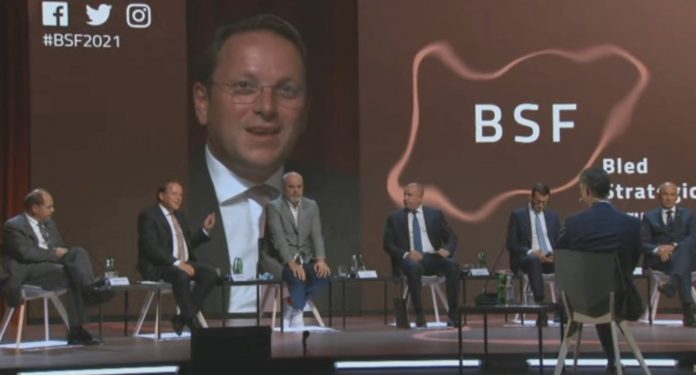
TIRANA, Sept 1 /ATA/ – The EU Commissioner for Neighbourhood and Enlargement Olivér Várhelyi, addressing the Bled Strategic Forum in Slovenia on Wednesday, drew attention to the current situation in Afghanistan.
Várhelyi Varhelyi underlined that this situation gives a lesson to the European Union, so that there is no time to waste with the European integration of the Western Balkans.
“You want to talk about the enlargement process, the EU enlargement policy, but you won’t talk about integration of the Western Balkans into Europe or European Union. I think this is the right concept to discuss, because enlargement is a process and as such it has its stages. It is more of an administrative process rather than a political one,” Várhelyi said.
However – he added – “what we should discuss is how the Western Balkans will become part of the EU and that is the integration process, which means integration politically, integration economically, but also integration in terms of the societies and the security architecture.”
”What we know and I think we have now a fresh example, and not only an example, but also a fresh experience of all of us, which is Afghanistan. Afghanistan is situated very far from here, but the Western Balkan is here and our responsibility towards the Western Balkans is even much higher than in Afghanistan. So, we can’t afford to fail with the Western Balkans, we cannot afford to fail and not to address all the integration aspects of the Western Balkans into the EU. This is what we should be working on: integrate them politically, economically and socially. The integration process as such is of a transformative nature and it is meant to create right initiatives. Afghanistan teaches us a lesson that we have no time to wait. We have to get down to business and we have to make all the decisions that are necessary for the region to move forward. The region is economically integrated almost fully. It is trading 68 % of its trade with the EU. We see that our investors are the biggest in the region,” Várhelyi noted.
He noted that the EU enlargement process is quite interesting when it comes to the administrative processes and the way how to design the whole procedure.
“The EU enlargement process would be meaningless, unless the region integrates in real life and this is why the other part of the new integration policy towards the Western Balkans was a substantive economic and investment plan for the region. We are proposing roughly one third of the region’s GDP to invest, or around 13 billion euros for the entire region to come and deliver in the next four or five years fundamental change on the ground for the people and the economy of the Western Balkans, to link up the capitals with highways and railways, phase out coal as the main energy source for electricity production, bring in renewable energy, invest in SME-s, create an investors climate that would attract foreign direct investments in the region, bring broad band high speed internet connections all over the region. These are the things people are missing and these are the bottlenecks in front of speeding up the region’s everyday development. This is what Europe is offering. No one else is offering this. When we start implementation of this plan already this semester and when you would see big projects coming up, you will see what the difference of this integrated policy that this Commission has put on the table means,” the EU Commissioner for Neighbourhood and Enlargement Olivér Várhelyi concluded.
/a.a/r.e/u.sh/