TIRANA, April 29 /ATA/ – Lonely Planet tourist guide, which has put Albania as one of the top destinations to visit in 2018, describes the archaeological sites with great interest from various periods – Greek, Roman, Venetian, Albanian.
Welcome to Albania
Albania has natural beauty in such abundance that you might wonder why it took 20 years for the country to take off as a tourist destination since the end of a particularly brutal strain of communism in 1991. So backward was Albania when it emerged blinking into the bright light of freedom that it needed two decades just to catch up with the rest of Eastern Europe. Now that it has arguably done so, Albania offers a remarkable array of unique attractions, not least due to this very isolation: ancient mountain codes of behaviour, forgotten archaeological sites and villages where time seems to have stood still are all on the menu. With its stunning mountain scenery, a thriving capital in Tirana and beaches to rival any elsewhere in the Mediterranean, Albania has become the sleeper hit of the Balkans. But hurry here, as word is well and truly out.
Top experiences in Albania
Welcome to The Accursed Mountains
The ‘Accursed Mountains’ (Bjeshkët e Namuna) offer some of Albania’s most impressive scenery, and the area has exploded in recent years as a popular backpacker destination. It’s a totally different side of the country here: that of blood feuds, deep tradition, extraordinary landscapes and fierce local pride. It’s absolutely a highlight of any trip to Albania, and indeed, it’s quite extraordinary to get this far removed from modern life in 21st-century Europe.
Welcome to Theth
This unique mountain village easily has the most dramatic setting in Albania. Just the journey here is quite incredible, whether you approach over the mountains on foot from Valbona or by vehicle from Shkodra. Both a sprawling village along the valley floor amid an amphitheatre of distant mountains and a national park containing stunning landscapes and excellent hiking routes, Theth is now well on its way to being Albania’s next big thing. An improved – though still incomplete – asphalt road from Shkodra has made access to this once virtually unknown village far easier in recent years, bringing with it the familiar problem of overdevelopment. Come quickly while Theth retains its incomparable romance and unique charm.
Welcome to Valbona
Valbona has a gorgeous setting, on a wide plain surrounded by towering mountain peaks, and its summer tourism industry is increasingly well organised. The village itself consists virtually only of guesthouses and camping grounds, nearly all of which have their own restaurants attached. Most travellers just spend a night here before trekking to Theth, which is a shame as there are a wealth of other excellent hikes to do in the area – ask for guides or information at the superhelpful Hotel Rilindja, or check out the excellent www.journeytovalbona.com website, a DIY-kit for the entire area.
Welcome to Berat
Berat weaves its own very special magic, and is easily a highlight of visiting Albania. Its most striking feature is the collection of white Ottoman houses climbing up the hill to its castle, earning it the title of ‘town of a thousand windows’ and helping it join Gjirokastra on the list of Unesco World Heritage sites in 2008. Its rugged mountain setting is particularly evocative when the clouds swirl around the tops of the minarets, or break up to show the icy peak of Mt Tomorri. Despite now being a big centre for tourism in Albania, Berat has managed to retain its easy-going charm and friendly atmosphere.
Kalaja
The Kala neighbourhood inside the castle’s walls still lives and breathes; if you walk around this busy, ancient neighbourhood for long enough you’ll invariably stumble into someone’s courtyard thinking it’s a church or ruin (no one seems to mind, though). In spring and summer the fragrance of camomile is in the air (and underfoot), and wildflowers burst from every gap between the stones, giving the entire sight a magical feel.
The highest point is occupied by the Inner Fortress, where ruined stairs lead to a Tolkienesque water reservoir. Views are spectacular in all directions, and guided tours are available from the entry gate for €10. It’s a steep 10-minute walk up the hill from the centre of town.
The Kala quarter’s biggest church, Church of the Dormition of St Mary(Kisha Fjetja e Shën Mërisë), is the site of the Onufri Museum. Ask at the Onufri Museum if you can see the other churches and tiny chapels in Kala, including St Theodore (Shën Todher), close to the citadel gates; the substantial and picturesque Church of the Holy Trinity (Kisha Shën Triades), below the upper fortress; and the little chapels of St Mary Blachernae (Shën Mëri Vllaherna) and St Nicholas (Shënkolli). Some of the churches date back to the 13th century. Also keep an eye out for the Red Mosque, by the southern Kala walls, which was the first in Berat and dates back to the 15th century.
Onufri Museum
The Onufri Museum is situated in the Kala quarter’s biggest church, Church of the Dormition of St Mary (Kisha Fjetja e Shën Mërisë). The church itself dates from 1797 and was built on the foundations of an earlier 10th-century chapel. Today Onufri’s spectacular 16th-century religious paintings are displayed along with the church’s beautifully gilded 19th-century iconostasis. Don’t miss the chapel behind the iconostasis, or its painted cupola, whose frescoes are now faded almost to invisibility.
Ethnographic Museum
On the steep hillside that leads up to the castle is this excellent museum, which is housed in an 18th-century Ottoman house that’s as interesting as the exhibits. The ground floor has displays of traditional clothes and the tools used by silversmiths and weavers, while the upper storey has kitchens, bedrooms and guest rooms decked out in traditional style.
Check out the mafil, a kind of mezzanine looking into the lounge where the women of the house could keep an eye on male guests (and see when their cups needed to be filled). There are information sheets in Italian, French and English.
Mangalem Quarter
Down in the traditionally Muslim Mangalem quarter, there are three grand mosques: the Sultan’s Mosque, the Lead Mosque and the Bachelors’ Mosque. All are worth a visit and each has its own idiosyncratic design and history.
The 16th-century Sultan’s Mosque (Xhamia e Mbretit) is one of the oldest in Albania. The Helveti teqe (a place of worship for those practising the Bektashi branch of Islam) behind the mosque has a beautiful carved ceiling and was specially designed with acoustic holes to improve the quality of sound during meetings. The Helveti, like the Bektashi, are a dervish order, or brotherhood, of Muslim mystics.
The big mosque on the town square is the 16th-century Lead Mosque(Xhamia e Plumbit), so named because of the lead coating its sphere-shaped dome. The 19th-century Bachelors’ Mosque (Xhamia e Beqarëvet) is down by the Osumi River; look for the enchanting paintings on its external walls. This mosque was built for unmarried shop assistants and junior craftsmen, and is perched between some fine Ottoman-era shopfronts along the river.
Chapel of St Michael
Perched on a cliff ledge below the castle is the artfully positioned 14th-century chapel of St Michael (Shën Mihell), best viewed from the Gorica quarter across the river. To get here you have to follow a narrow zigzagging pathway that begins on the river embankment, though sadly the church is normally locked.
Drymades
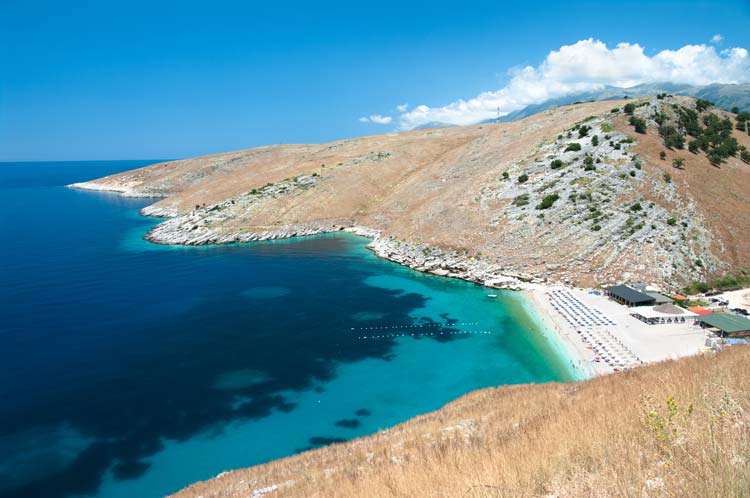
Heading south from Palasa, the next beach along the Albanian Riviera is Drymades. To get here leave the main road for Dhërmi, then take the first right (signposted for the Turtle Club). In 20 minutes, you’ll reach the rocky white beach via the sealed road that twists through olive groves.
Welcome to Tirana
Lively, colourful Tirana is the beating heart of Albania, where this tiny nation’s hopes and dreams coalesce into a vibrant whirl of traffic, brash consumerism and unfettered fun. Having undergone a transformation of extraordinary proportions since awaking from its communist slumber in the early 1990s, Tirana’s centre is now unrecognisable, with buildings painted in primary colours, and public squares and pedestrianised streets that are a pleasure to wander.
Bunk’Art
This fantastic conversion – from a massive cold war bunker on the outskirts of Tirana into a history and contemporary art museum – is Albania’s most exciting new sight and easily a Tirana highlight. With almost 3000 sq metres of space underground spread over several floors, the bunker was built for Albania’s political elite in the 1970s and remained a secret for much of its existence. Now it hosts exhibits that combine the modern history of Albania with pieces of contemporary art.
Just arriving at the bunker is quite an exciting experience, as you go though a long, dark tunnel in the hillside that leads you to the entrance on the side of a still-active Albanian military base. Once you’re inside the bunker itself, you can wander through the furnished rooms intended for the communist elite as they faced the invasion that so terrified them. Elsewhere you’ll find a very detailed history of modern Albania, beginning with the 1939 Italian invasion and ending with the overthrow of communism. The display arguably brushes over the true horrors of Hoxha’s Stalinist regime, while at least recognising them, and there are some fascinating documents and photographs, including a video of Enver Hoxha’s 1985 state funeral. Other highlights include the enormous Assembly Hall, the main social centre of the bunker, as well as the private chambers of other senior officials. Bunk’Art is an incredible place and promises to grow with the opening of further rooms and addition of more displays in the near future.
To get here from the centre of Tirana take a bus bound for Linza from outside the Palace of Culture on Sheshi Skënderbej, and ask the driver to let you out at Bunk’Art. It’s located right next to the Dajti Express, so it makes sense to combine the two outings.
National Gallery of Arts
Tracing the relatively brief history of Albanian painting from the early 19th century to the present day, this beautiful space also has temporary exhibitions. Downstairs there’s a small but interesting collection of 19th-century paintings depicting scenes from daily Albanian life, while upstairs the art takes on a political dimension with some truly fabulous examples of Albanian socialist realism. Don’t miss the small collection of communist statues in storage behind the building, including two rarely seen statues of Uncle Joe Stalin himself.
National History Museum
The largest museum in Albania holds many of the country’s archaeological treasures and a replica of Skanderbeg’s massive sword (how he held it, rode his horse and fought at the same time is a mystery). The excellent collection is almost entirely signed in English and takes you chronologically from ancient Illyria to the postcommunist era. One highlight of the museum is a terrific exhibition of icons by Onufri, a renowned 16th-century Albanian master of colour.
A disturbing and very important gallery devoted to those who suffered persecution under the communist regime is the most recent addition to the collection, though frustratingly almost none of this display is in English. The modernist mosaic adorning the museum’s facade is entitled Albania and shows Albanians victorious and proud from Illyrian times through to WWII, with some unsurprisingly communist overtones.
Mt Dajti National Park
Just 25km east of Tirana is Mt Dajti National Park (1611m). It is the most accessible mountain in the country, and many locals go there to escape the city rush and have a spit-roast lamb lunch. A sky-high, Austrian-made cable car, Dajti Express, takes 15 minutes to make the scenic trip to (almost) the top. Once there, you can avoid all the touts and their minibuses and take the opportunity to stroll through lovely, shady beech and pine forests.
There are grassy picnic spots along the road to the right, but if you didn’t pack a picnic, try the lamb roast and spectacular views from the wide terrace of its restaurant.
To get to the Dajti Express departure point, take the public bus from outside Tirana’s clock tower to Porcelan (30 lekë). From here, it’s a 1.5km walk uphill, or you can wait for a free bus transfer (departures every 30 minutes, 5 minutes). Taxis seem to charge what they want to the Dajti Express drop-off point, but the trip from Tirana should only cost 600 lekë. It’s also possible to drive or cycle to the top.
Et’hem Bey Mosque
To one side of Sheshi Skënderbej, the 1789–1823 Et’hem Bey Mosque was spared destruction during the atheism campaign of the late 1960s because of its status as a cultural monument. Small and elegant, it’s one of the oldest buildings left in the city. Take your shoes off to look inside at the beautifully painted dome.
Pyramid
Designed by Enver Hoxha’s daughter and son-in-law and completed in 1988, this monstrously unattractive building was formerly the Enver Hoxha Museum and more recently a convention centre and nightclub. Today, covered in graffiti and surrounded by the encampments of Tirana’s homeless, its once-white marble walls are now crumbling, but no decision on whether to demolish or restore it has yet been reached. It’s sometimes open for temporary exhibits, for which it’s a surprisingly great venue.
Sheshi Skënderbej
Sheshi Skënderbej is the best place to start witnessing Tirana’s daily goings-on. Until it was pulled down by an angry mob in 1991, a 10m-high bronze statue of Enver Hoxha stood here, watching over a mainly car-free square. Now only the equestrian statue of Skanderbeg remains, and the ‘square’ – once Tirana’s most popular meeting point in the decades where 99% of people were forced to get around on foot – is now a huge traffic roundabout.
Former Residence of Enver Hoxha
This simple three-storey villa was the home of Albanian dictator Enver Hoxha for decades, and his wife continued to live here for years after his death in 1985. While the Albanian communist leaders clearly lived a much simpler life than their comrades in Romania, for example, it was still another world for the people on the street, who thronged here in amazement when the Blloku was finally opened to the public in 1991. The house is closed to the public.
Welcome to Gjirokastra
Defined by its castle, roads paved with chunky limestone and shale, imposing slate-roofed houses and views out to the Drina Valley, Gjirokastra is a magical hillside town described beautifully by Albania’s most famous author, Ismail Kadare (b 1936), in Chronicle in Stone. There has been a settlement here for 2500 years, though these days it’s the 600 ‘monumental’ Ottoman-era houses in town that attract visitors. The town is also synonymous for Albanians with former dictator Enver Hoxha, who was born here and ensured the town was relatively well preserved under his rule; though he is not memorialised in any way here today. Far less touristy than Berat, the town is equally charming and has several fascinating sights, as well as some excellent accommodation options.
Cold War Tunnel
Gjirokastra’s most interesting sight in no way relates to its traditional architecture, but instead to its far more modern kind: this is a giant bunker built deep under the castle for use by the local authorities during the full-scale invasion Hoxha was so paranoid about. Built in secret during the 1960s, it has 80 rooms and its existence remained unknown to locals until the 1990s. Personal guided tours run from the tourist information booth on the main square all day.
It’s an interesting contrast to Tirana’s Bunk’Art, as unlike the capital’s version, this bunker is virtually empty and feels even more creepy as a result. The rooms have their use displayed on the door and nothing else, though it’s interesting to note that the bunker – which could hold up to 300 people – had everything from its own classroom to a law court.
Gjirokastra Castle
Gjirokastra’s eerie hilltop castle is one of the biggest in the Balkans and is definitely worth the steep walk up from the Old Town. The castle remains somewhat infamous due to its use as a prison under the communists. Inside there’s an eerie collection of armoury, two good museums, a recovered US Air Force jet shot down during the communist era, and a hilariously hard-to-use audiotour that’s included in your entry fee. The views across the valley are simply superb.
There’s been a fortress here since the 12th century, although much of what can be seen today dates to the early 19th century.
Zekate House
This incredible three-storey house dates from 1811 and has twin towers and a double-arched facade. It’s fascinating to nose around the almost totally unchanged interiors of an Ottoman-era home, especially the upstairs galleries, which are the most impressive. The owners live next door and collect the payments; to get here, follow the signs past the Hotel Kalemi and keep zigzagging up the hill.
Gjirokastra Museum
This superb new museum is a beautifully lit and presented, fully English-signed display on the long and fascinating history of the town. Some highlights include a 6th-century grave containing the skeletons of two small children, as well as information on such luminaries connected with Gjirokastra as Ali Pasha, Lord Byron, Edward Lear and Enver Hoxha.
Army Museum
As well as photos of the partisan resistance against the Italians and a vast number of rifles and machine guns, it’s possible to visit the cells where political prisoners were kept between 1929 and 1968. It’s a humbling experience. Look for the seven windows that face the town here: “you’ll be sent to the seven windows” was a common threat to naughty children in the town throughout the communist era.
Skenduli House
The latest Ottoman-era mansion to receive a renovation, the Skenduli House is well worth a visit and desperately needs contributions to pay for the remaining restoration work. You’ll most likely be shown around by Mr Skenduli himself, who speaks Italian and some basic French, but no English. The house dates from 1700 and has many fascinating features.
Bazaar
The ‘Neck of the Bazaar’ makes up the centre of the Old Town and contains artisan shops that support masters of the local stone- and wood-carving industries. A full renovation is promised in the next few years, which will hopefully preserve the many crumbling facades rather than sanitising this historic intersection of cobbled streets.
Ethnographic Museum
This museum houses local homewares and was built on the site of Enver Hoxha’s former house, in the middle of the Old Town. Its collection is interesting if you’re a fan of local arts and crafts, but don’t come expecting anything about Hoxha himself.// a.i/