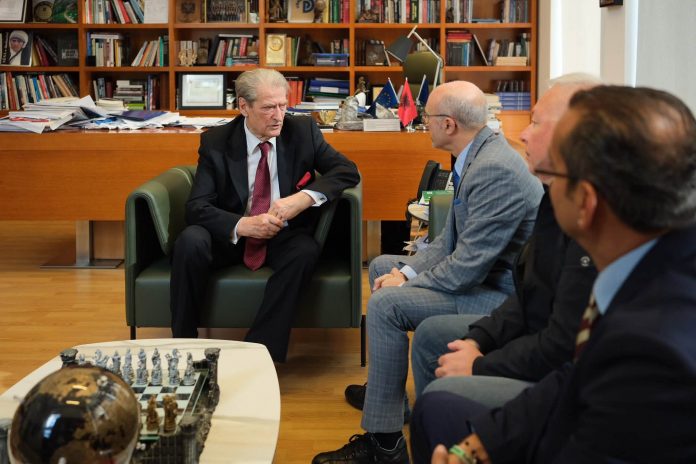
TIRANA, Nov. 3 /ATA/ – Democratic Party leader Sali Berisha met with a visiting delegation from Italy’s Fratelli d’Italia party, telling them that the establishment of a technocratic government was essential to ensuring free and fair elections in Albania.
The delegation included Prof. Ugo Falcone, coordinator of the Adriatic Coast Geopolitical Observatory, vice-president of the UNESCO Club of Udine and a member of Fratelli d’Italia’s National Assembly; architect Roberto Guggino, municipal councillor and leader of the Fratelli d’Italia group in the municipality of Pradamano, Udine, and an associate of BLDing Studio Srl in Pordenone; and Albert Meçaj, a business adviser with international experience and a member of the Adriatic Coast Geopolitical Observatory.
According to the Democratic Party’s press office, Berisha briefed the visitors on the latest political developments in Albania, focusing in particular on student protests, which he described as among the largest in the country’s history.
He said students had taken to the streets to protest against corruption, what he termed a “narco-state,” and the undermining of the electoral process, demanding the government’s resignation and the formation of a technocratic administration to help steer Albania out of its crisis.
Berisha described what he called a “narco-state” as Albania’s biggest problem, saying it had devastating consequences for democracy, the rule of law, society and the economy.
He also claimed that the euro and the U.S. dollar had depreciated by 32% and 35%, respectively, in Albania, severely undermining the country’s exports and economic competitiveness.
Referring to the circumstances surrounding the latest parliamentary elections and findings in international reports, Berisha argued that a technocratic government was a necessary condition for guaranteeing free and fair elections in Albania, the Democratic Party’s press office said
He also stressed that restoring free and fair voting, combating corruption and freeing state institutions from the influence of organised crime were prerequisites for restoring democracy and safeguarding the country’s European future.
/m.q/a.f/u.sh/