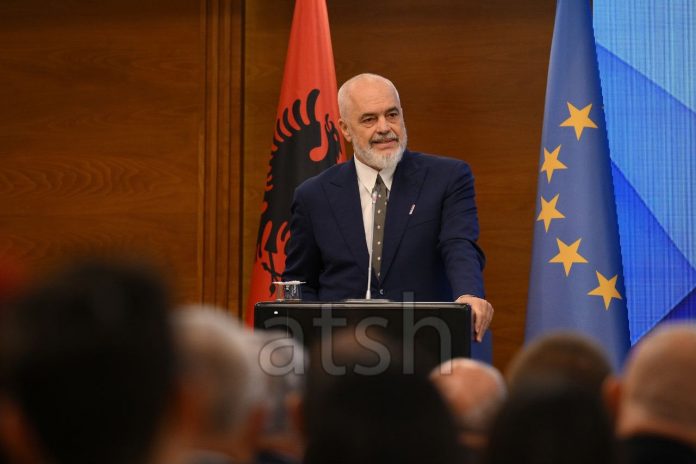
TIRANA, September 30 /ATA/ – Prime Minister Edi Rama presented today the draft amendments to the Code of Criminal Procedure.
Rama focused on the process of assigning security measures and the strengthening of alternatives to imprisonment.
During presentation of the draft, Rama mentioned Professor Rafael Pariso on the concept of the security measures within the Albanian Code.
“A code that begins with imprisonment and then descends to lighter measures conditions the system to this pattern, prompting it to always consider prison as the first option,” Rama said, arguing that the new package aims to counter precisely this logic.
According to the prime minister, the court should start from the premise of liberty, consider milder measures, and evaluate house arrest, resorting to imprisonment only when other alternatives prove insufficient.
The draft, according to Rama, stipulates that for criminal offenses carrying a maximum sentence of up to 3 years, no restrictive measures should generally be imposed, while for offenses carrying a maximum sentence of less than 5 years, there should not be ordered any imprisonment.
According to him, “The court must conduct its own independent evaluation; if it merely copies the prosecutor’s arguments without explaining why less severe measures are insufficient, the decision becomes invalid and the judge incurs disciplinary liability.”
Rama stated that, “Whenever detention is ordered, the court must also consider financial bail—calculated, of course, based on the individual’s actual financial situation—subject to necessary exceptions for risks regarding evidence tampering, serious violent crimes, terrorism, offenses against the constitutional order and specific cases falling under the jurisdiction of the Special Court.”
According to the prime minister, the prosecutor must report to the court every month on whether the grounds justifying the measure still exist and provide arguments to support them. “Liberty cannot be restricted once and then forgotten, as if it no longer exists,” he said.
In his presentation, Rama stated that, “The package also enhances protections for vulnerable individuals: mothers with children up to the age of six; fathers or guardians—where the mother is deceased or unable to provide care; persons over the age of 70; the seriously ill; and those in therapeutic programs—can no longer be treated as if their human circumstances do not exist.”
/m.q/ /a.g/p.s./