

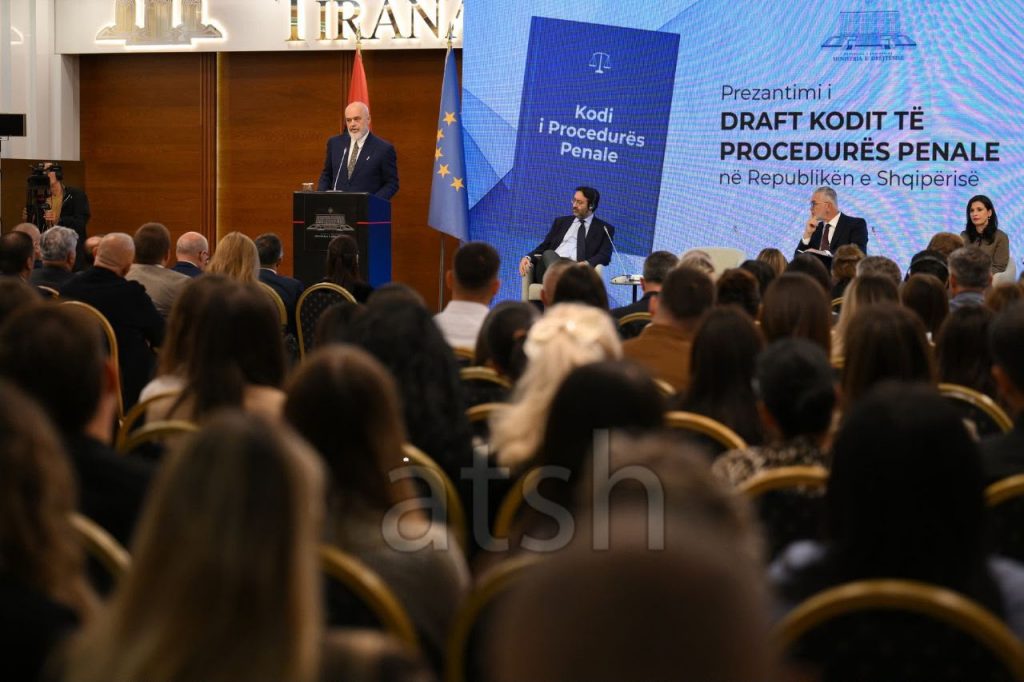
TIRANA, Sept 30 /ATA/ Prime Minister Edi Rama said today that one of the key changes introduced by the new package on the Code of Criminal Procedure concerns the concrete consequences of violations of procedural rights.
“Alongside absolute and relative nullity, an intermediate legal regime is being introduced for serious violations of the right to be heard, to participate in proceedings and to present evidence. Such violations can no longer go without individual accountability. A judge who restricts a person’s liberty without providing adequate reasoning, a prosecutor or judicial police officer who discloses confidential information, an official who fails to record an interviewing process, or an officer who misuses the provisions governing flagrante delicto or urgent procedures must be held personally liable. A procedural violation remains a violation, even where the person is ultimately convicted,” Rama said.
Rama said the package does not affect the pillars of the justice reform, nor does it strip the prosecution of its powers to conduct wiretapping, searches, seizures, asset investigations or international cooperation. According to the prime minister, the change lies in how these powers are exercised and in strengthening judicial oversight over their use.
Rama said the package does not alter the justice reform or the prosecution’s investigative powers, but changes how those powers are exercised and strengthens judicial oversight.
“Special regimes will continue to apply to cases involving corruption, organised crime, terrorism, trafficking, weapons offences, serious violent crimes and matters falling under the jurisdiction of the Special Court. This is a deliberate choice, as the fight against corruption and organised crime must not be compromised in any way,” Rama said.
/m.q/j.p/sm/








