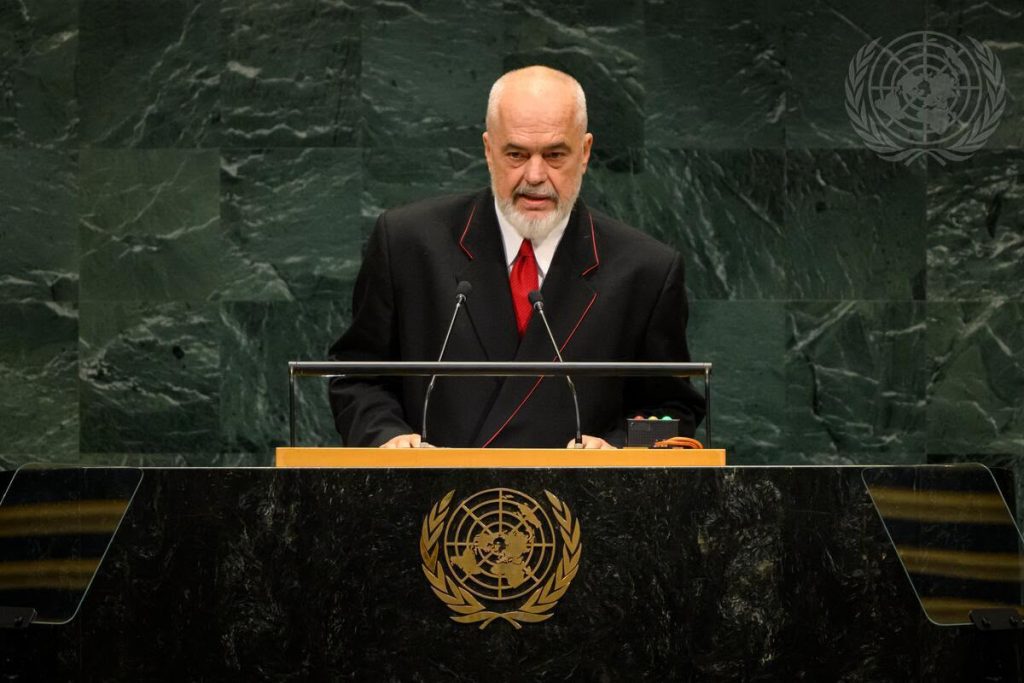
TIRANA, Sept 25 /ATA/-By Maela Marini/ Prime Minister Edi Rama today called for an international pact to establish a sovereign and democratic artificial intelligence. Addressing the United Nations General Assembly in New York, he warned that freedom of expression is now equally threatened by the weaponisation of the freedom to disseminate.
Rama told the United Nations General Assembly that citizens should be able to distinguish when influential political content has been artificially generated or altered. He said the architecture of distribution must be made transparent, enabling citizens and states to know who created, financed, targeted or artificially amplified such content. Rama further stressed that any influential use of artificial intelligence by a public institution must preserve a clear chain of legal human accountability.
Rama added that democracies must establish a shared early‑warning mechanism so that data on AI‑driven manipulation can circulate among like‑minded states as swiftly as the manipulation itself. He stressed that smaller countries must not be left outside this protective architecture.
Rama said in his address that digital sovereignty cannot once again be reserved for the wealthiest nations. He warned that lies travel without visas, ignoring walls and border controls, while algorithms cross frontiers without passports or fear of governments. Those who attack our countries already cooperate across jurisdictions, Rama said, and our states must first and foremost learn to do the same.”
According to him, the challenge is not a race between mankind and machines, but between divergent human purposes. He warned that freedom of expression cannot be safeguarded by leaving distribution entirely in obscurity. For centuries, censorship was the greatest threat to free speech, he said. Speech is the right to voice an idea; distribution is the power to place that idea before millions. Speech belongs to human beings, but distribution can be bought, automated, manipulated and covertly directed by platforms, corporations, criminal networks and foreign states.
While the right to speak is universal, there is no universal right to anonymous, unlimited and artificially amplified dissemination. He warned that when a lie is multiplied billions of times, truth no longer needs to be censored — it is simply buried. Citizens may remain formally free to speak, but their voices are drowned in a storm no human sound can withstand. As a result, freedom of expression can suffer defeat without banning a single book, jailing a single journalist or deleting a single post. Rama stressed that the answer to covert, industrial amplification must be exposure — and it must come sooner rather than later.
Prime Minister Edi Rama told the United Nations General Assembly that citizens must be able to ask who authored a message, who financed it, whether it was spread by people or machines, why individuals were targeted, and whether apparent public reaction was genuine, coordinated or directed from abroad. He said that safeguarding democracy and each nation’s freedom to live in its own way does not mean controlling what people are allowed to think, but revealing the concealed powers that seek to dictate what people are compelled to see. Rama added that while some call for artificial intelligence to be halted or slowed down.
Rama argued that Albania, though small, cannot support a moratorium on artificial intelligence, warning that a pause by democracies would not restrain dictatorships, hostile powers, criminal networks or manipulation industries. He said democracies must not “regulate themselves into impotence” and endorsed Donald Trump’s view that the solution is not to stop but to accelerate AI development — with the caveat that acceleration must have clear direction.
He said that artificial intelligence must be built by free societies, shared among allies and placed at the service of citizens. He said sovereign AI does not mean isolation, but ensuring no country is left powerless before systems it cannot understand, control or accept. Every state, he argued, should be able to protect its language and authentic communications, authenticate public discourse, detect coordinated manipulation, safeguard data and inform its citizens without relying entirely on the commercial priorities of a distant corporation.
/r.e/a.f/sm/