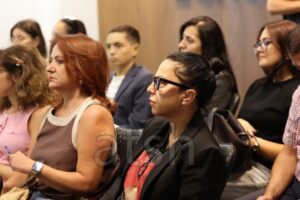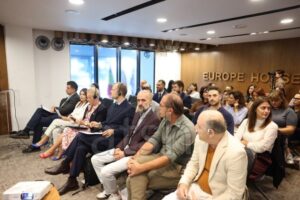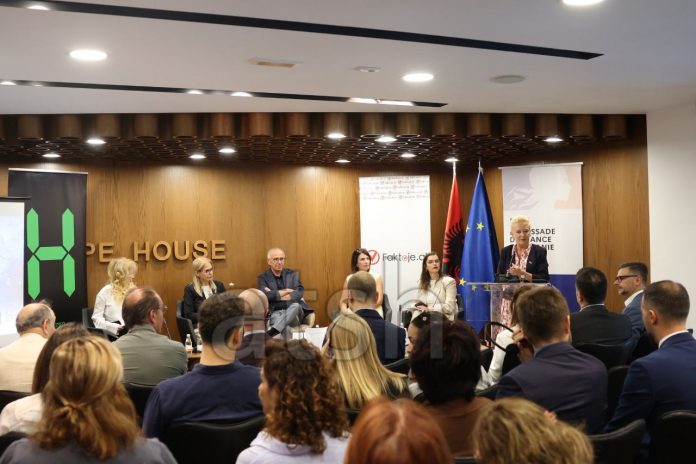
TIRANA, September 23 /ATA/ – The conference “Who Protects Information Integrity? EU Approaches and French Experience,” held today at Europe House in Tirana, centered on safeguarding information integrity, fighting disinformation, and holding digital platforms accountable.
The conference was organized by “Faktoje,” in partnership with “Hibrid.info” and the French embassies in Albania and Kosovo, with the participation of representatives from institutions, the media and civil society, as well as experts of the field.
The discussions centered on how public and private sectors must safeguard information integrity in an age dominated by AI, digital platforms and information manipulation.
In her opening remarks, the French Ambassador to Albania Catherine Suard stated that the international situation and the evolution of social media are creating new challenges for public information and democracies.
“Social media is increasingly influencing how events—including international ones—are perceived,” Suard said, noting that when there is crises, emotions are often amplified more than efforts to understand the actual situation. The ambassador emphasized that information manipulation by state and non-state actors is on the rise and that these practices aim to deepen the polarization of public debate and exploit the internal vulnerabilities of democratic societies.
“France is particularly exposed to these hostile information maneuvers,” said Suard, adding that protecting the integrity of information and combating its manipulation have become new public policies and important components of French foreign policy.
She emphasized the need for an integrated approach that includes rapid responses to false information, diversified communication methods, collaboration with media, fact-checkers and social media influencers as well as strengthened governance of digital platforms.
Suard also outlined France’s efforts to build strategic communication and counter-disinformation capabilities, including the “French Response” initiative, which uses humor to expose and discredit disinformation content.
“It is time to wake up,” the ambassador stated, referring to the need for Albania to also build its capacity to tackle these challenges.
She also mentioned the Franco-German cooperation aimed at creating an “information shield” to support the European Union’s external action.
Suard hailed Albania’s adoption of a national strategy to combat disinformation as a significant development, noting that such discussions contribute to its implementation and improvement.
Gledis Gjipali, the European Movement Albania CEO, remarked that the discussion is held in the proper time as Albania aligns its Digital Services Act with the European framework. “Once approved by Parliament, this act will impose obligations on the media and civil society. This requires coordination and cooperation among the relevant actors, while also defining duties and responsibilities for us all,” stated Gjipali.
Klodiana Kapo, Executive Director of “Faktoje,” focused on the role of professional journalism in the face of the massive influx of information and the difficulty of distinguishing the truth from the manipulated content.
“Journalism core is integrity—on presenting facts and the truth. There is only one truth,” said Kapo, emphasizing that technological advancements have created a significant advantage for the spread of unverified information.
According to her, independent and professional journalism might appear “naive” under the current circumstances, yet it remains more essential than ever.
“It is necessary to understand who lies behind certain narratives. Half-truths are the poison that has killed journalism,” Kapo remarked, also criticizing the publication of unsigned articles on portals that are difficult to identify.
She underscored that “Faktoje” aims to foster critical thinking, fact-checking and accountability, while urging that legislation regarding information integrity also take election campaigns into account.
On her part, Socialist Party MP Iris Luarasi pointed at some cases when manipulated images were used in public debates, specifically referring to protests against a tourism project in Zvërnec.
She presented a photo showing a young woman holding a poster that depicted Albania split in two, featuring both the Albanian and Israeli flags. Luarasi also mentioned another image showing a fence in Zvërnec adorned with signs and the flags of Albania and Israel. According to her, fact-checking revealed that the image had been edited and that the features shown did not exist in reality, raising suspicions that the photo was created using artificial intelligence.
“Thus, the debate over a tourism project turned into a story about people buying our homeland,” Luarasi said, emphasizing how such instances demonstrate how a specific issue can be transformed into a manipulated narrative that influences public perception.
The conference also addressed disinformation trends in Albania and Kosovo, cross-border narratives, AI-generated content, foreign interference in the information space and the role of platforms in disseminating such material. The experts also addressed the transparency and accountability of digital platforms, the implementation of the EU Digital Services Act, institutional responsibilities, media literacy, professional journalism and cooperation among the media, institutions and civil society.
The conference concluded with discussions on a list of priority measures to enhance information integrity, democratic resilience and inter-institutional cooperation over the coming year. /p.s./