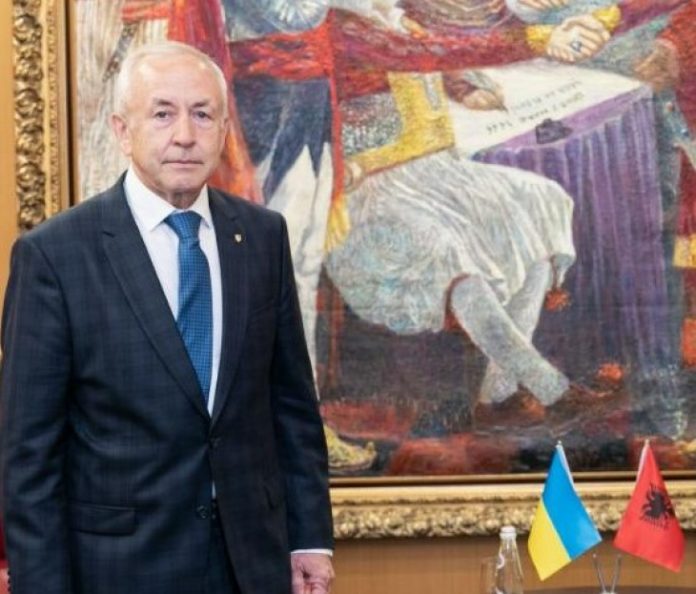
TIRANA, Aug 24 /ATA/ Ukraine’s Ambassador to Albania, Volodymyr Shkurov, has shared a message marking the 35th anniversary of Ukraine’s independence.
History knows many states that have declared independence. But only a few generations have the honour—and, at the same time, the challenge—of defending and consolidating it. Today’s Ukrainians are among those generations.
Yet this is precisely where the main lesson of Ukrainian history lies: independence cannot be taken for granted. It is an ongoing journey, paved with a people’s sacrifices in defence of their freedom.
This was not merely a separation from the Soviet Union, but a return to Ukraine’s European political traditions and the restoration of its statehood. Independence was not the end of the country’s history, but the beginning of a major responsibility: building a modern and democratic state.
Ukraine chose the path of freedom.
Despite the Ukrainian people’s heroic efforts, the full-scale and bloody war launched by Russia has now continued for more than four years. Ukraine’s heroic Armed Forces are defending their people and their land at the cost of their lives.
As Russia struggles to achieve significant gains on the battlefield, it has intensified its attacks on Ukrainian cities and villages. Night after night, Russian missile and drone strikes are killing civilians, causing deaths and injuries, and inflicting widespread destruction on residential buildings, hospitals, schools, energy facilities and other critical civilian infrastructure. They are also damaging cultural heritage sites and destroying ecosystems across entire regions.
Deliberate attacks on civilian facilities and populations are part of the military terror that Russia is systematically waging against Ukraine, in serious violation of international law and basic humanitarian principles. To date, more than 20,000 confirmed cases of the deportation or forcible displacement of Ukrainian children have been documented.
According to the UN Human Rights Monitoring Mission in Ukraine, 437 civilians were killed and another 2,610 were injured in July 2026 alone. The civilian death toll was the highest recorded since May 2022.
A year before the war, in February 2021, I had the honour of opening the Embassy of Ukraine in the Republic of Albania.
The last time we celebrated it in Tirana was in August 2021, marking the 30th anniversary of an independent and peaceful Ukraine. For almost five years, Ukraine has been asserting its independence with weapons in hand.
The resilience of the Ukrainian people has also been made possible by the support and solidarity of the Albanian people, the Government of Albania, the countries of the European Union, the United Kingdom, the United States and the wider democratic world.
I once again express my deepest gratitude to Prime Minister Edi Rama, President Bajram Begaj, Speaker of Parliament Niko Peleshi, Minister for Europe and Foreign Affairs Ferit Hoxha, members of the government and everyone who has contributed, for their willingness to support Ukraine in its heroic struggle against Russian aggression.
The escalation of the enemy’s attacks on our rear areas, destroying civilian infrastructure, is nothing more than a criminal attempt to break the will of our people. We are preparing for even greater hardships, including the harsh challenges of a winter without electricity, heating or water. It is difficult to comprehend, but the reality is truly harsh and beyond anything that should be conceivable in the civilised world of the 21st century.
Ukraine continues to fight, work and build. Ahead lie the reconstruction of the country, the return of our people to their homes, reforms and Ukraine’s full membership of the European Union.
This is the choice of our people and what they believe in, despite the pain of their losses. Independence is not a static condition, but an ongoing process of strengthening the state, developing democracy and fulfilling our responsibility to our citizens.
Thirty-five years after restoring its independence, Ukraine remains true to the choice it made in 1991. In the face of every challenge, it continues along its path — the path of freedom, European integration and a peace based on justice — because Ukraine is convinced that it is safeguarding freedom for future generations.
Thirty-five years after restoring its independence, we understand its true value better than ever. It is measured not only by national symbols or international recognition, but by human dignity, the courage of those defending their country, the resilience of society and faith in the future.
That is precisely why the Ukrainian people chose the path of independence for themselves. And I am convinced that this path will lead to victory, a just peace and Ukraine’s rightful place in a united Europe.
/gj.m/j.p/sm/