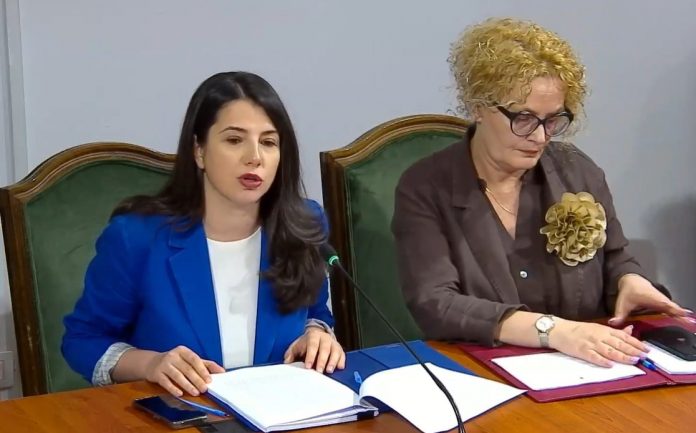
TIRANA, June 29 /ATA/ The Parliamentary Committee for Europe and Foreign Affairs today reviewed the draft law “On certain amendments and additions to Law No. 90/2012, ‘On the organization and functioning of the state administration’.”
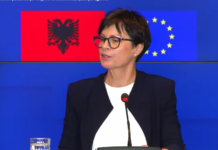
During her presentation to the committee, Minister of State for Public Administration and Anti-Corruption Adea Pirdeni stressed that the draft law represents one of the two main pillars of the public administration reform and its alignment with European standards, alongside the Civil Service Law.
Pirdeni said that the legislative initiative is the result of a two-year process carried out with central government institutions and independent bodies, in close coordination with the European Commission and SIGMA, as well as following a broad consultation process with experts and stakeholder groups.
According to her, the timing of the adoption of this draft law coincides with a crucial stage of Albania’s European integration process, as part of preparations for closing accession negotiations with the European Union.
She recalled that at the 8th Intergovernmental Conference, the EU’s common position on interim benchmarks was also adopted, which includes as key obligations the approval and effective implementation of this law, as part of the horizontal conditions for advancing the integration process.
Referring to international assessments, Pirdeni said that according to OECD/SIGMA, Albania is currently rated a leading country in the region in key areas of public governance, including public finance management, policy coordination, human resource management, and digital governance.
She stressed that these achievements underpin the need for a new phase of modernization of the state administration, with a focus on strengthening accountability and institutional efficiency.
According to her, the draft law introduces a number of changes, including the simplification of non-ministerial institutions into two main categories: subordinate institutions and autonomous agencies, with the aim of clarifying their roles and responsibilities and ensuring a unified governance model.
Referring to the OECD/SIGMA 2024 report, the minister said that a number of bodies with executive functions currently report to Parliament and are not part of the government structure. Therefore, the draft law aims to regulate their legal status, ensuring functional independence in line with European standards.
The law also provides for a ban on the executive issuing instructions or intervening in the activities of agencies that enjoy functional independence.
Another change, according to Pirdeni, is the establishment of a unified system for monitoring the performance of institutions under ministries, accompanied by clear planning and reporting mechanisms, as well as the regular publication of annual performance reports.
The draft law also strengthens the role of the director general as the main level of executive decision-making within ministries, defining clear institutional responsibilities.
Among other changes, it also provides for strengthened prior oversight of the creation and reorganization of public administration institutions, through a requirement for preliminary analyses, with the aim of preventing unnecessary expansion of state structures.
The minister also underlined that the draft law sets out clear rules on the recruitment, career progression, and dismissal of public service employees working directly with citizens and regulated under the Labour Code, including sectors such as health and education, with the aim of increasing transparency and preventing abuse.
In conclusion, Pirdeni stressed that the law also aims to regulate the establishment of institutions under the Prime Minister only when they are necessary, with a temporary mandate and linked to government priorities, as well as to introduce a minimum threshold for small-staff structures, with the aim of increasing efficiency and avoiding fragmentation of the public administration.
/gj.m/j.p/r.e/sm/