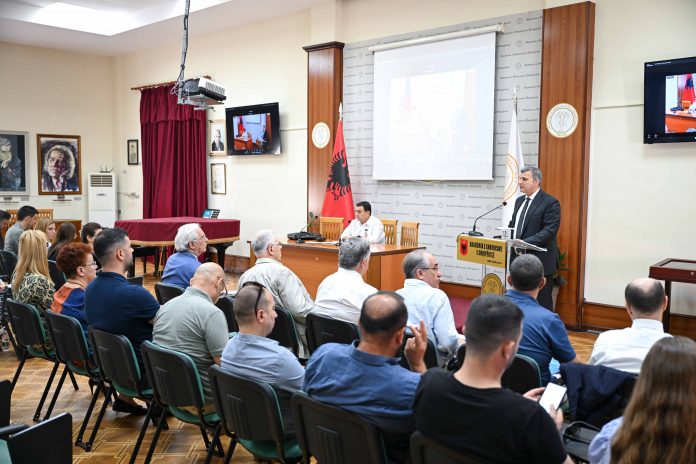
TIRANA, June 26 /ATSH/ Governor of the Bank of Albania Gent Sejko participated in the “Cashless Albania: are we ready?” workshop, organized by the Academy of Sciences, with the participation of representatives of public institutions, the banking sector, academia and international organizations.
The Governor highlighted several major milestones, notably the transposition of the EU’s PSD2 framework, the advancement of open banking, and the modernization of national payment systems. Culminating in Albania’s landmark integration into the Single Euro Payments Area (SEPA), this achievement empowers Albanian citizens and businesses to make euro transfers at significantly reduced costs, matching the speed and efficiency of the European Union.
The Governor noted that recent reforms have successfully transformed the digital payments market. Annual transactions per capita have surged to 29—up from just 5 a decade ago—with a 25% year-over-year growth rate making electronic transactions the dominant payment method. Furthermore, 1.5 million cards are now in circulation, and the POS network continues to expand geographically. Together, these milestones reflect an enduring shift toward electronic payments and a strong increase in public trust.
Governor Sejko identified the development of a TIPS-based national instant payments platform as a key strategic priority for the Bank of Albania. He noted that modernizing this payment infrastructure must go hand-in-hand with enhanced financial education for citizens. To ensure success, he called for continued collaboration between the financial industry, policymakers, and scholars, particularly praising the Academy of Sciences for its role in driving scientific dialogue and digital financial literacy. /e.xh/r.e/a.f/p.s./