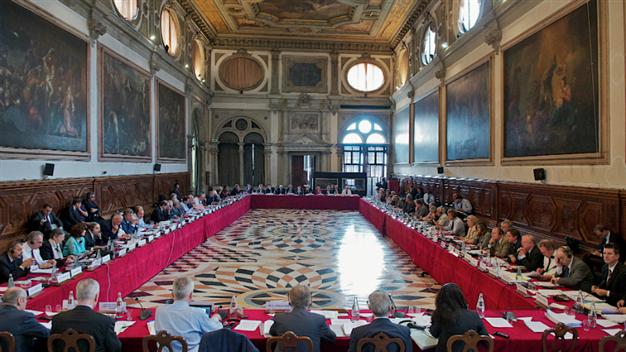
TIRANA, June 17 /ATA/ The Venice Commission and the Council of Europe (DGI) have published a joint opinion on the SP and DP’s draft law on political party financing.
In a 38-page report, Venice Commission experts hail the draft law as a crucial step toward modernizing political financing, increasing transparency, and tightening oversight of party finances. The assessment identifies the legislation as a vital advancement for strengthening accountability in party revenues and expenditures.
The Venice Commission suggested reflecting on the draft law to ensure that the provisions governing ordinary party funding and election campaign financing are fully harmonized and consistent with each other.
Following are the key recommendations of the Venice Commission and DGI:
- Ensuring that the rules concerning regular party financing and election campaign financing are harmonized and do not contradict each other [paras 105-106];
- Providing more precise and more detailed regulations in the Draft Law, leaving only technical details to secondary legislation, and ensuring that implementing rules adopted by the Central Election Commission and the Council of Ministers are based on sufficiently precise, objective and foreseeable criteria [paras 31, 53-54, 62, 65, 70, 84, 89, 91-92, 101-103];
- Regulating more comprehensively hidden financing and indirect financing by third parties and entities affiliated to or controlled by political parties [para 31-34];
- Making it clear in the law that political parties’ financial reports must include, on an itemized basis, all sources of income, expenditures, assets, liabilities, loans, debts, guarantees, in-kind contributions, below-market-value services, related-entity transactions, public support in kind, media and digital communication expenditure, and the gender and youth grant; and considering more frequent reporting obligations, particularly in election years [paras 70, 74];
- Strengthening the oversight of party financing, including by establishing clearly defined mechanisms for cooperation between the Central Election Commission and other State agencies, and ensuring that the Commission has a clear mandate, the authority and adequate resources to effectively and pro-actively supervise the funding of political parties and to investigate alleged infringements of political financing regulations; regulating in more detail the “structure responsible for the financing, monitoring, and control of political party financing” which is planned to be established within the Central Election Commission, including safeguards of independence of that structure; and strengthening the independence of the accounting experts which are tasked to audit parties’ financial reports [paras 80, 82, 89];
- Revising the sanctioning provisions to ensure that sanctions are available for violations of all obligations and prohibitions under the Draft Law; providing a broader range of different sanctions to ensure that they are effective, proportionate and dissuasive; considering increasing the ranges of certain administrative fines; with respect to the measure of barring a party from participating in elections in case of certain violations of the law, making it clear that this mechanism only applies to serious cases, as a matter of last resort, after notice, opportunity to remedy and effective judicial review [paras 78, 95-97]. 113. Further recommendations are contained in the Opinion. /p.s/ /a.g/p.s./