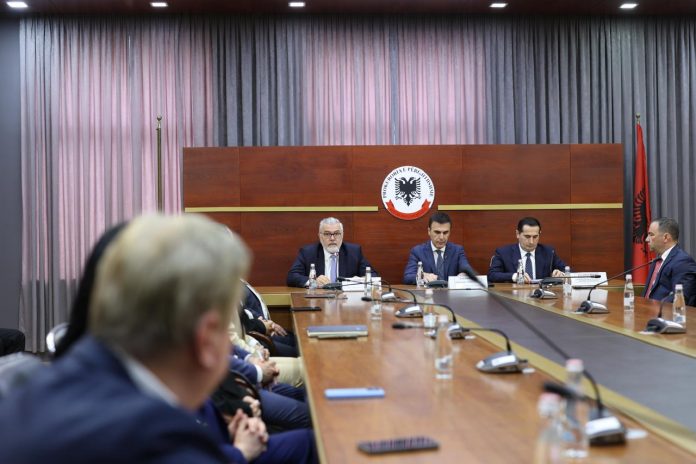
TIRANA, June 2 /ATA/ Minister of Justice, Toni Gogu, on Tuesday presented 2026 crime-fighting recommendations to the Prosecutor General Olsian Çela, the chief prosecutor of the Special Prosecution Office against Corruption and Organized Crime Klodian Braho, and heads of regional prosecution offices.
Gogu said the recommendations are organized into eight main areas, in line with the European Union accession benchmarks under Chapters 23 and 24.
“The recommendations are structured around eight key areas, also aligned with the closing benchmarks of Chapters 23–24, namely the rule of law, human rights, the fight against crime, integration and transparency, institutional efficiency and capacity, modern investigative methods, cooperation with the Ministry of Justice, inter-institutional cooperation, and international cooperation. This alignment is not coincidental; it reflects a deliberate methodological choice,” Gogu said.
Gogu emphasized that the analysis of the implementation of the 2025 recommendations served as the basis for developing the methodology for 2026.
According to him, the 2026 recommendations aim to address areas identified for improvement.
“I am referring here to investigations initiated ex officio within the general jurisdiction prosecutor’s offices. Financial parallel investigations remain below the potential of the prosecution services, and final confiscations require increased attention,” he said.
For 2026, the minister noted that three structural layers have been defined, adding that these are “areas where the evolution of criminality and the requirements of integration converge.”
First, according to Gogu, tax evasion is identified as a criminal enforcement priority.
“Tax evasion, in our view, is not merely a fiscal matter; it constitutes a structural pillar of the country’s economic order and of fair competition. When compliant businesses fulfil their tax obligations while non-compliant actors do not, market distortions arise, the state’s fiscal capacity is undermined, and economic governance is adversely affected. The EU negotiating position explicitly highlights that high levels of economic informality and weaknesses in law enforcement constrain the effective functioning of the market economy. The 2026 recommendations therefore address tax evasion as a criminal enforcement priority, as a means of safeguarding the State’s financial interests and ensuring fair competition. This requires, inter alia, the intensification of prosecutorial action, proactive investigative measures, and structured inter-institutional cooperation,” he stated.
The minister also citied road traffic offences.
“Driving under the influence of alcohol or narcotics, and driving without a licence, are offences with a direct impact on public safety and the lives of citizens, as we have unfortunately witnessed in recent weeks. Therefore, the 2026 recommendations require this area to be addressed with increased focus. This includes intensified investigations and criminal prosecution, improved investigative quality, and, above all, strengthened cooperation with the State Police,” Gogu concluded.
/m.q/j.p/sm/