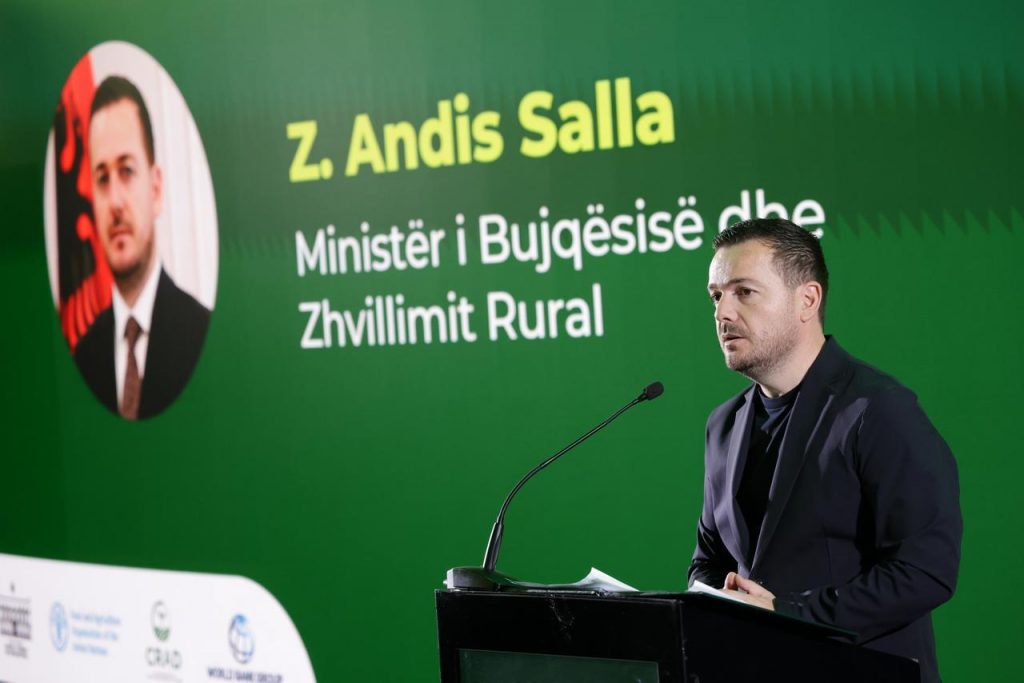
TIRANA, June 1 /ATA/ – The Ministry of Agriculture and Rural Development on Monday unveiled “YLLI”, an artificial intelligence-powered virtual assistant designed to provide farmers with real-time information and support in Albanian as part of Albania’s push to digitise the agricultural sector.
The assistant was presented at the “Digital Agriculture for Albania 2030” conference in Tirana and will be integrated into the government’s Farmer Portal platform.
Agriculture Minister Andis Salla said Albania was entering a new phase of development in which farming would increasingly rely on technology and real-time data.
“Digital technologies are now a necessity for agriculture in the face of challenges linked to climate change, rising production costs, market competition and the need to meet European standards,” Salla said.
According to the minister, YLLI will provide farmers with immediate guidance on agricultural activities, public support schemes and other sector-related information through a smartphone-based platform.
The Farmer Portal will also publish real-time market and collection-point prices, a measure the government says will improve transparency and help farmers make better-informed decisions.
Salla said the digitalisation programme would extend to the use of smart sensors in agricultural plots, providing real-time data on irrigation, fertilisation, weather conditions and crop-management needs.
The initiative forms part of Albania’s broader Digital Agriculture 2030 strategy, aimed at improving productivity, competitiveness and alignment with European Union standards.
Speaking at the conference, World Bank Country Manager for Albania Massimiliano Paolucci described the project as a strategic step towards building a national digital infrastructure for agriculture.
“Albania is not building an application. It is building a national digital backbone,” Paolucci said.
He said the system, being developed under the Climate Resilient Agriculture and Development (CRAD) project with World Bank support, would provide farmers with real-time advice on irrigation, crop diseases and farm management decisions.
The pilot phase is expected to cover around 2,000 hectares and between 4,000 and 5,000 farmers, with the system designed to be integrated with European Union standards from the outset.
/e.xh/j.p/r.e/u.sh/