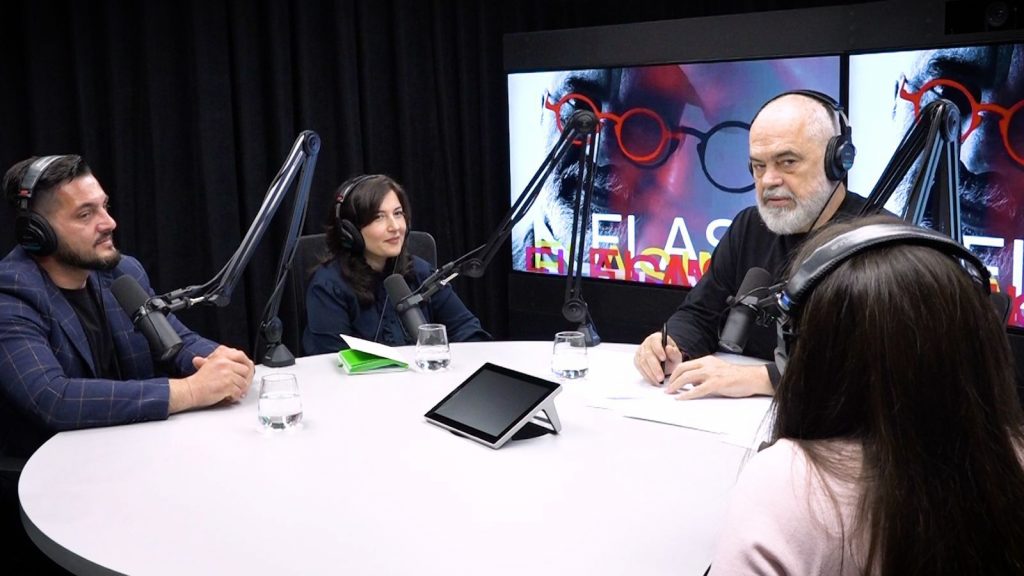
TIRANA, May 24 /ATA/ In the podcast Flasim, Prime Minister Edi Rama hosted three young guests—Fabjola, Alba, and Ervin—who, according to him, ‘come from the worlds of technology, scientific research, and innovative solutions designed to address longstanding problems and needs in innovative ways.
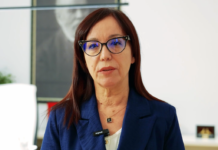
Rama said that Fabjola was introduced to him as ‘a young woman with a magic key for a material widely used worldwide—concrete.’ She explained that she has developed a technology for producing ‘self‑healing concrete’ by using industrial waste and special bacteria. Fabjola noted that her project aims both to reduce environmental pollution and to lower infrastructure maintenance costs.
She explained that the technology is based on the use of a bacterium that is activated upon contact with moisture, producing calcium and automatically sealing cracks in the concrete, thereby making the material ‘self‑healing.’ She added that the idea has received international recognition, winning awards in Finland and being ranked among the best startups in Germany, while also being registered in Albania with the aim of developing this innovative concept domestically.”
According to Fabjola, the project could move into the industrial phase with an investment of around €400,000, requiring the establishment of a small production unit for testing and on‑site application.
As she put it, ‘I am enthusiastic because we believe that, beyond achieving a breakthrough in relation to concrete, the most important accomplishment is that we are cleaning the environment. There are industrial waste materials that simply remain for years on sites, decanting and causing continuous pollution without being put to any use. Having worked for a long time in industrial enterprises, I was given the opportunity to pursue a master’s degree in Belgium.
Together with the experience of my classmates, one of my colleagues—also a co‑founder from Ghana—had knowledge about bacteria, and we discovered a highly resilient bacterium that could survive in a difficult material such as industrial waste. When cracks form in this concrete, the bacterium is released and, in the presence of moisture, produces calcium that automatically fills the fissures. In other words, we have achieved a breakthrough: self‑healing concrete. Over time, as conventional concrete degrades, this material will instead repair itself, eliminating the need for costly maintenance. We won first place in Finland as the most innovative idea of 2025 and were ranked among Europe’s top startups in Germany. After many meetings, I decided to bring this startup to my own country, Albania, where it is now registered. We are currently in the experimental phase, and we have documented and proven that it works. In fact, we even have video evidence showing a sample cracked into three pieces that, after three days in normal conditions, rejoined into a single solid block.”
Prime Minister Edi Rama stated, ‘We are fully available to further develop this initiative. I will certainly support it.
Meanwhile, Alba explained that she has put together a research platform called Match for Research.
She explained that the platform focuses on bringing together academia and industry—professionals, scientific researchers, and market experts—in order to meet the needs of Albanian companies and public institutions, which she is confident will require support in applying for international grants. She added that the platform has been backed by Startup Albania Grand, with an application submitted in 2025 under last year’s grant, and has now been in development for one year.
/m.q/a.f/sm/