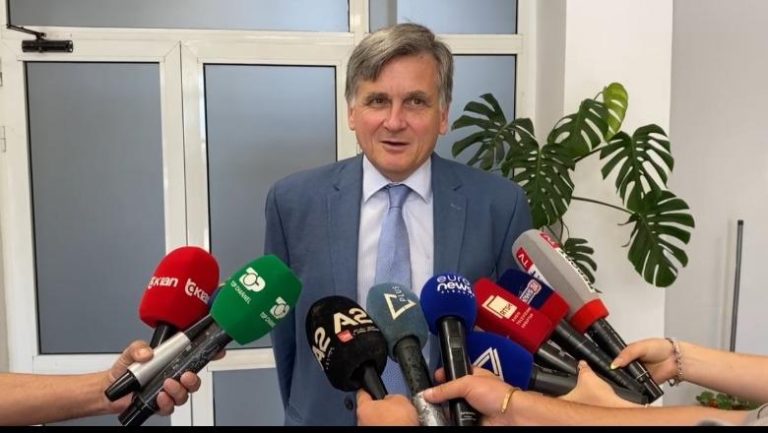
TIRANA, May 21 /ATA/ Speaking in Pogradec, the OSCE Ambassador to Albania, Michel Tarran, stated that the work of the Special Parliamentary Committee on Electoral Reform has advanced at a slow pace. Nevertheless, he welcomed the recommencement of the committee’s activity and its renewed focus on the financing of political parties.
Ambassador Tarran emphasised that the OSCE Presence in Albania has been committed from the very beginning to providing the committee with expert support, while the recommendations of ODIHR continue to constitute the basis of the electoral reform process.
He underlined that the OSCE does not seek to prescribe a specific electoral model for Albania, stressing that each state has its own system and that it is for the Albanian people themselves to decide which model they wish to implement.
With regard to the debate on the number of members of parliament, Ambassador Tarran stated that these are internal matters which must be resolved by Albanian politics.
The OSCE Presence in Albania has supported the Special Committee on Electoral Reform from the very beginning, despite slow progress and lost time. Tarran welcomed the committee’s renewed activity, particularly its focus on political party financing, which he described as vital for democratic life. He stressed that the OSCE does not intend to impose any electoral model, noting that each country has its own system and challenges. Instead, the process should be guided by ODIHR’s recommendations, issued after every election observation in Albania.
Tarran stressed that the OSCE’s role is to assist Albania in implementing ODIHR recommendations, not to impose an electoral model. He noted that the organisation’s 57 participating states each have their own systems, and it is for Albanians themselves to decide which model to adopt. Issues such as the number of MPs are internal matters, with differing arguments for fewer or more representatives, and the OSCE will not comment on such technical aspects.
Asked about the concerns of smaller parties regarding the dominance of the reform process by the larger parties, the Ambassador cited the example of the United States, which operates under a two‑party system. According to him, Albania remains in a period of democratic transition, while he added that discussions on the electoral system are processes that always take place.
Tarran highlighted that many countries operate on systems built around two major blocs or parties, citing the United States as an example where smaller parties have not succeeded, yet democracy is not questioned. He stressed that different electoral systems exist, Albania remains in democratic transition, and the country must identify the model most appropriate to its own context.
Tarran emphasised that Albania’s democratic transition is ongoing, shaped by its historical legacies, but this does not mean development has stalled. He noted that electoral systems evolve everywhere, citing France’s repeated reforms and current debates as an example. He concluded that Albania must identify the electoral model best suited to its own national context.
/m.q/j.p/sm/