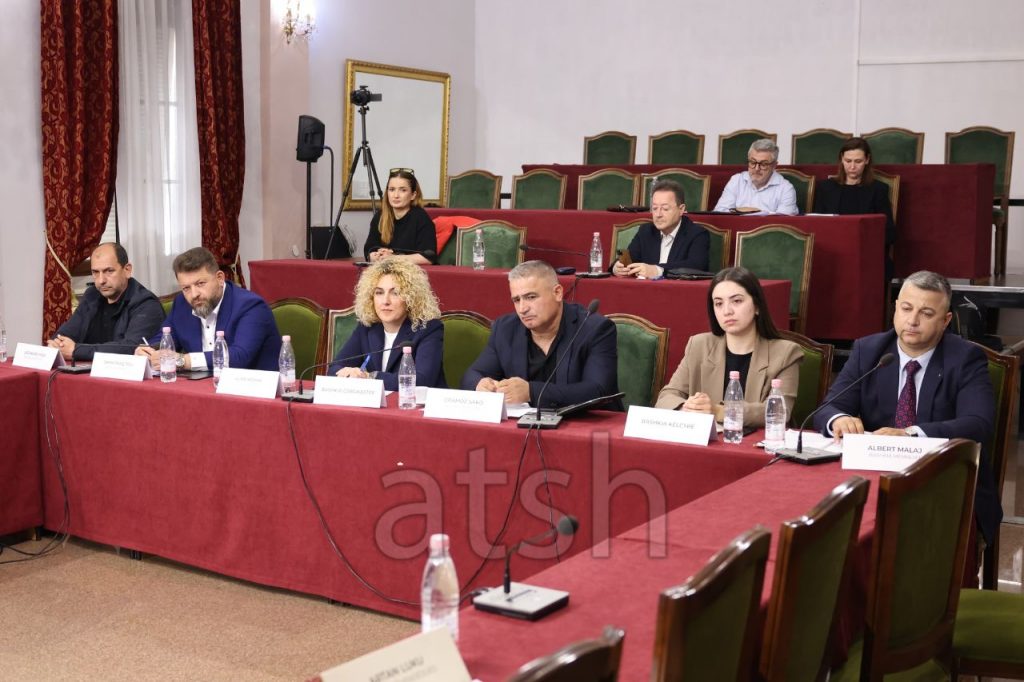
TIRANA, May 20 /ATA/ The consultation process on territorial reform proceeded today in Gjirokastër region, where local authorities and representatives of the government engaged in deliberations concerning the functioning of municipalities, their statutory competences, financial arrangements, and the potential scenarios for territorial reorganisation.
At the opening of the discussions, Minister of State for Local Government, Arbjan Mazniku, stated that the process is currently in the phase of public hearings and is focused on collecting feedback from local authorities on all aspects of the reform. He went on saying: ‘We have already undertaken consultations in three regions, which have involved extensive deliberations to explain to mayors the nature of the process. We are in a hearing phase, and the purpose is to gather as much feedback as possible on all elements of the reform — finances, territorial organisation, and other related matters.’”
According to the Minister, the consultations are intended not only to spotlight the perceptions of citizens as beneficiaries of the reform, but also to address the issues relating to competences, the delegation of functions, and the financing of local government. For his part, the Co‑Chair of the Commission on Administrative‑Territorial Reform, Democratic Party MP Luçiano Boçi, stated that the reform is focused on improving the functionality of municipalities and the quality of services delivered to citizens.
The reform we have undertaken is directed towards improving the functionality of municipalities, with particular emphasis on enhancing the quality of services provided to citizens. There are two principal actors in this process: the provider and the recipient of the service. The providers are the municipalities, whilst the recipients are the citizens. The citizen is without fault, for it is he who rightly expects that the service delivered to him should be of the highest possible quality,” Boçi said.
Local govt. representatives, for their part, raised a range of concerns regarding the effects of the 2015 territorial reform, the financial challenges faced, and the need to enhance the competences of local government. The Deputy Mayor of Gjirokastër, Artiste Koko, emphasised that territorial reform should not be regarded merely as a redrawing of the administrative map, but must also take into account the issues that arise in the exercise of functions.
“One of the challenges brought about by the reform was the amalgamation of functions from the former communes without the allocation of adequate funding to support their delivery. In certain instances, we were compelled to raise tariffs in order to perform these functions,” she stated.
Mayor of Libohovë, Leonard Hide, drew attention to the concerns of smaller communities regarding the future of municipalities and the need for greater support. He declared: ‘Citizens ask whether we shall continue to exist as municipalities or not. Despite the financial difficulties, the challenge remains the strengthening of capacities and the training of staff so as to provide a wider range of services to the community.’
Meanwhile, Dropull Mayor Dhimitraq Toli stressed that the reform process should take into account the particular characteristics of municipalities with unique features.
Mayor of Tepelenë, Gramoz Sako, stated that the debate should go beyond simply redrawing the administrative map. ‘The main problem is not whether the number of municipalities is large or small, but the insufficient powers that municipalities currently have. The reform should focus on increasing competencies and decision-making authority at the local level,’ Sako emphasized.
On the other hand, the mayor of Memaliaj, Albert Malaj, expressed opposition to scenarios that foresee merging smaller municipalities with larger ones. ‘Memaliaj Municipality is not a case for merging with another unit. Such a move would risk losing its voice and identity in decision-making, leaving the community’s needs sidelined,’ Malaj declared.
/sm/