TIRANA, April 15 /ATA/ The improvement of the legal framework against racism and hate speech, as well as its alignment with European standards, was the highlight of a high-level parliamentary dialogue held on Wednesday in the Albanian Parliament.
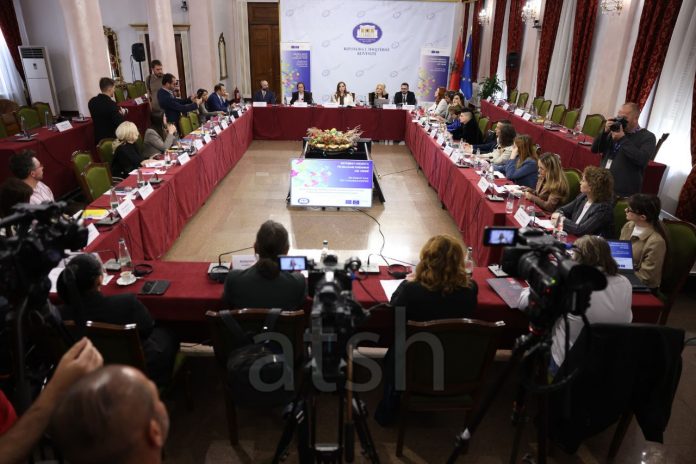
The meeting was organized by the Committee on Human Rights and Mass Media, in cooperation with the Council of Europe Office and the Delegation of the European Union to Albania, bringing together representatives of institutions, diplomacy, civil society, and field experts.
In her remarks, the representative of the Council of Europe, Gulia Re, emphasized the importance of comprehensive reforms and the need to ensure that legal changes do not remain only on paper.
“It is essential to move from the adoption of laws to implementation. The changes must be directly reflected in the improvement of citizens’ lives,” she stated.
Democratic Party Member of Parliament Jorida Tabaku described the roundtable as an important step toward initiating a structured debate grounded in a study and analysis of hate speech in Albania. She emphasized that the strengthening of the legal framework is closely tied to the European integration process, particularly Chapter 23 of the accession negotiations.
“Integration is not merely a technical process; it is political, social, and, above all, moral. It represents a contract with citizens to guarantee their rights,” Tabaku stated. She further noted that the main challenge remains the effective implementation of legislation.
“No matter how significantly the legal framework is improved, if it is not effectively implemented, the reforms will remain merely formal and will not have a tangible impact on everyday life,” she emphasized. Referring to the findings of the report, Tabaku underlined that, although progress may be highlighted on paper, in practice many fundamental rights and the issue of hate speech continue to remain concerning.
On her part, the Chair of the Committee on Human Rights and Mass Media, Iris Luarasi, focused on the concrete experience of discrimination and violence, particularly in the digital space. She highlighted the adoption of the gender equality law, describing it as a positive step, but stressed that significant challenges remain in its implementation.
“Online violence is not merely virtual; it harms our families and erodes the sense of security, particularly among children. It seeks not only to inflict harm but also to silence our voices,” Luarasi stated. She went on saying that disinformation feeds prejudice and prejudice fuels hate speech.
“Disinformation feeds prejudice, and prejudice, in turn, leads to threats,” she emphasized.
The representative of the European Union Delegation to Albania, Andre Rizzo, stated that the discussion is taking place in a key institution of democracy.
“We are in the Parliament of Albania, at the heart of democratic governance, where fundamental rights are translated into laws and standards for a more inclusive society,” he said.
Rizzo emphasized that racism and hate speech inflict real harm on society. “They are not abstract concepts. They cause real harm, erode social cohesion, and undermine fundamental human rights,” he stated.
The EU representative in our country recalled that human rights are one of the fundamental principles of the European Union and are enshrined in the European Convention on Human Rights, adding that they are essential within Chapter 23 of the accession negotiations.
Meanwhile, the Ombudsman, Endri Shabani, drew attention to concrete findings from the study, according to which 97% of Albanian citizens are familiar with the term “hate speech.”
Shabani emphasised that there remains a clear conflation between hate speech and ordinary insults. “Compliance with Council of Europe standards is not merely a formality, but a dividing line between a democratic society and a violent one,” he said.
“Statistics indicate that 97% of Albanian citizens are familiar with the term ‘hate speech’, which is a positive finding. However, it is also evident that the vast majority do not distinguish between hate speech and ordinary insult. Compliance with the standards set out in the Council of Europe framework for the protection of human rights is not merely a procedural requirement, but a red line separating a civilised society from a violent one. Our role, as the Office of the Ombudsman, is not simply to act as an institution that registers complaints, but to serve as a genuine guarantor of human rights,” Shabani said.
On the other hand, Dorian Matlia, head of a civil society organisation, presented the regional findings of the study, stressing that all countries have constitutional safeguards of non-discrimination.
According to him, these safeguards are broadly aligned with the EU acquis and Council of Europe instruments, but the main challenges relate to their implementation.
The event included the presentation of findings from a comparative analysis of anti-racism policies in EU accession countries, as well as the study “Beyond Definitions – A Call to Action against Hate Speech in Albania.” The discussions focused on challenges related to institutional coordination, data collection, public awareness, and implementation, as well as concrete measures to address these gaps.
The dialogue concluded with an exchange of views on priorities for strengthening Albania’s response to racism and hate speech, including the role of Parliament in advancing legislative reforms in line with European standards.
/sm/