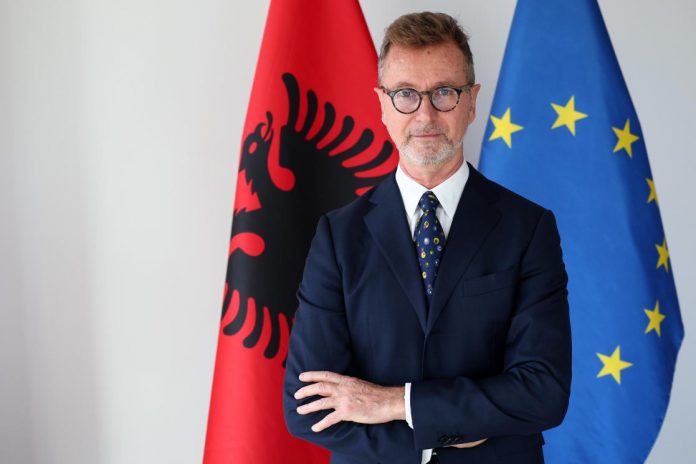
TIRANA, Feb 20 /ATA/ In an exclusive interview with Deutsche Welle, the European Union Ambassador to Albania, Silvio Gonzato, commended the work of SPAK, one of the justice institutions in which the European Union has made the most significant investments in Albania.
“We aim for the accession process to be genuinely a state-building process, one that fosters the creation of stable, strong, and independent institutions. This is what Albania needs,” stated the EU Ambassador to Albania, Silvio Gonzato.
DW: Mr. Ambassador, how do you assess the current situation of Albania on its path to EU integration?
Silvio Gonzato, Ambassador of the EU Delegation: I believe Albania has made exceptional progress, and I consider myself fortunate to have witnessed this development. In fact, I would say I have been more than just a witness, as I believe we also played a significant role in the successful conclusion of the review process. When the European Commission and the government assessed what needed to be done for Albania to qualify for EU membership, we were able, within 18 months, to open all the chapters of the EU acquis. This was, without a doubt, an extraordinary achievement.
We are now at a crucial turning point. This is the moment when we must assess whether Albania has made substantial and measurable progress in several key areas, which are regarded as “Fundamentals” within the European Union. These areas are central to the EU’s core values and encompass issues such as fundamental rights—specifically women’s and children’s rights—as well as the rule of law and the justice system. This also includes the consolidation of the 2016 justice reform, the fight against corruption and organized crime, and the adherence to democratic standards.
This is indeed a critical and highly significant phase, during which the Commission will evaluate whether the legislation, regulations, and measures implemented by the government in recent months show tangible progress in all of these areas. We will present a report to the member states, and it will then be up to the 27 member states to agree with the Commission’s assessment. If they do so, we can proceed with the closing of chapters, which is absolutely vital if we are to maintain the ambitious timeline set by the Albanian government. This is a timeline that we are committed to supporting. It is ambitious, and it is the objective they have set, but we are determined to be supportive in this process.
In this context, it is also important to emphasize one point: while we are working under significant pressure, I believe it is crucial that we do not compromise transparency and inclusivity. The adoption of laws and measures must be based on an open debate, where people understand what is being done and why it is being done. This debate must be constructive, allowing all elements of society to contribute to it.
DW: And on this long path to membership, in one of the recent activities of the Albanian government, in which you also participated, regarding the funding of social welfare, which concerned Albania’s access to 100 million euros from EU funds dedicated to social inclusion projects, you called for greater transparency with EU funds. Why?
Ambassador Gonzato: If you look at the various projects we are undertaking, we are investing approximately 100 million euros to facilitate the transition, from education to the labor market, which is crucial for young people. I recall that for me, one of the most stressful periods of my life was when I completed my university studies and had to begin searching for a job. It became clear that education alone does not necessarily equip you with the tools required to be fully prepared for the job market.
And we do this with various actors and partners, which may include NGOs, local government, and ministries. However, what is most important is not only offering benefits to Albanian citizens but doing so in the right manner.
As I bear financial responsibility, overseeing the management of European Union taxpayers’ funds, it is crucial that these resources are used with full transparency and accountability. It is vital that Albanian authorities establish the necessary mechanisms to ensure this level of transparency. Upon Albania’s accession to the European Union, a significant portion of the EU funds, allocated to demonstrate solidarity with its member states, will be delegated to local authorities and managed at the local level. Therefore, local authorities must provide assurances that they are adhering to EU financial regulations. The project selection process, for example, must be objective, based on clear and transparent criteria, and free from any personal or political influence. This level of transparency and rigor in procedures is essential for the proper management of EU funds.
DW: Mr. Ambassador, in relation to your findings, I would like to address the issue of IPARD funding concerning agriculture. What is the status of these frozen funds?
Ambassador Gonzato: At this stage, negotiations are still ongoing between Brussels and Tirana, between the European Commission and the Albanian government. The Albanian government has engaged an external auditor to conduct a comprehensive audit. The auditors are reviewing which grants have been allocated, who has received the grants, who has received payments, and are verifying the compliance of these payments. They are also evaluating whether the funds have been spent appropriately and are conducting a detailed accounting of these resources.
They have also evaluated the measures taken by the government after the incident to determine whether they are adequate to ensure the protective mechanisms we seek. The European Union is committed to continuing its support for Albanian farmers. I consider this a crucial part of our assistance to Albania. The agricultural sector requires all the help it can get to become competitive, as once Albania becomes an EU member, it will need to compete with EU farmers.
However, we cannot proceed unless we have the necessary guarantees that the funds are being properly managed, and we expect the Albanian government to take this issue seriously. Consequently, the ball is in the court of the Albanian government to evaluate this audit report and provide assurances to Brussels that the measures they have implemented are sufficient for us to resume financial assistance under the IPARD framework.
DW: I would like to ask you about the justice reform in Albania, which is one of the EU’s largest investments. What is your assessment of the current work of SPAK?
Ambassador Gonzato: I believe SPAK is doing extremely important work. If you speak with the member states, you will see that they highly value the work SPAK has done, particularly in the fight against organized crime, including dismantling criminal gangs that operate not only in Albania but also within the EU, especially in several EU member states.
They highly appreciate the work SPAK is doing in cooperation with their law enforcement agencies, as well as with EUROPOL and EUROJUST, in tracking these criminal gangs, monitoring their activities, and fighting organized crime. This has become an increasing concern among EU member states. For instance, the role played by Albanian networks in international drug trafficking is impacting the security of certain cities in Northern Europe. Therefore, this work is highly valued.
Secondly, the fight against organized crime and corruption is one of the key elements in assessing Albania’s readiness to join the European Union. This lies at the heart of the fundamental process I mentioned earlier. Thus, we see SPAK as an institution that plays a central role in this regard—fighting corruption and impunity at the political level. We do not see any obstacles to the prosecution and investigation of high-ranking politicians. I believe this is an important aspect in evaluating Albania’s readiness, and it is something we highly value and support. Therefore, the overall assessment is certainly positive.
We believe that additional efforts are required on the preventive front in the fight against corruption and organized crime. For this reason, as part of the “Fundamentals,” one of the measures recently adopted by Albania, as part of its initial steps in the accession process, was the criminalization of money laundering. This will serve as a significant means to financially undermine some of the illegal activities conducted by these networks. Consequently, we expect the government to not only adopt strategies for corruption prevention but also to implement concrete measures in this regard.
DW: However, the strategy being pursued by the Albanian government involves amending legislation to suspend requests for the removal of immunity by SPAK. How do you assess these efforts by the Albanian government?
Ambassador Gonzato: We are closely monitoring the proposed amendment to the Criminal Procedure Code, which concerns the provision enabling a court to suspend a public official who is under investigation. Matters pertaining to the rule of law and the administration of justice are of paramount importance to us, and we assess them not only in Albania but across all candidate countries. The integrity of the judicial system is central to the obligations and requirements of a country within the framework of accession negotiations. Therefore, we expect any legislative initiative to align with the government’s overarching commitments to combating corruption and organized crime. We will continue to closely scrutinize how this impacts these critical areas.
Ambassador Gonzato: We view SPAK as an institution that plays a fundamental role in this regard—in the fight against corruption, in addressing impunity at the political level, and we see no obstacle to the summoning and investigation of high-ranking politicians.
DW: Mr. Berisha, the leader of the opposition, has consistently criticized SPAK for its work, and now, the Albanian government’s current initiative. Do you believe that Mr. Berisha and Mr. Rama are attempting to undermine SPAK’s work?
Ambassador Gonzato: I will not speculate on this matter. What is certain is that we have consistently expressed our concerns in our annual reports regarding attacks on the judiciary. We have stated that, in fact, the judiciary and the judicial system have become more resilient to these attacks, partly because it is an independent system. However, we remain concerned about these attacks from politicians and political interference. It is something that should not continue.
DW: And a final question, what is your message to the political class in Albania regarding EU membership?
Ambassador Gonzato: I believe the visit by the members of the European Parliament’s Foreign Affairs Committee was extremely significant for me, as it demonstrates that individuals with very different political backgrounds, coming from various member states with diverse viewpoints, can work together. The message they conveyed to their counterparts was quite unified, which, in fact, surprised me, as I expected greater divergence of opinions on this matter.
It was very positive; it was a message emphasizing the need to take this seriously, to lead by example, particularly in areas such as the fight against organized crime and corruption. Additionally, it stressed the importance of ensuring that, on one hand, room is provided for the opposition, meaning the majority should allow the opposition to play its role, and on the other hand, the opposition should engage constructively. Therefore, I believe this was a very strong message from politicians to politicians, and I can only reiterate it.
/a.f/sm/