TIRANA, Feb 18 /ATA/ Minister of Economy and Innovation, Delina Ibrahimaj, stated today that Corridor VIII is far more than a transport project; it is a key instrument for European integration, economic development, and the strengthening of regional stability.
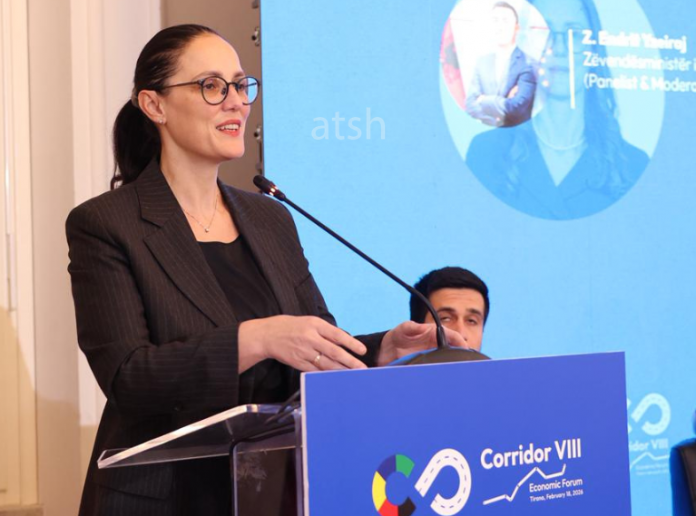
Ibrahimaj participated in the Economic Forum on Corridor VIII, held as part of the VIII Corridor Ministerial, under the theme: “Corridor VIII at Europe’s Strategic Moment: Connectivity, Resilience, and Shared Prosperity through Integration.”
Addressing ministers, representatives of international institutions, financial partners, and the business community, Minister Ibrahimaj underscored that physical and economic connectivity is vital for boosting competitiveness, safeguarding security, and laying a foundation for shared prosperity.
“Corridor VIII extends far beyond a mere transport project; I can affirm with confidence that it constitutes a key instrument for European integration, economic development, and the strengthening of regional stability. In light of European Union enlargement and the evolving strategic priorities of Europe, physical and economic connectivity is essential for enhancing competitiveness, ensuring security, and serving as the cornerstone of shared prosperity,” Ibrahimaj said.
She emphasized that the repositioning of Corridor VIII within the TEN-T framework is a critical issue that requires shifting from political commitments to European priorities, with well-planned, sustainably financed, and efficiently implemented projects.
“The repositioning of Corridor VIII within the TEN-T framework is one of the most fundamental issues. It entails shifting from political commitments to actionable European priorities, through projects that are well-planned, sustainably financed, and efficiently implemented,” the Minister stated.
Minister Ibrahimaj highlighted Albania’s strategic potential as an east-west hub and Adriatic gateway, emphasizing the development of ports, road networks, and rail infrastructure.
According to her, the enhancement of port and rail transport logistics can position the country as an entry point for Southeast European markets into Western Europe, reducing logistical costs for businesses and improving access to European markets.
“Our geographic position places us at a key junction connecting the Adriatic, the Balkans, and the Black Sea. Through the development of ports, road networks, and rail infrastructure, Albania can confidently become a critical transit and distribution hub for the region and beyond,” she emphasized.
The Minister added that the project is fully aligned with the National Strategy for Development and Integration Albania 2030, the Economic and Investment Plan for the Western Balkans, and the commitments of the Berlin Process.
She highlighted the project as essential for facilitating trade, now entering its second phase, financed by the World Bank with support from the European Union.
“The Minister called for a shift from strategic planning to implementation, from vision to concrete investment, and from declarations to tangible outcomes for Albanian citizens and businesses.”
/r.e/a.f/sm/