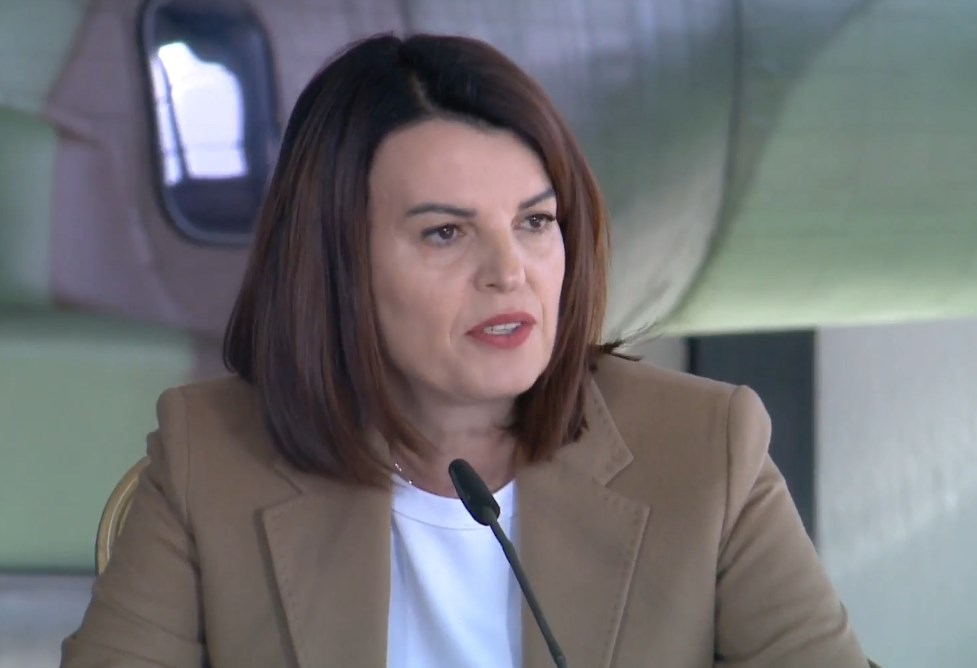
TIRANA, Oct 4 /ATA/ Interior Minister Albana Koçiu stated today that firefighting services, field coordinators, and a range of Civil Protection institutions will be integrated under a single command.
Speaking at the event in Farkë marking a new chapter in civil protection through the transformation and modernization of the Fire Brigade—attended by Prime Minister Edi Rama, Defense Minister Pirro Vengu, and Minister of State for Local Government Ervin Demo—Koçiu noted, “Last summer highlighted a stark contrast between the personal dedication and heroism of each firefighting unit, including the hundreds of firefighters who battled with fires across the country, and the way our national anti-fire preparedness is organized.”
“This gap has been gradually closing over the years, as the data clearly show. Investments in the Firefighting Service over the past decade have led to a doubling of both fire trucks and personnel. While there were 739 employees dedicated to the service in 2016, today the number exceeds 1,400 firefighters,” she added.
“The same goes for our fire truck fleet, which has increased from 100 to 185 vehicles, some of the most advanced in our inventory. We have developed a service that functions efficiently, particularly in community-based operations, addressing daily incidents such as urban fires, floods, and search-and-rescue missions,” Koçiu remarked.
Minister Koçiu stated that, regarding the management of national-level emergencies and large-scale fires, the entire structure needs to be elevated to a new level.
“Currently, we have a structure that, to be honest, is fragmented, with a complex hierarchy, unclear responsibilities, and overlapping duties at times,” Koçiu noted.
Minister Koçiu noted that multiple institutions—including fire and rescue services, the National Civil Protection Agency, municipalities, prefectures, the Armed Forces, and field coordinators—are involved in managing civil emergencies.
Koçiu stressed the importance of unifying all emergency management institutions under a single command for effective coordination.
Koçiu also mentioned the State Police dispatcher system and the Medical Emergency service, a unified command should be able to coordinate all actions as a single entity and optimize inter-institutional and international cooperation.
“It must maximize the efficient use of funds and effectively expand coverage across the entire territory. It is especially important to recognize that, while the firefighting service is present in all municipalities, larger municipalities have greater capacities. A fire in a forest near Tirana can be prevented and extinguished much more easily than a fire in smaller municipalities such as Pustec, Delvina, Leskovik, or Finiq, which have more limited resources,” Koçiu explained.
Koçiu emphasized the need to optimize firefighting capacities and announced plans to remodel the service according to international best practices, including reviewing the legal framework and establishing a Centralized Command aligned with European protocols and other emergency services.
Koçiu highlighted that “another crucial and irreplaceable aspect is the people working in this service.”
She added, “Firefighters will be placed at the center of the transformation and future vision of this service, which has the potential to become a model service. We will standardize recruitment procedures, starting with clear admission criteria. We plan to replicate successful platforms such as ‘Teachers for Albania’ and ‘Doctors and Nurses for Albania,’ applying rigorous selection processes, periodic training analysis, recruitment evaluations, and assessments of physical, psychological, and professional skills.”
Koçiu also emphasized that a **National Firefighter Training Center** will be established to ensure continuous on-the-job training.
“Under a national plan built on established curricula and aligned with European standards, all firefighters will undergo regular, continuous training in the latest fire-fighting techniques and methods. This program will be complemented by incentive schemes, offering additional financial benefits and clear pathways for career advancement within the service,” she stated.
Koçiu further highlighted the importance of ongoing awareness and education campaigns, beginning in schools and extending across communities and local institutions, to promote fire safety and protection.
“Innovation and technology will accompany us and help ensure timely reporting of any fire-related incidents or issues closely linked to health and safety. These are just some of the objectives we have set for this term. Truly, this is a mandate aligned with Europe and European standards, which explains why we have hit the ground running. Our goal is to build a Firefighting Service grounded in knowledge, technology, international and inter-institutional cooperation, and increasingly qualified personnel,” Koçiu stated, emphasizing that this is a vital service staffed by motivated and respected professionals who serve not only during emergencies but every day of the year, 24/7.
/sm/