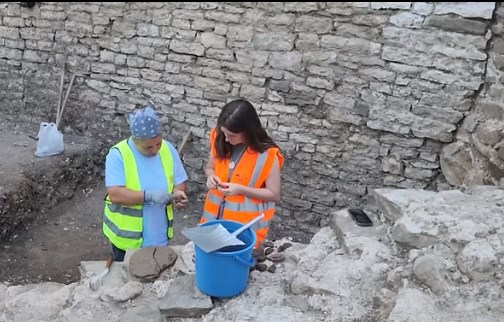
TIRANA, July 25 /ATA/ – Archaeologists have discovered the skeletal remains of a man and a horse at Gjirokastër Castle, southern Albania, embedded in a wall dating back to Late Antiquity, possibly the 6th century AD, which was later damaged and repurposed as a foundation for medieval constructions.
Pamela Llapaj, the excavation lead, explained that a Late Antiquity wall – one of the earliest known fortifications – had been dismantled and reused in the Middle Ages.
“In addition to ceramic findings, we uncovered a human skeleton positioned inside the wall, as well as a horse skeleton,” she said.
The unusual burial – thought to be symbolic or ritualistic – suggests the man may have been a military figure. The site, once part of early fortifications, was later repurposed in medieval times.
She noted that while the current excavation phase is coming to a close, the findings are significant. “We are uncovering older foundations and layers of habitation and fortification that were previously undocumented. Future studies may provide deeper insights into these lesser-known periods of our history,” Llapaj added.
Researchers say the find opens new questions about ancient burial customs and sheds light on a little-known chapter of Albanian history. Further analysis will determine more about the individuals and the context of their interment.
/m.m/j.p/u.sh/