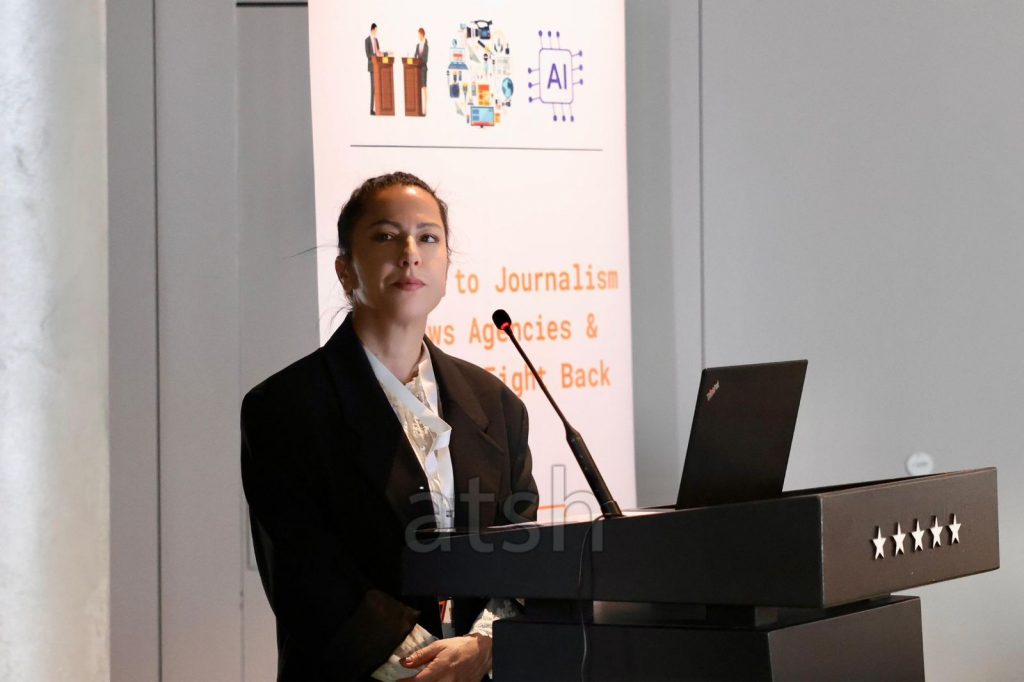
TIRANA, May 15/ATA/ For the first time in its history, the Albanian Telegraphic Agency hosts in Albania the Spring Conference of the CEOs of the European Alliance News Agencies (EANA), in which ATA is a full member. The conference on the topic “Threats to Journalism & News Agencies & Tools to Fight Back” is held in the venues of the Hotel Plazza in Tirana today.
ATA Director General Valbona Zhupa and Associated Press Europe and Africa News Director James Jordan opened the proceedings of the Conference, which was attended by leaders and representatives from 32 European news agencies from France, Germany, Italy, Greece, Finland, Croatia, Ukraine, Spain, Turkey, Serbia, Czech Republic, Azerbaijan, Kosovo, Bosnia and Herzegovina, Sweden, Norway, Bulgaria and others.
At the start of the conference, there was played a promotional video for Albania as a tourist destination.
In her remarks, ATA Director General Valbona Zhupa said the following:
“Honorable colleagues,
Dear friends,
It is a great honor for me to have the opportunity to welcome you to Tirana.
Representatives of news agencies here today constitute the core of trustworthy information on our continent and beyond.
Journalism and news agencies today face a more challenging environment than ever before; from misinformation circulating instantly to economic pressure, from the trust decline to the dominance of global news platforms, each and every one in this very chamber know that the main mission of the media – informing in accordance with the core principles of humanity – is increasingly being challenged on daily basis. Indeed, what unites us is precisely the fact that no serious agency can cope with reality alone.
We often remain in the shadows, albeit we are the first to report, but the last to be cited when the news story is delivered. And yet, without our work, free media and quality information would not exist as we know it today. However, the seriousness of the facts, accuracy, the speed at which news spreads, the accuracy and reliability of our sources still guide the rest of the media, where different interests are in play and step in even to misuse information and divert its content.
That is why now, more than ever, we need to jointly think about: not only about the external challenges, but also how to defend ourselves, how to further improve, and how to continue being important to our public.
These are challenges we can’t ignore.
Many of the challenges affecting journalism as a whole affect the news agencies too – perhaps harder than any other media types.
First and foremost, misinformation, one of the biggest wounds of modern times.
We live in an era where false information spreads much faster than the truth and, in many cases, false information is easily believed, without verifying its sources. In an overloaded market with anonymous and unverified sources, telling the difference between factual and opinion statements is diminishing, while real information is being ignored.
This is a challenge facing anyone who takes the truth seriously. And we do. That is why verifying information and transparency on our sources stand at the core of our work.
Second, new distribution models and modules.
Large digital websites distribute news stories produced by news agencies without providing due compensation. Moreover, these algorithms often opt for emotional, conflicting content or simply tend to get a scoop, understandably not necessarily accurate or verified. In this aspect, we need a common voice and shared solutions. Some countries have begun to negotiate new models. We need to be part of this discussion and address real issues.
Third, pressure – be it hard or soft – on editorial policy.
In many countries, pressure is not exerted directly as classic censorship. It is exerted in more refined ways. And this pressure is as real as the direct one, as it is linked to interests of certain interest groups. There is a challenge to include the moral canons of journalists and above all respect for the journalist’s order. Incorporating moral integrity of journalists and, most importantly, respecting the Order of Journalists, remains a challenge.
Fourth, trust.
Perhaps the biggest challenge. For decades, the public has believed that the stories reported by the news agencies are accurate and flawless. Today, this public trust has decreased, not because of our direct responsibility, but because of a common trend with every being questioned. For this trust to be restored it is insufficient for us to be only fair – we must also communicate better, be more transparent and more open to our public. But, we have to be self-critical, because this is the way to grow trust in us.
Ways to deal with challenges
All these challenges are familiar to us but our response remains irrelevant. It is up to us not just to respond, but also to find innovative ways to cope with the current issues through quality journalism. And I am confident we have some powerful tools we need to use more willfully.
First and foremost, cooperation among us.
Gatherings like this are more than a formality; they represent a platform to exchange ideas and absorb experiences from the most advanced ones. They are also seen as an opportunity to share experiences, build joint projects, and create a truly European network of news agencies that assist one another in terms of technology, training and fact-checking.
Second, technology modernization.
We can’t fall behind. We need to invest in our platforms, in artificial intelligence to detect fake news, in building more efficient content management systems, and applications that make our news stories more accessible for the ordinary citizens.
We should ask our authorities to be more aware that the modernization of our institutions would be translated into the progress of our states.
Third, increasing accessibility of the news agencies.
We need to be more present in the public debate, not only through the content we produce, but also by educating the public about our role. Many people still are unaware of the news they read in the media or listen to the radio come from a news agency. This has to change, but we also have to exercise our authority so that our news is a reference for institutions, the public and especially for the bodies that require impartiality and information professionalism.
As an epilogue: It is time for wise actions
Dear colleagues,
These are not easy times for journalism. Yet they are a time of great historical weight. Because it is at such times that the importance of the hard work we do for the public is valued.
We can’t afford to be passive or nostalgic. But we have the power to be smart, committed and united. In this battle, there are no longer peripheral countries or large centers. Every responsible voice matters.
I strongly believe that if we maintain ethics and respect good journalism rules, increase quality and strengthen cooperation – news agencies will not only be significant, but also irreplaceable and quality journalism will know how to survive and cope with any crisis. As it has always done.
Thank you for being here.
Gratitude for your work.”