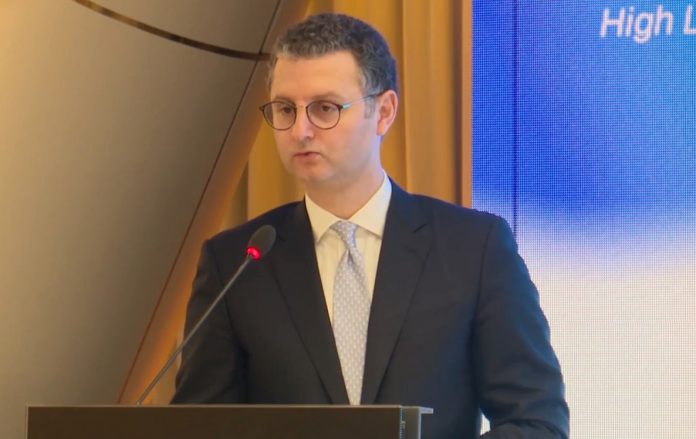
TIRANA, November 8/ATA/ Minister of Finance and Economy Ervin Mete stated today that the Albanian government has taken concrete measures in context of the Berlin Process commitments.
During the proceedings of the two-day conference on Trade Facilitation, organized by the General Directorate of Customs, Mete stated that the Berlin Process is a good opportunity to fulfill the common goals for economic integration and development of the Balkan region.
For Minister Mete, the harmonization of customs procedures with those of the European common market is of priority importance.
“The progress achieved at the political level through the removal of customs tariffs between the European Union and the countries of the Balkans and between the countries of our region through free trade agreements, Stabilization-Association and CEFTA, is being complemented by technical measures for the removal of non-tariff barriers, creation of common “One Stop Shop” control points, mutual recognition of Authorized Economic Operators, as well as through an integrated transit system”, he said.
In this regard, Mete said that the Ministry of Finance and Economy has supported the idea for the second phase of the World Bank’s project for Trade and Transport Facilitation. This proposal, according to him, requires the undertaking of a series of measures, as well as other initiatives, such as blue lanes, green lanes, etc.
“The example of the ‘One Stop Shop’ between Albania and Kosovo, Montenegro and from July 2023 also with North Macedonia, are concrete models of implementation of how time has been halved and costs have been reduced for economic operators between the countries of the region. Therefore, this conference is a good opportunity to engage the other customs of the Western Balkans to conclude similar agreements with their neighboring EU member states”, he emphasized.
The minister said that it is about the common European market, with more than 450 million consumers, where 85% of Western Balkan businesses believe that their products, goods and services can not only survive, but also compete with what the 27 EU countries currently have to offer.
On the other hand, Mete said that digitalized services have significantly reduced physical contacts with the customs administration. Today, he said, 34 services are offered electronically through the e-Albania government portal, while work is underway to implement 21 other services.
Mete further said that digitization is enabling businesses to faster commerce.
He also focused on the work done by the Albanian government for “paperless” trade./p.s./