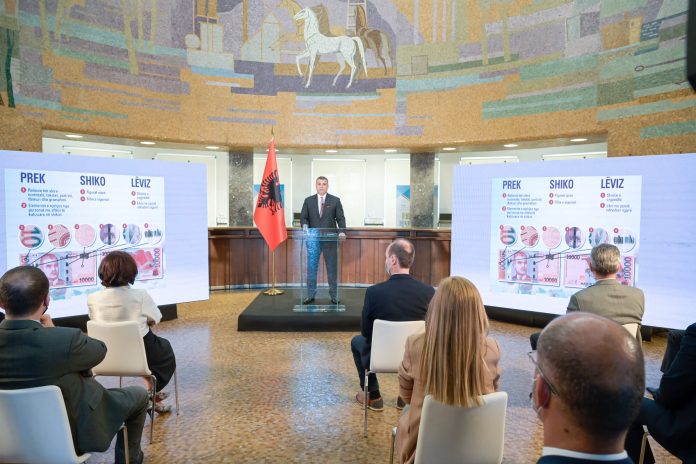
TIRANA, Nov 1 /ATA/ – Governor of the Bank of Albania Gent Sejko told a press conference on Wednesday that Albania’s economic activity is expected to maintain an upward trend over the medium-term horizon, helping the increase in employment and wages, in addition to supporting the soundness of the financial balance sheets of enterprises and households.
According to Sejko, the inflation rate is expected to gradually decline over the course of next year and return to the central bank’s target by mid-2024.
Albania’s central bank notes that fall in inflation over 2023 was mostly driven by the fall in imported inflation.
“This trend reflects the overall stabilisation of commodity prices in international markets, the decline of inflation in our trading partners, as well as the appreciation of the lek exchange rate in the last two years. In parallel, domestic inflationary pressures have also been decreasing, although they still remain relatively high and stable. Against this backdrop, the pace of inflation’s decline decelerated in the third quarter, while core inflation continues to remain above the target,” governor Sejko told a press conference after a meeting of the Supervisory Council on the quarterly monetary policy review.
Wages in the private sector increased by 15% in the second quarter, the unemployment rate stands close to historical lows, while businesses report difficulties in providing labour force. This dynamic suggests that – although declining – domestic inflationary pressures are not yet in line with our price stability objective,” Sejko added.
According to him, in macroeconomic terms, growth was fuelled also by the upswing in external demand across certain segments of Albanian exports, the sound balance sheets of private sector, the improved confidence in both enterprises and consumers, and the still simulating monetary and financial environment.”
Central bank governor underlined that Albanian economy keeps pursuing an upward growth trend.
“The volume of economic activity grew by 3.2% in the second quarter, marking an improvement compared to the previous period. Available indirect data suggest that this growth trajectory has continued in the third quarter as well. The expansion in both consumption and private investments, coupled with the increase in income from tourism underpinned the economic growth. The latter is reflected in the expanded activity in the sectors of services and construction, while the performance across the other sectors of economy was weaker,” he said.
Sejko noted that the central bank’s projections suggest that the main indicators of the country’s domestic and external balances, the soundness of the banking sector; public debt and the foreign debt of Albania will remain stable or will be improving.
/r.e/u.sh/