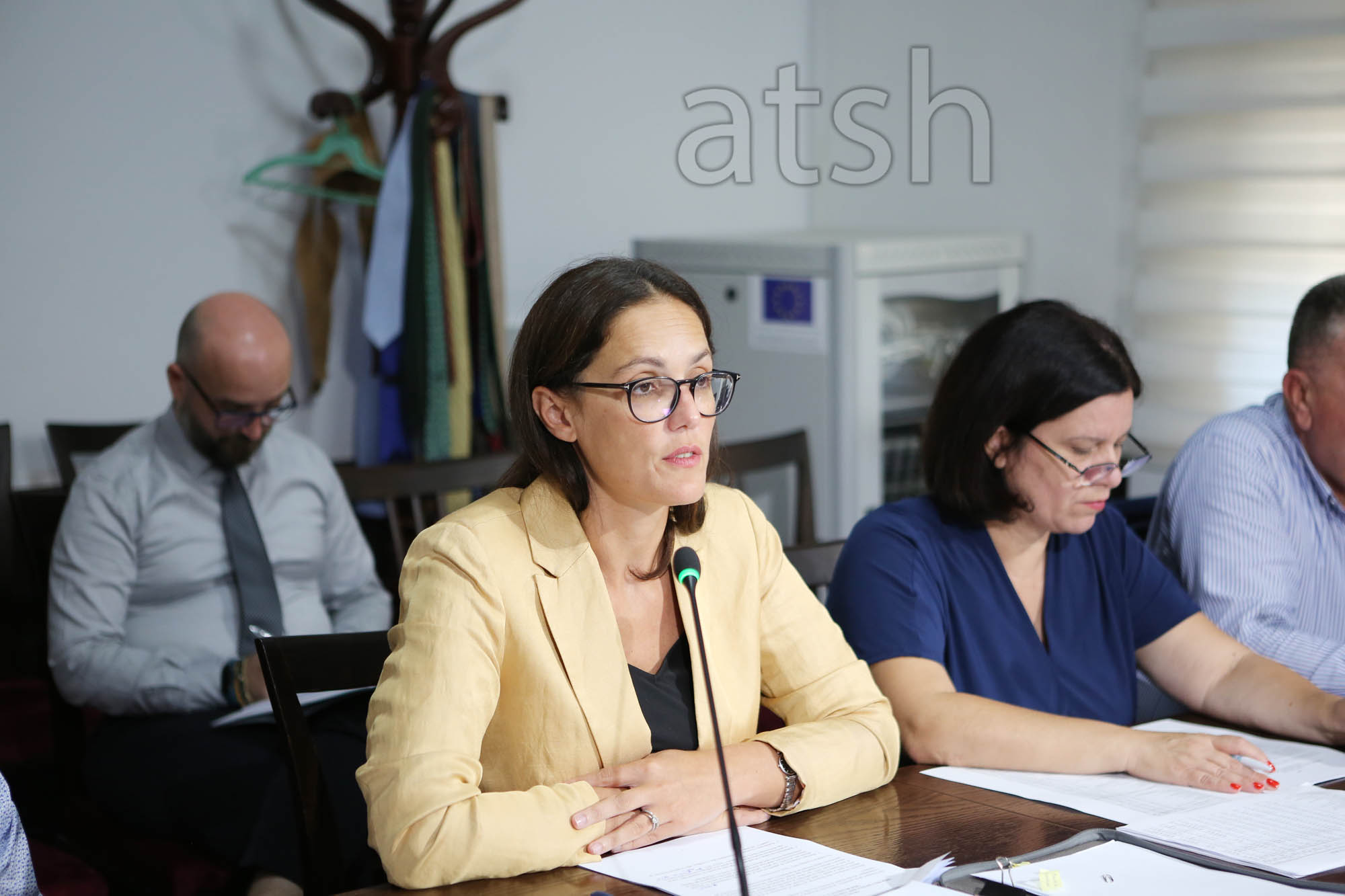
TIRANA, September 6 /ATA/ Minister of Finance and Economy Delina Ibrahimaj presented today to the Parliamentary Committee of Economy and Finance the normative act for the review of the 2022 budget.
The minister stated today that the revision of the budget has as its main goal extension of the funding of the first aid package for consumers with the aim of further coping with the consequences of the increase in consumer prices, through the re-allocation of a contingency fund for the “Resistance Social Package ” to the consequences of the crisis, at a cost of ALL 6.1 billion.
“The proposed changes will serve to ensure until the end of 2022 the stability of the key macro-fiscal parameters, in addition to the orientation of financial resources towards support of the most vulnerable layers and priority policies”, said Ibrahimaj.
Through the intervention, said Ibrahimaj, the general expenses increase by about 13 billion ALL, which after that, reach the level of 660.7 billion ALL, from 647.7 billion ALL.
“It enables an increase in total expenses by about 13 billion ALL, mainly to cushion the impact of prices. More specifically, the funds have been allocated for ad-hoc packages of social assistance to ease the impact of price increases, of course on the most needy sections of society. Funds have been allocated to partially compensate additional costs in the main inputs of public investments, the continuation of which is quite important for keeping the economy vital, both in the short term and in the medium term”, said the minister.
The minister also informed that a plan is being drawn up, which aims at a more stable medium-term support, given that the crisis is expected to last.
“Our focus is on pensioners and people with disabilities, where our challenge remains to cope with the increase in the price of energy”, stated Ibrahimaj.
“From the perspective of macroeconomic parameters, this normative act foresees a real economic growth of 3.2%. Through this normative act, the budget deficit and net internal borrowing are reduced by 17 billion ALL, reducing it to 84 billion ALL from the current 101 billion ALL. Consequently, as a percentage of GDP, this revised level of the deficit decreases to the level of 4.2%, from the 4.5% that resulted in 2021”, said the minister. /j.p/p.s./