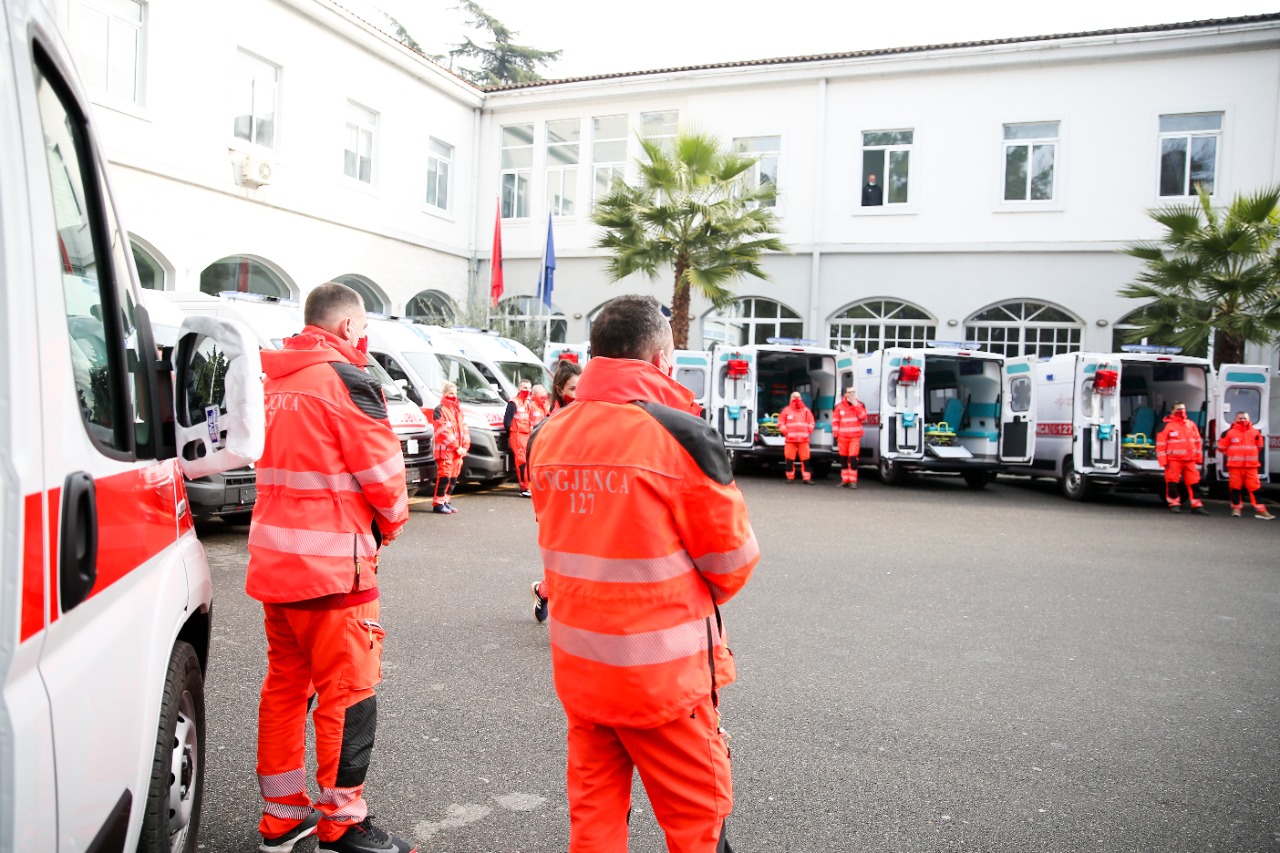
TIRANA, Jan 10 /ATA/ – The National Health Emergency Service keeps increasingly strengthening thanks to an investment drive in equipment and new technology. A total of 20 brand new ambulances fully-equipped with the latest technology and fitted to deal with emergency and trauma situations add to the National Emergency Service’s fleet to allow healthcare emergency service and paramedics deliver real-time adequate service to anyone needing emergent health care amid the pandemic situation all over Albania. The latest investment worth of 1.4 million euros provides for new ambulance vehicles best-equipped with live-saving technology that serve not only to transport a patient, but also provide all the needed care and life-saving procedures before arriving at a hospital centre.
Prime Minister Edi Rama visited the Trauma Hospital Centre, which is being reconstructed under a project designed to further expand the facility’s capacities and build contemporary premises in terms of health care delivery.
The Minister of Health and Social Protection Ogerta Manastirliu said that upgrading the capacities of the National Medical Emergency fleet with new ambulance cars will help the paramedics to deliver best and real-time care services to any patient throughout territory of the country. “It is a 1.4 million euro worth investment. A total of new ambulances fully fitted with all life-saving equipment have been provided as part of the effort to further upgrade the National Medical Emergency Service and best respond and cope with the Covid-19 pandemic situation. Hospital structures and medical teams throughout the country, under the coordination of the National Medical Emergency Service, carried out more than 140,000 missions in 2021. Around 50% of the missions were conducted in Tirana and that’s why a good part of the new fleet will be deployed in Tirana. A total of 15 ambulance posts or locations, from 12 previously, will now be available to deliver best service, and a mini-fleet for the gravest emergency cases. More than 100 new ambulance cars have been added to the medical emergency fleet in the last few years,” Health Minister Manastirliu said.
Meanwhile, the Director General of the National Medical Emergency Centre, Skender Brataj explained that the new ambulance cars have been fitted with any required equipment to ensure safe transport of the patients to hospital. “What is specific about these ambulances is that they also involve a mechanical ventilator to allow for transportation of any intubated patient from any corner of Albania. The equipment also include monitor/defibrillator, infusion pumps, a portable suction unit, airway management devices and emergency drugs. They are also fit with two 10-liter medical gas cylinders and two smaller two-litre cylinders, which can provide supply autonomously for 16 hours. We no longer face oxygen transmission problems especially at this stage of the pandemic. These are equipment we now find installed in every ambulance. They are equipped to deal with emergency and trauma situations,” Brataj said.
The Director of the Medical Emergency Centre also said that the emergency service is successfully responding to the COVID-19 pandemic by employing all its capacities. “Since outbreak of the pandemic, the National Medical Emergency Centre has received over 1.330 million calls and has handled more than 40,000 missions for COVID patients, with 48% being transported to the hospital centres and 52% of them being delivered care at home. More than 615,000 calls were received and 140,000 house visits were performed in 2021 only.
The government head was briefed on the newest investment in Tirana’s Trauma Hospital Centre, which is currently handling health emergencies along with medical staff at the Shefqet Ndroqi University Hospital.
“A new investment is underway at Trauma Hospital to rehabilitate the entire emergency and the internal diseases wards. A skyway will connect the whole hospital’s central corpus. The investment will allow us to treat all the internal diseases at this new facility that is being rehabilitated and will be equipped with the best contemporary equipment and conditions,” Health Minister Manastirliu said, adding “that new laboratory under the public-private partnership has been made available. The labs network will become available in all territories of Albania and in the four remaining regional hospitals and I am confident we will complete an essential service up to the highest contemporary standards of the entire medical labs network. Construction of this building is set to complete within next October. With rehabilitation of the central corpus, we will complete the entire rehabilitation project. The Trauma Hospital and the Shefqet Ndroqi University Hospital centre are currently handling all the medical emergency cases, as work is also underway to rehabilitate the Infectious Diseases Hospital and we need to relieve University Hospital Centre from handling emergent surgical interventions.”
/u.sh/