TIRANA, Oct 6 /ATA/ – The Prime Minister of Albania told Spanish daily newspaper “El Pais” that the “kind words” about the country’s accession to the European Union are not followed by facts.
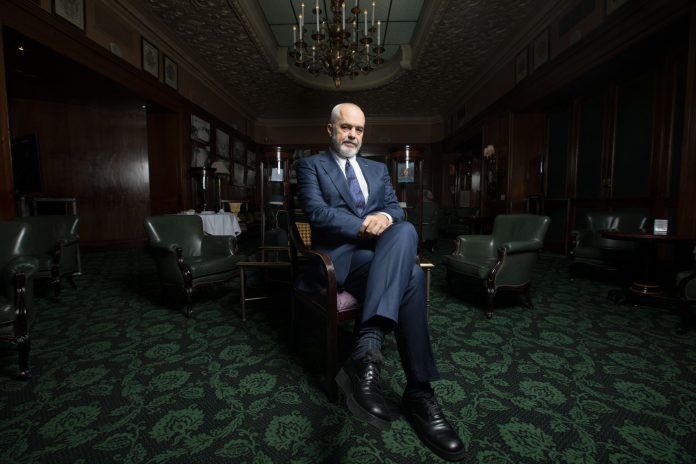
“From his days as a basketball player (he is 1.98 meters tall and came to play for the Albanian national basketball team), the Albanian Prime Minister Edi Rama has brought a more pivotal style to politics,” Antonio Pita wrote on the top-ranking Spanish newspaper.
Shortly before meeting with the Prime Minister Pedro Sánchez this Monday, on the first official visit to Spain by an Albanian head of government, he received El Pais at a hotel in Madrid.
“It is difficult to distinguish if you are tired from the trip, in a bad mood or simply tired of hearing what you call ‘nice words’, which are not followed by the facts regarding the country’s future in the EU,” PM Rama said.
An issue that is the focus of the EU-Western Balkans Summit on Wednesday in Slovenia and from which Rama dryly acknowledges he expects “nothing”. Albania, together with North Macedonia, received the green light in March 2020 to start accession negotiations, but Bulgaria blocks them from starting due to a bilateral identity conflict with Skopje to which Tirana has been held hostage.
In those rare few moments when he smiles, Rama shows, however, the charisma that has helped him last month to become the first head of government to secure three consecutive terms in office since the fall of the Communist regime in 1991. For his supporters, he is a social-democratic leader who is modernizing – including a necessary judiciary reform – one of the poorest European countries, and has just formed the cabinet with more female ministers in percentage terms (70%) in the world. “I didn’t do it to get a message across, but to have the right people in the right place,” he says.
Rama served as mayor of the capital between 2000 and 2011 and head of government since 2013. In 2017 the photo in which he appeared at a European summit wearing a black suit and white Adidas with red stripes went viral. This Monday, in Madrid, the only thing that attracted attention was his red rose mask, designed by himself.
“We have learned the hard way not to expect anything, because we have seen that Europe is not in a very good moment, with its many internal problems and enlargement is not being received with enthusiasm,” he said about the summit. This is said just days after the European Commission President, Ursula von der Leyen, demonstrated in Tirana her objective to unblock the dialogue this year. “We have been hearing that over the years and nothing has changed,” he replies. “Von der Leyen speaks on behalf of the Commission, but the Commission is one thing, the Council is another; pretty words are one thing; the facts, another … There have always been one, two, three Member States that oppose the process. Now it is Bulgaria, so it is better for us not to wait, because when you wait you have to experience the shame of being rejected,” Rama said.
Rama insists that Albania’s accession to the EU is a “must”, which he neither wants nor has an “alternative to” and sums it up with symbolism: “Europe is our choice and our religion.” “It is the only process that I consider a vital transfer of know-how on how to build a democratic and functional state based on the rule of law, in a competitive free market economy based on a dynamic society in line with the EU standards. It is what we have to do. Not because we are asked for, but because it is our future. Then, what happens in Brussels is neither up to us nor does it concern me. I’m not pessimistic, but I don’t want to waste any more energy complaining,” he argues.
The message of the lack of alternative seeks to dispel fears that the negotiating impasse will make a possible union with Kosovo, with which it shares ethnic identity and language. He himself has hinted at this possibility in the past, which is so supported by the new Prime Minister of Kosovo, Albin Kurti, as well as by the public opinion in both countries.
“Of course we want to unify with them, but within the whole way of joining in the EU. For now, Kosovo is hostage to an unfinished peace process with Serbia. That comes first. Then the rest,” he points out. He stiffens when talking about Kurti, with whom he clashes about a regional initiative called “mini-Schengen” and maintains a distant relationship (an Albanian newspaper reported a meal in which both remained silent for much of the time). “We have common national interests. When it is about the day-to-day politics, I don’t care what he thinks,” Rama said.
“Very different”
Albania, with 2.8 million inhabitants, has improved many indicators in the last eight years, but has not taken off in others. The country occupies basically the same position in the index of perception of corruption of Transparency International or the freedom of the press according to the Reporters Without Borders. “The situation is very different. Some reports must be considered with great caution: how they are compiled, who compiles them, etc. They are not scientists and have nothing to do with reality. I am not saying that Albania faces no corruption problems, because that would be a lie, but that it cannot be compared at all with eight years ago,” he underlines.
“Of course it is a country with problems because we come from a long and painful past,” he says in reference to the particularly cruel communist regime during Enver Hoxha’s leadership – between the end of World War II and 1991.
“30 years are many in a person’s life, but nothing in the course of history. The process of building institutions is not easy. We face our challenges, but no one can teach us about any of the bad things because we didn’t make them up. We found them when we were free. Prostitution was already there, illegal trafficking was already there, everything was there …”
/ a.jor. /u.sh/