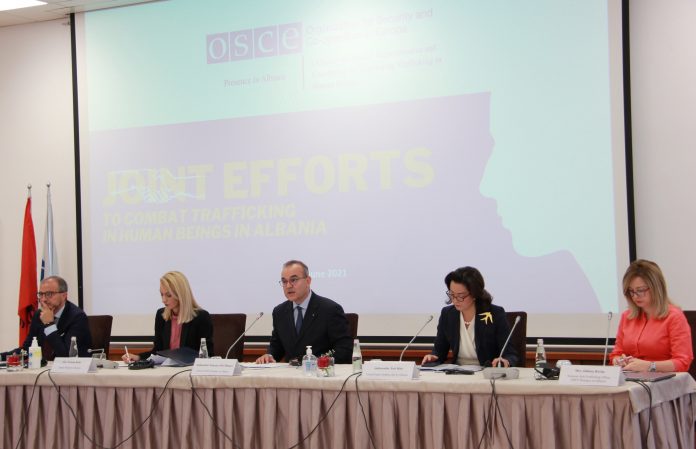
TIRANA, June 17/ATA/Albania has taken serious steps and concrete actions to combat trafficking in human beings, the Ambassador Del Monaco said today at the conference “Joint efforts to Combat Trafficking in Human Beings in Albania” hosted by the Presence and the Office of the OSCE’s Special Representative and Coordinator for Trafficking in Human Beings.
Ambassador Del Monaco’s full remarks:
“I am honoured to open today’s conference to discuss “Joint efforts to Combat Trafficking in Human Beings in Albania”, and let me begin by thanking the OSCE’s Special Representative and Coordinator for THB, Valiant Richey, for co-hosting this event.
Let me thank the Ambassador at Large against Trafficking in Human Beings of Sweden that holds the OSCE Chairpersonship this year, H.E. Anna Ekstedt, for joining us today to share the vast experience Stockholm has also in this field.
Your presence, dear Colleagues, testifies to the extent Vienna supports the OSCE Field Operations and OSCE participating States in this important endeavour.
A note of gratitude I would extend to Mme Deputy Minister of Interior, Romina Kuko, who is a longstanding partner of the Presence in Albania, and will speak this morning about her Government achievements against trafficking of human beings.
Thank you to all of your active attendance reflects perfectly the priority all of us place on countering human trafficking.
In fact, change does not happen with the work of one institution only and the diversity of the assembled speakers today clearly demonstrates that.
Let me borrow from French a useful sentence to set the tone of our discussion: “L’autre me regarde”, “the other is looking at me”. The meaning is twofold: the other is looking at me, seeking for my help, (il me regarde) and “the other matters to me” (il me concerne).
And this is exactly the core of today’s exercise on Trafficking in Human Beings. We will discuss about the concept of responsibility, transcending the static idea of a simple recognition of these crimes.
Aren’t legality and ethics intertwined? There is actually a sequence that starts with the notion of individual freedom and ends with solidarity and with taking responsibility for the other. Allow me to draw your attention on three key points:
- Trafficking in human beings is a global scourge.
It is worse than a crime, and it is a systemic threat, as Jamille Bigio and Rachel Vogelstein, both from the Council on Foreign relations, brilliantly wrote in an article published just a few days ago.
Despite the landmark agreement of 2000, the Palermo Protocol to Prevent, Suppress and Punish Trafficking in persons, this plague persists and an estimated 25 million people worldwide are victims of forced labor and sexual exploitation.
The majority of victims are women and children. Trafficking of human beings is fueled by social and economic inequality, by poverty, unemployment, violence, and conflict.
Advances in information communication technology facilitate it. As an international problem, it constitutes a serious breach of human rights, and threat to democracy and security.
Let us think for a moment of the criminal organizations or extremist groups that make money out of this lucrative “trade”, fuelling corruption, subjugating civilians, undermining governance and distorting free market competition.
Clearly, there is no country spared from THB, but a number of Countries, for instance Albania, have taken serious and concrete action to counter it. In Vienna we have all seen how Albania successfully did during its Chairpersonship-in-Office, and I fully trust that also from its UNSC non-permanent seat Tirana will give a critical contribution.
Anti-trafficking measures are embedded across politico-military, economic and environmental, and human dimensions of the OSCE, both at Secretariat level and of our field missions.
When it comes to external cooperation, the OSCE runs a very innovative partnership, the Alliance against Trafficking in Persons, which held its annual conference earlier this week, from 14-16 June. The conference we are holding today comes immediately after that to take stock of discussions at this important high-level event to tackle THB challenges in the OSCE region.
The OSCE is quite unique in addressing THB because of its many commitments and a dedicated Action Plan, which are approved by consensus of all OSCE participating States.
To this end, providing assistance to Albanian institutions to end human trafficking is the cornerstone of our role.
And as such, we provide expertise to Albanian institutions and civil society to improve the policy and operational framework, strengthen co-ordination mechanisms across social, enforcement, and judicial institutions, and upgrade skills to respond to this continuously evolving phenomenon.
Let me share with you one example of how this partnership is well-established in our activities.
With funds from the UK Government, and under a project implemented through UNICEF Albania, which I both thank, we are launching a unique training this fall for multiple institutions encompassing police, judicial, and social services to properly investigate human trafficking.
This simulation-based training is one of the OSCE flagship capacity development initiatives, which Special Representative Richey and his team are strongly supporting us to implement for the first time in Albania and in the region.
- THB is a crime and human rights violation.
Ending THB means protecting those who fall prey to THB. A 2020 UN Office on Drugs and Crime Report noted “over the last 15 years, the number of detected victims has increased”.
The vast majority of cases simply go undetected. Let me reiterate here my admiration for the shelters for victims of trafficking who are present here today and will speak of their invaluable work. I have visited one, and the exchange I had with young women victims left on me an indelible imprint. It is also for that reason that today’s seminar is taking place.
Albania has a remarkable example of running a victims’ advisory board, which gives voice to trafficked adults and children in any programme that is run by the state or partners in addressing THB. It is a great initiative to have a platform that enables them to speak for themselves.
We are all aware of the substantial complexities in prosecuting and convicting human trafficking and in this particular crime; investigations must respect the rights of the victims at every stage of the proceeding.
Albania has built a solid legal framework to criminalise human trafficking and convict perpetrators. In this spirit, we look forward to the discussions today and especially to hearing from High Court Judge Mr Simoni of the importance of a victim-centered approach in the prosecution and trial of human trafficking cases.
3-Partnership in fighting THB
Finally, let me reiterate the importance of coordination and partnership in this field. The role of the National Coordinator is crucial in ensuring that the entire mechanism is functional and the comprehensive approach is a reality.
Let me commend here Deputy Minister Kuko, who is responsible for the Anti Trafficking portfolio. Just as important is the role of monitoring mechanisms, and we look forward to hearing how the Albanian Parliament has exercised this function. Ms Gjebrea, we are grateful to have you here today to share your experience as both former National Coordinator and a Member of Parliament.
The private sector should also be part of the discourse, to make sure that supply chains are free from forced labor. We also need the co-operation of the financial world, to disrupt illegal transactions related to trafficking in human beings.
To cut it short, we need to change gear, to inject more energy in this fight, to lift it up in the political agenda, and I am sure that results will not fail. It is a fight for the primacy of rule of law, and it is a fight of an ethic nature. We need to take stock of the past and of the lessons learned, we need to leverage on the present and to look at the future embracing innovative tools.”
//a.i/