TIRANA, Nov 3 /ATA/ Albania recorded approximately 32 million attempted cyberattacks in the first nine months of 2026, equivalent to an average of 81 attempts every minute.
Yet threats to the country’s digital infrastructure are not the only growing concern. Disinformation, the manipulation of information and the spread of fabricated content are also increasingly being used to deepen divisions and erode public confidence in democratic institutions.
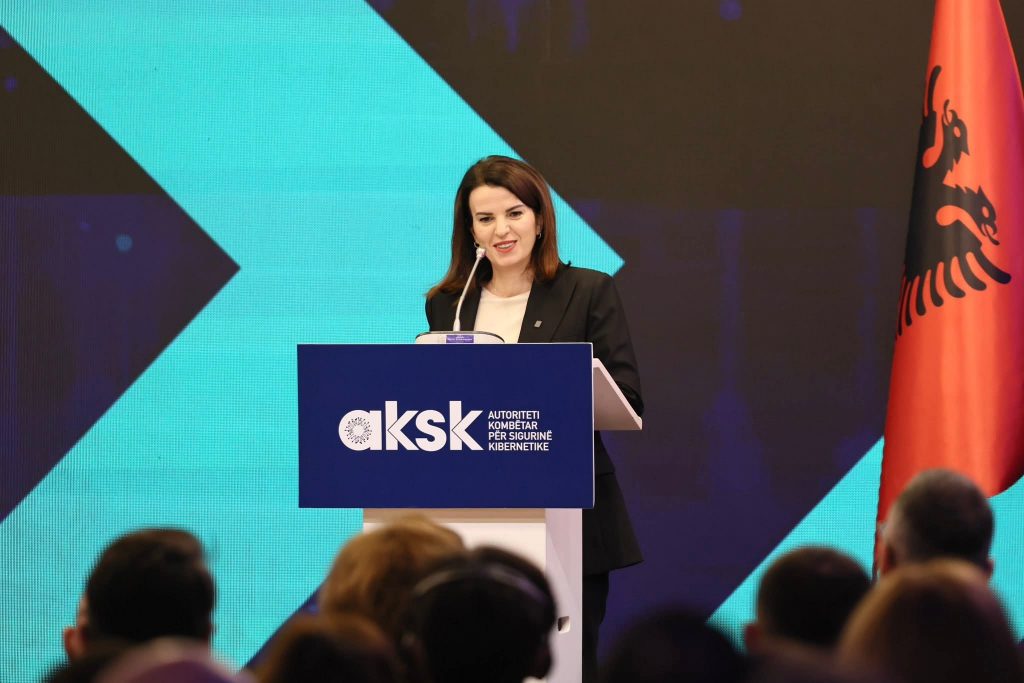
The figures were announced by Deputy Prime Minister Albana Koçiu at the National Cybersecurity Conference, organised by the National Cyber Security Authority (AKSK) under the theme “Building Cyber Resilience: Strengthening the Frontline of Defence”.
The event was attended by US Ambassador Eric Wendt, chargé d’affaires of the European Union Delegation André Rizzo, representatives of state institutions, critical infrastructure operators, private sector representatives and international partners.
In her address, Koçiu stressed that cybersecurity should not be viewed merely as the protection of computer systems, servers or technological networks, as it is directly linked to the functioning of the state, citizens’ security and their trust in institutions.
Referring to the 2022 cyberattack orchestrated by Iran against Albania’s digital infrastructure, the Deputy Prime Minister described it as a turning point in the country’s approach to cybersecurity.
“Albania learned this the hard way. In 2022, the cyberattack orchestrated by Iran against our digital infrastructure confronted us with a new reality. It showed us that a country can be severely hit without a single soldier crossing its borders, and that an attack on digital systems can seek to achieve the same result as an attack on physical infrastructure: disrupting the functioning of the state and undermining public trust in institutions,” Koçiu said.
According to figures released by Koçiu, 51 cyber incidents were recorded in 2025, while 25 were registered between January and September 2026.
However, beyond attacks targeting systems and critical infrastructure, Koçiu noted that the digital space had also become a battleground for another struggle: the fight for truth. She said fabricated videos, information manipulation, deceptive content and the use of algorithms could be exploited to fuel divisions, create confusion and sow distrust in democratic institutions.
She said these risks should be clearly distinguished from citizens’ exercise of their right to protest, which remains a fundamental element of democracy.
“A strong democracy requires citizens to distinguish facts from manipulation and form their own views on the basis of reliable information,” Koçiu stressed.
She also highlighted the impact of artificial intelligence, which, on the one hand, creates new opportunities to identify and prevent cyberattacks but, on the other, can be used to develop more sophisticated and harder-to-detect threats.
Koçiu stressed that despite improvements in cybersecurity, threats were becoming increasingly sophisticated as technology and artificial intelligence advanced. She underlined the need to invest both in technology and human resources to strengthen the country’s cyber defences.
In this context, she said that operators of critical infrastructure had invested more than €28 million in cybersecurity over the past year.
Koçiu also highlighted the legal and institutional measures taken, including the adoption of the new Cybersecurity Law and the National Strategy in 2024, as well as ongoing efforts to align Albania’s legal framework and institutions with European Union standards.
According to Koçiu, the challenge now extends beyond protecting digital infrastructure to safeguarding information integrity and public trust, both of which are essential to institutional resilience and the functioning of democracy.
/e.i/a.f/r.e/sm/