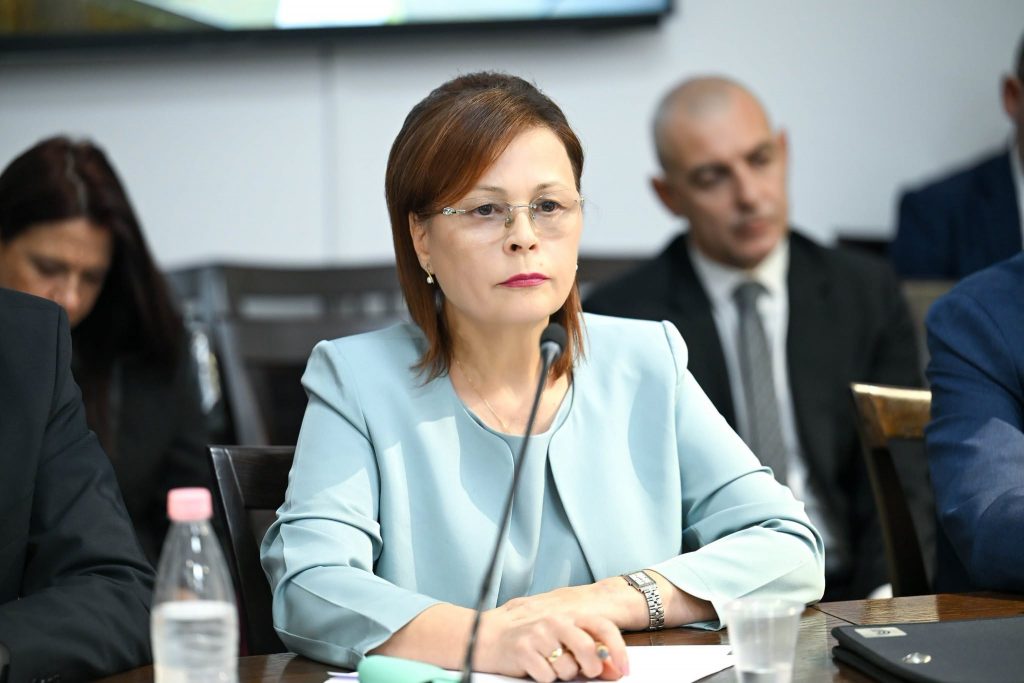
TIRANA, November 2 /ATSH/ – The Second Deputy Governor of the Bank of Albania Natasha Ahmetaj stated today that the 2027 draft budget maintains a focus on fiscal consolidation, contributing to the sustainability of public finances and creating space for investments.
During a discussion at the Committee on Economy, Employment and Finance—regarding the Bank of Albania’s opinion on the draft law “On the 2027 Budget” and the associated fiscal package—Ahmetaj noted that the institution’s assessment centers on the draft budget’s fiscal policy, revenue projections and the control of the budget deficit, in line with legal requirements for fiscal responsibility.
Addressing the macroeconomic context, Ahmetaj highlighted that Albania has experienced sustained growth in economic activity over the past few years. The Deputy Governor emphasized that the country’s economic and financial stability has improved, while consumer price inflation remains low and close to the Bank of Albania’s target.
“The country’s external and fiscal sustainability indicators—including public debt, the current account deficit, and the budget deficit—have dropped to their lowest levels in two decades,” said Ahmetaj.
She added that improvements have also been recorded in indicators regarding the financial health of Albanian businesses and households, as well as in the stability of the banking sector.
“This progress has been recognized in assessments by international institutions—such as the IMF, the World Bank, and the European Commission—which align with the aforementioned findings; it is also reflected in the reduction of the country’s sovereign debt risk by Moody’s and Standard & Poor’s,” she said.
However, Ahmetaj noted that the economic outlook remains exposed to risks, both regarding inflation and economic growth.
According to her, the medium- and long-term outlook for economic development remains positive, but it requires the continuation of reforms to reduce structural weaknesses and accelerate the pace of growth.
“Albania’s status as a middle-income economy, combined with the prospect of facing higher levels of competition within the EU, makes it indispensable the continuation of reforms aimed at reducing structural weaknesses and accelerating growth. These reforms should focus on broadening the sectoral base of growth, enhancing labor and capital productivity—by improving the quality of education—refining the business climate and fostering an environment conducive to investment and innovation,” Ahmetaj emphasized.
Regarding the 2027 draft budget, Ahmetaj assessed that the document successfully balances short-term challenges with the country’s medium- and long-term development priorities.
Ahmetaj also addressed the new tax package, which, according to her, aims to expand the revenue base and reduce informality. The draft budget projects a budget deficit of 2.3% of the Gross Domestic Product and a continued downward trajectory for public debt—indicators which, according to the Bank of Albania, demonstrate a commitment to maintaining fiscal sustainability. /e.i/r.e/a.f/p.s./