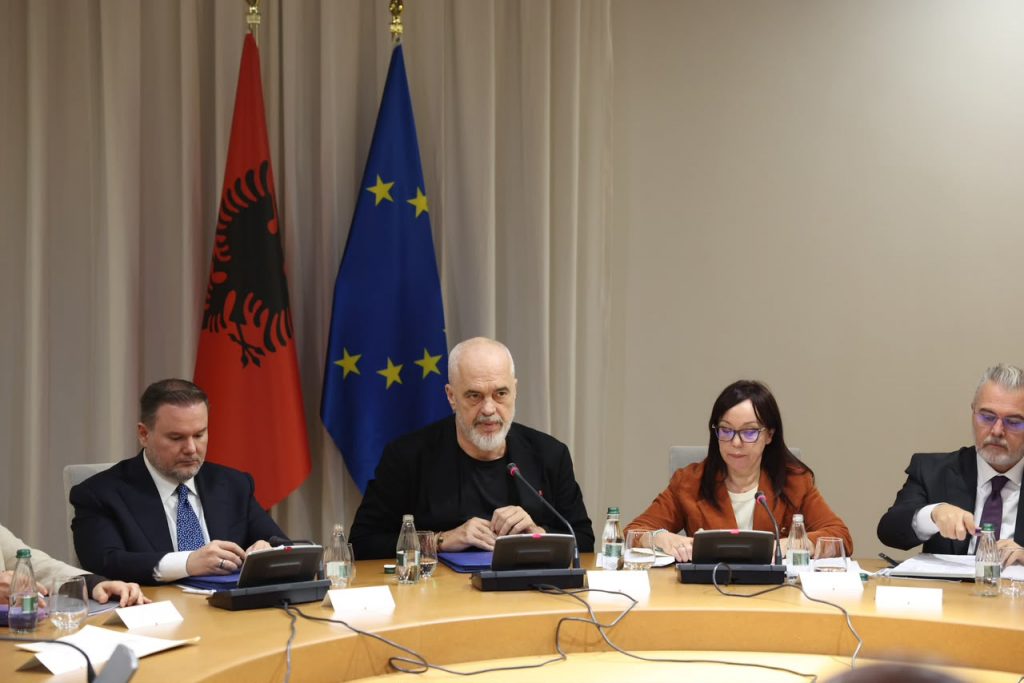
TIRANA, Oct 30 /ATA/ Prime Minister Edi Rama voiced concern over the way some sections of society view violence, speaking at a meeting of the National Council for the Rights and Protection of Children, which focused on recent events and the need for a joint action plan involving civil society and international partner institutions.
He underlined the importance of the meeting as a platform for bringing together different viewpoints and shaping a coordinated response to the challenges facing the country.
“At this critical juncture, the council serves as an important forum for bringing together diverse perspectives and shaping a common approach based on the lessons to be drawn from the current situation,” the Prime Minister said.
He thanked representatives of independent institutions, civil society organisations and international bodies for attending and contributing to discussions on child protection.
“I would like to thank you for being here and for adding value to this meeting. My thanks go to all those representing independent institutions, civil society organisations and international bodies working on children’s issues,” Rama said.
The Prime Minister expressed concern over the attitudes towards violence displayed by some sections of society, emphasising that violence has no place in a democracy or in democratic coexistence.
“I believe we are all of the same mind and have witnessed a deeply disturbing attitude towards violence among certain sections of society,” he said.
“Violence is unacceptable in any democracy, prohibited by every constitution and incompatible with democratic coexistence,” Rama continued.
He added that recent events had seen violence increasingly normalised and justified, to the extent that it had even been glorified.
He also criticised what he described as a misleading and miseducative approach to the way these events had been handled, which, he said, had led to the stigmatisation of the State Police.
“We have also seen how violence has been given a misleading and miseducative narrative, turning it into a stigma for the State Police,” Rama said.
Continuing his argument, the Prime Minister said that some of those who had conveyed messages about schools, education, freedom and the right to hold different views, express opposition and protest had, in his view, acquired a certain degree of civic standing and a form of media immunity.
“Meanwhile, all those who have offered guidance on schools, education, freedom and everyone’s right to hold a different opinion, express dissent, protest and defend private property have acquired civic standing and media immunity, as representatives or proponents of what is portrayed as an admirable effort to overthrow a system,” he said.
Rama stressed that exposing and criticising these phenomena was not enough unless accompanied by an approach aimed at preventing the spread and normalisation of violence in society.
“All of this, of course, is easy to expose and criticise. But if we stop at exposure and criticism, we will continue to face violence, in various forms and at different times, as a new tool adopted by society, which could then be used by anyone, including any young man or woman who has misunderstood the message,” the Prime Minister said.
He warned that violence could become a means of reacting against anyone perceived as an obstacle, citing teachers, university lecturers, universities and businesses.
“Violence could become a tool used against teachers, university lecturers, universities, business owners and anything that an individual or a group might regard as an obstacle. This is the phenomenon we are now witnessing,” Rama stressed.
/gj.m/a.f/r.e/sm/