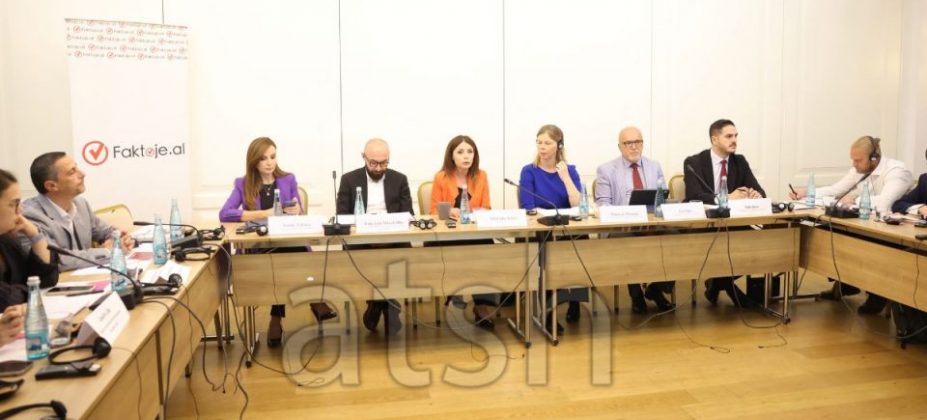
TIRANA, Oct 6 /ATA/ The role of the media in following up on audit findings and strengthening public accountability was the focus of a roundtable held today under the title “Truth Beyond Numbers – From Audit Findings to Public Accountability”, organised by Faktoje.
The event presented the findings and recommendations of a policy paper examining how audit reports can be used to strengthen accountability, ensure greater follow-up and improve transparency.
The event brought together representatives of oversight and justice institutions, the media, civil society and partner organisations.
Discussions focused on the follow-up to published audit reports, the implementation of recommendations, circumstances in which audit findings may prompt criminal investigations, and the need for stronger cooperation between public institutions and the media.
The Ambassador of the Kingdom of the Netherlands to Albania, Marleen Monster, highlighted the importance of turning audit findings into concrete action and public accountability.
She said that figures do not “speak for themselves”, as they need to be interpreted, explained and used to raise questions about the problems they highlight.
Monster stressed the important role of the media in revisiting an issue after an audit report has been published, and noted that the management of public funds and the effective functioning of institutions are central to European standards.
“An audit finding becomes a matter of public accountability only when citizens can understand it,” the ambassador said, stressing the importance of cooperation between institutions, journalists and civil society.
She said Albania had made progress on its path towards European Union membership, but stressed that standards for the management of public funds and institutional accountability remained essential.
Deputy Minister of Economy and Innovation Enkelejd Musabelliu stressed the need for audits to go beyond simply identifying breaches and also contribute to improving institutional practices and public administration.
He said audit recommendations should help identify shortcomings in institutional organisation and strengthen the administration’s capacity.
Musabelliu also highlighted the role of the media and audit bodies in strengthening the administration’s ability to assess its own performance, stressing the importance of communicating technical findings more effectively to the public.
Socialist Party MP Adi Qose focused on the follow-up of audit recommendations in Parliament and the need for the oversight process to extend beyond the publication of an audit report.
He said parliamentary committees should have a more structured mechanism for monitoring the implementation of recommendations, particularly those with financial implications.
Qose proposed that high-risk recommendations be subject to a clear action plan setting out responsibilities, deadlines and the documentation of results.
According to him, a public register of recommendations would improve transparency and allow citizens to track their implementation status.
Democratic Party MP Jorida Tabaku stressed the need for audit reports to be more accessible and easier for the public and lawmakers to understand.
She said the large volume of reports makes them difficult to analyse and that a clearer structure is needed to identify responsibility and monitor follow-up measures.
Tabaku cited audit reports on public-private partnership contracts and incinerators as examples, arguing that audit findings should be followed through until responsibility is established and concrete measures are taken.
She also called for a stronger role for parliamentary committees and the creation of mechanisms to ensure the transparent monitoring of recommendations.
In her remarks, Klodiana Kapo, executive director of the non-governmental media organisation Faktoje, stressed that public audits should be accompanied by transparency, public information and continued follow-up of their findings, while noting that the media has an important role to play in communicating them to citizens.
Kapo said Faktoje’s work focuses on public scrutiny and on making audit findings accessible and ensuring they are followed up in the public domain.
She highlighted cases involving audited public investments, stressing the importance of verifying identified problems and informing the public about how institutions address them.
Kapo said Faktoje has investigated various issues over the years through reports, videos, documentaries and podcasts, backed by data and documentation, with the aim of ensuring that audit findings receive followup.
She said the key challenge was making technical audit findings understandable to the public in order to strengthen transparency and institutional accountability.
Ilir Ciko, an expert on the “Truth Beyond Numbers” project, presented the findings and recommendations of the policy paper, saying the main weakness lies not in the technical quality of audits but in their follow-up and communication.
He said the media largely focuses on the publication of audit reports and less often follows up on the implementation of their recommendations.
Ciko said audit reports are an important source for journalists, as they are based on documentation, data and verifiable methodologies.
However, he stressed that an irregularity identified through an audit does not in itself constitute a criminal offence, noting that this requires separate procedures and evidentiary standards.
Xhuljeta Çelaj, a representative of the Supreme State Audit Institution, highlighted the importance of effectively communicating and following up on audit recommendations, as well as strengthening cooperation with the media. She said technical reports should be made more accessible to the public while maintaining their accuracy and professional auditing standards.
Çelaj said implementing audit recommendations takes time and requires regular assessment, while dialogue with the media can help improve transparency and keep the public informed about the outcomes of audit processes.
The policy paper presented by Faktoje recommends that the Supreme State Audit Institution introduce a standardised summary for each audit report, rank findings according to economic damage and systemic risk, publish data in searchable formats, establish a public register tracking the status of recommendations, and produce a more accessible annual report on their implementation.
The roundtable concluded with discussions on strengthening cooperation between institutions, the media and civil society, as well as the next steps for the “Truth Beyond Numbers” initiative.
/sm/